

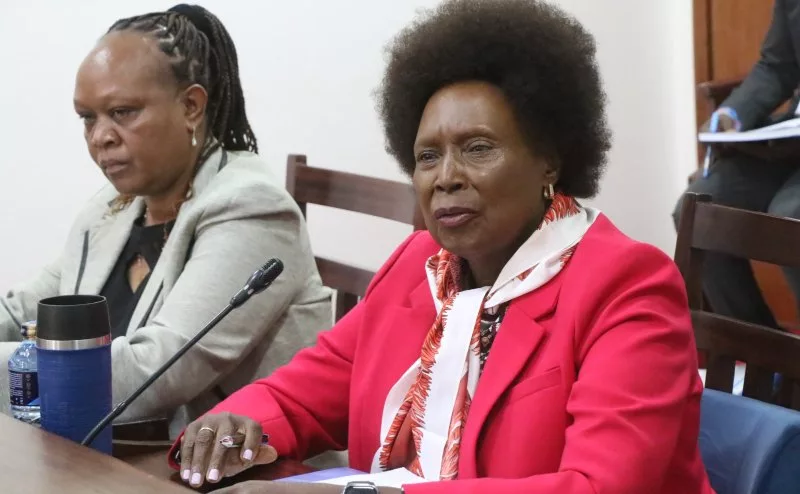
 Street Families Rehabilitation Trust Fund chief executive officer Caroline Towett and chairperson Mary Wambui/HANDOUT
The number of people living and working on the streets has fallen by more than half over the last seven years, with a new national census recording 18,049 street-connected persons.
The figure represents a sharp decline from the 46,936 street families recorded in the 2018 census.
The Street Families Rehabilitation Trust Fund disclosed the figures during a meeting between the agency’s chairperson Mary Wambui and CEO Caroline Towett and the National Assembly’s Social Protection Committee.
“The 2018 census report recommended that such censuses be conducted every five years to determine the nature and magnitude of street families and enable planning of interventions,” Wambui said.
The Trust Fund attributed the decline to coordinated rehabilitation programmes implemented by the government and its partners under the National Policy on Rehabilitation of Street Families, 2023.
“The results indicated a decrease in the number of street families compared with the 2018 census,” the Trust Fund said.
The second national census was conducted in July 2025 after preparations began in 2024.
It was carried out in collaboration with the Kenya National Bureau of Statistics, the State Department for Children Services and other government and non-state actors.
Nairobi recorded the highest number of street-connected persons at 4,690, followed by Nakuru with 1,546, Mombasa with 1,428 and Kiambu with 1,370.
The census covered urban centres across all 47 counties.
The findings, however, showed that the street population remains largely youthful, with children and young people accounting for more than 76 per cent of those counted.
The Trust Fund said economic vulnerability remains one of the main factors driving people into street life.
“Economic vulnerability emerged as a key driver of street life, compounded by family instability and breakdown, particularly among children and adolescents,” it said.
The agency said street-connected persons also face significant barriers in accessing basic services.
These include education, healthcare, social protection and legal documentation.
The lack of civil documents, particularly birth certificates, was identified as one of the obstacles preventing vulnerable people from accessing government services.
Despite the challenges, the census produced a positive finding, with most respondents expressing willingness to leave street life.
“Most respondents expressed willingness to leave street life, presenting an opportunity for targeted rehabilitation, reintegration and economic empowerment interventions,” the Trust Fund said.
The agency is now calling for stronger prevention and family support programmes to address the root causes of street life.
It has recommended increased support for families, parenting programmes, school retention, substance-use prevention and expanded livelihood opportunities.
The Trust Fund also wants age- and gender-responsive interventions for children, youth, adults, older persons and people living with disabilities.
It said rehabilitation should also include access to safe shelters, affordable housing, healthcare, mental health services, and water and sanitation facilities.
The government has been implementing the 4Rs+P programme — Rescue, Rehabilitation, Reintegration, Resocialisation and Prevention — to address the problem.
Between the 2023-24 and 2025-26 financial years, the Trust Fund said it rescued 15,766 street-connected persons and provided psychosocial support to 17,570.
A further 17,351 street families received education and vocational skills training.
The agency said 13,884 street-connected persons were reintegrated into their communities, while 1,293 families received economic empowerment support.
Another 660 duty bearers involved in street-family rehabilitation were trained during the three-year period.
“These interventions have enhanced access to essential services, strengthened family support systems, promoted skills development and supported sustainable reintegration into the community,” the Trust Fund said.
However, the agency said more resources are needed to sustain the gains.
It plans to construct a model rehabilitation centre in Mavoko, Machakos county, with a capacity to accommodate 500 beneficiaries.
The proposed facility is estimated to cost Sh1.96 billion, with the Trust Fund seeking support to finance its construction.
The centre will cater for street-connected children, youth and adults and provide rehabilitation, safeguarding, case management and reintegration services.
The Trust Fund also wants street-family programmes incorporated into national and county budgets.
It has recommended that the census be conducted regularly and integrated into the national statistical system to provide reliable data for planning and accountability.
“The Street Families Rehabilitation Trust Fund remains committed to ensuring that street families are not left behind,” the agency said.
It said sustainable reintegration would require more than rescuing people from the streets, arguing that interventions must address poverty, family breakdown, unemployment and limited access to essential services.
INSTANT ANALYSIS
The reduction of more than half is significant and is directly linked to the Trust Fund’s 4Rs+P approach.
Between the 2023-24 and 2025-26 financial years, the agency rescued 15,766 street-connected persons, provided psychosocial support to 17,570, and supported 17,351 with education and vocational training. It also reintegrated 13,884 people into communities and economically empowered 1,293 families.
These interventions have strengthened family support systems, expanded access to essential services and created alternatives to street life. However, persistent poverty, family breakdown and unemployment could reverse the gains without sustained investment.







