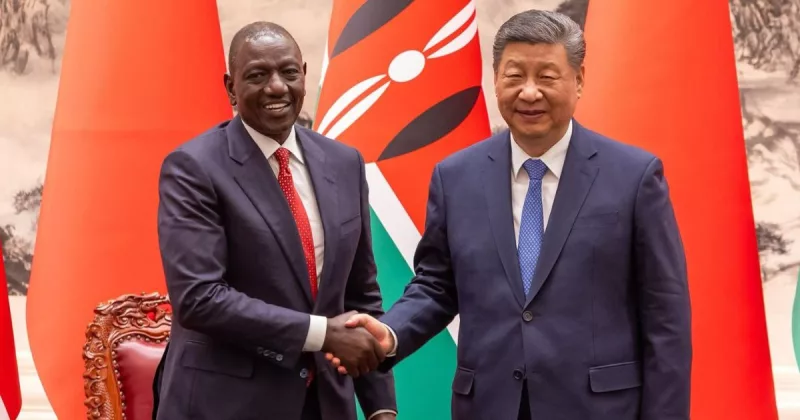
 President William Ruto shakes hands with his Chinese counterpart Xi Jinping during a past meeting in Beijing/FILE
Kenya’s debt to China has declined by nearly a fifth over the past five years, with the latest National Treasury figures showing that Beijing accounts for just 10.8 per cent of the country’s external debt.
The figures provide fresh perspective on the debate over Kenya’s borrowing from China, particularly claims that Chinese lenders are the dominant source of the country’s debt burden.
According to Treasury data, Kenya’s total external debt stood at Sh5.68 trillion at the end of June 2026.
Of this, multilateral creditors accounted for Sh3.10 trillion, while commercial lenders held Sh1.54 trillion.
Kenya’s debt to China stood at Sh616.8 billion, down from Sh764.2 billion in 2021.
By comparison, the country owed the World Bank Sh1.70 trillion by June this year, making it Kenya’s largest individual external creditor and accounting for 29.8 per cent of total external debt.
The figures come amid wider concerns over Kenya’s public debt, which has crossed the Sh13 trillion mark, and the growing amount of government revenue being consumed by debt repayment.
The China component has attracted particular attention because of loans used to finance major infrastructure projects, most notably the Standard Gauge Railway.
But the latest figures show that Chinese lending forms only one part of Kenya’s broader external debt portfolio.
A major change in the Kenya-China debt relationship came in July 2025, when the Export-Import Bank of China and the National Treasury signed supplementary agreements covering three SGR-related loans.
The dollar-denominated loans were converted into Chinese yuan, reducing Kenya’s exposure to movements in the US dollar.
The adjustment was also intended to ease pressure on Kenya’s foreign-exchange reserves and lower the cost of servicing the loans.
The Chinese statement said the restructuring would “cut Kenya’s annual debt-servicing costs” and “relieve the pressure on Kenya’s forex reserves and stabilise the exchange rate of Kenyan shilling."
Kenyan media estimates at the time put the potential annual saving at about Sh27.8 billion, or $215 million.
The arrangement has been presented as an example of how bilateral negotiations can be used to manage debt pressures without necessarily taking on new borrowing.
The Chinese government has also rejected the characterisation of its financing to Africa as a debt-trap strategy, arguing that its lending is intended to support infrastructure and economic development.
“China has actively helped African countries defuse debt risks through bilateral and multilateral channels,” the statement said.
Beijing pointed to its participation in the G20 Debt Service Suspension Initiative and the G20 Common Framework, which have been used to support debt treatment for developing countries, including several African nations.
However, the debate over Kenya’s Chinese loans also involves the performance of projects financed through the borrowing.
The SGR has significantly changed passenger and cargo transportation between the Port of Mombasa and Nairobi, with the line later extended towards Naivasha.
Questions have nevertheless remained over the railway’s financial returns and the cost of servicing its associated loans.
For Kenya, the issue extends beyond the identity of individual creditors.
The critical question is whether borrowed money is being invested in projects and programmes capable of generating sufficient economic activity, jobs, exports and government revenue to support repayment.
This is particularly important as the country faces rising debt-service costs.
The latest Treasury figures show that Kenya’s external debt is spread across multiple categories of lenders, with multilateral and commercial creditors accounting for the majority.
China remains an important bilateral creditor, but its Sh616.8 billion exposure is significantly lower than Kenya’s obligations to the World Bank and the combined debt owed to other multilateral and commercial lenders.
The figures therefore complicate the popular narrative surrounding Kenya’s Chinese debt.
Rather than viewing the debt challenge through the lens of a single creditor, economists and policymakers face the broader task of managing the entire portfolio while reducing refinancing, interest-rate and foreign-exchange risks.
The 2025 SGR restructuring is one example of efforts to reduce those pressures.
“The successful implementation of the debt adjustment is the outcome of close China-Kenya cooperation,” the Chinese statement said.
Kenya is, meanwhile, pursuing fiscal consolidation and other liability-management measures as it seeks to contain its debt burden.
The country’s debt challenge remains significant despite the decline in its Chinese exposure.
With public debt above Sh13 trillion, the cost of servicing existing obligations is likely to remain a major pressure on the national budget.
The latest figures thus offer a more nuanced answer to the question of Kenya’s debt to China.
China is a significant creditor, particularly because of its role in financing the SGR, but it is not Kenya’s largest external lender.
The more fundamental challenge for Nairobi is ensuring that its entire borrowing programme remains sustainable and that investments financed through debt generate enough economic returns to meet obligations without placing an excessive burden on future taxpayers.