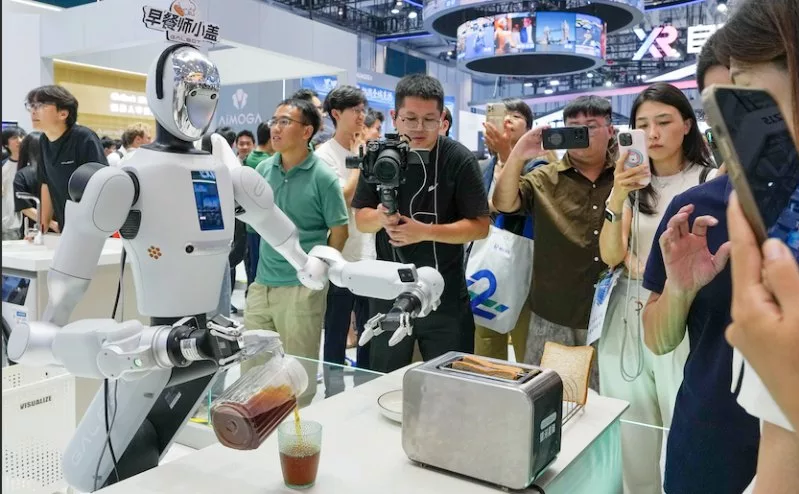
 A robot showcases breakfast-making skills during the 2026 World Robot Conference in Beijing on August 20, 2026 /XINHUA /JU HUANZONG
Humanoid robots can now sprint, box, dance and perform increasingly complex physical tasks. The more important question is whether they can plug in a cable correctly, recover from an error and complete useful work repeatedly without constant human intervention.
That contrast was visible at the 2026 World Humanoid Robot Games in Beijing, where more than 2,000 robots from hundreds of teams competed in events ranging from running and martial arts to industrial assembly, hotel service and emergency-response tasks. The athletic events attracted attention, but the less spectacular exercises may tell us more about where robotics is heading.
The economic value of a humanoid robot will not come from how convincingly it imitates an athlete. It will come from whether it can operate reliably in environments built for people and perform tasks that improve productivity, safety or quality of life.
Traditional industrial robots are already extremely effective in structured factory environments. Humanoid robots attempt something more ambitious: navigating stairs and corridors, using tools, handling objects and working in spaces originally designed around the human body. If those capabilities become reliable and affordable, the implications for manufacturing, logistics, healthcare, emergency response and maintenance could be significant.
The International Federation of Robotics has noted that artificial intelligence is making robots more adaptable to less predictable environments, particularly in logistics and industrial applications. But there remains a large gap between a machine performing an impressive demonstration and one delivering dependable work day after day.
That distinction should matter to Kenya.
Technology policy is often seduced by demonstrations because they are easy to understand. A robot running or boxing looks advanced. A machine connecting cables correctly hundreds of times, recovering from a failed grip or completing a repetitive inspection task safely is far less dramatic. Yet those are the capabilities that determine whether robotics creates economic value.
A factory does not need a robot that succeeds spectacularly once. It needs one that performs reliably thousands of times. A warehouse does not benefit simply because a humanoid can lift a box. It benefits when the machine can identify the correct item, handle it safely, adapt when something changes and work alongside people without creating new risks.
The same principle applies to healthcare and emergency response. A hospital may eventually benefit from robots that move supplies, transport equipment or perform physically demanding routine tasks. Emergency responders may use robots to enter dangerous industrial sites, collapsed structures or fire environments. In both cases, mobility is only the beginning; reliability, safety, communication and integration into human workflows matter more.
Kenya should therefore ask where robotics can solve problems relevant to its own economy rather than treating humanoid machines as futuristic entertainment.
Manufacturing is one obvious area. Kenya wants to expand industrial production, and robotics could support repetitive or hazardous tasks while increasing demand for engineers, technicians, software developers and maintenance specialists. Logistics presents another opportunity because Kenya is a regional transport and distribution hub, where warehouses, ports and fulfilment centres can benefit from automation that improves speed, safety and consistency.
Agriculture also deserves attention, although useful agricultural robots do not need to be humanoid. Advances in computer vision, autonomous navigation and robotic manipulation can support crop monitoring, sorting, harvesting and handling. The larger lesson is that robotics capability developed in one sector can strengthen skills and industries across several others.
Universities will be central to this transition because robotics is inherently multidisciplinary. A functional autonomous system combines mechanical engineering, electronics, embedded systems, artificial intelligence, computer vision, control systems, networking, cybersecurity and human-machine interaction. Teaching these disciplines separately will not be enough if Kenya wants graduates capable of building intelligent physical systems.
The move towards competency-based university education creates an opportunity to respond. Students studying robotics should be expected to build and test systems, explain design decisions, diagnose faults and improve performance under changing conditions. A prototype that works only in a carefully rehearsed demonstration is weaker evidence of engineering competence than one that can recover from unexpected failure.
Cybersecurity must also become part of robotics engineering. A modern robot is a connected computer with physical consequences. If compromised, it may expose information, interrupt production, damage equipment or create safety risks. As robots become connected to cloud services, cameras, sensors and enterprise systems, secure software updates, identity management, access control, encryption and incident response become essential.
Greater autonomy makes this even more important. The more decisions a robot can make without direct human instruction, the more carefully organisations must define what it is authorised to do, how its actions are logged and how it can be stopped when behaviour becomes unsafe.
The employment question cannot be ignored either. Automation will change some jobs and redesign others. Kenya should prepare through skills rather than assume that robotics can simply be resisted. The policy objective should be to help workers move into technical, supervisory, maintenance and higher-value roles as production methods change.
There is also a strategic economic question. China is not investing heavily in humanoid robotics simply because robots are entertaining. Companies are building supply chains, improving actuators, developing control systems, collecting physical-world data and competing to commercialise machines for factories and service environments.
Africa should not wait until these technologies mature only to participate as a buyer. Kenya already has strong software talent, growing AI capability and a young technical workforce. Those strengths can be extended into robotics, embedded systems and advanced manufacturing if universities, industry and government begin building practical capability early enough.
The Beijing games therefore offer a useful lesson. The robots crossing finish lines will attract the most attention, but the robots that create the greatest economic value may be the ones quietly performing difficult, repetitive or dangerous work reliably every day.
Kenya should judge robotics by the same standard it should apply to every emerging technology: whether it solves a real problem at an acceptable cost, with sufficient reliability, security and human benefit.
Humanoid robots do not need to defeat humans to matter. They need to become useful enough to work with us.
ICT, cybersecurity and digital governance professional