
A humanoid robot has broken the 100-metre sprint record held by Usain Bolt. The robot, named Lightning, ran the distance in 9.32 seconds during a preparatory test event.
Lightning was developed by the Chinese smartphone manufacturer Honor. During the run, it reached an impressive peak speed of 14.5 metres per second. This performance surpassed the human world record of 9.58 seconds, which has stood for 17 years since Bolt set it in Berlin.
Engineering the Record Run
To achieve this speed, researchers made physical adjustments to Lightning. At the Beijing half marathon in April, which the robot won in 50 minutes and 26 seconds, it stood 169cm tall with 95cm legs. Before these games, researchers lengthened its legs by 10 centimetres to 1.05 metres.
The test took place ahead of the second World Humanoid Robot Games in Beijing. The five-day event is held inside the National Speed Skating Oval, a venue built for the 2022 Winter Olympics.

A Rising Industry
China is promoting humanoid robots as a strategic emerging industry. Policymakers and companies believe that advances in artificial intelligence and hardware will speed up their deployment in manufacturing, logistics and consumer fields.
The Games featured other record-breaking events. In the standing high jump, a robot from Beijing-based X-Humanoid cleared 2.88 metres. This surpassed the human high jump record of 2.45 metres set by Javier Sotomayor in 1993.
It was also a massive increase from last year’s best humanoid result of just 0.95 metres.
More than 2,000 humanoid robots from 16 countries, including Germany, Japan and the United States, participated in the games. 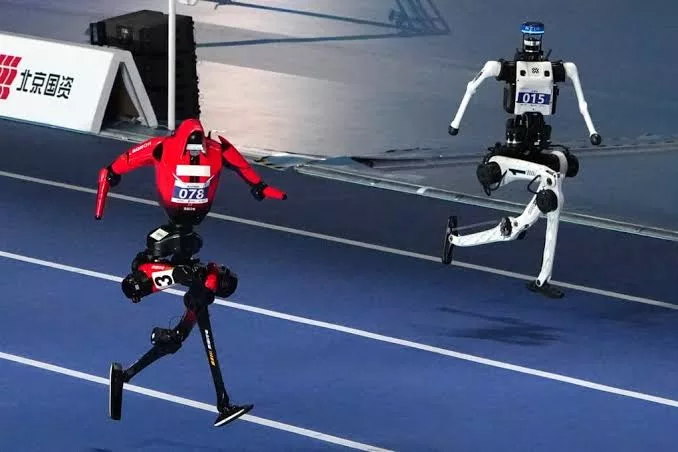
Events ranged from table tennis and football to weightlifting and tug of war.
Barriers to Mass Deployment
Despite these athletic feats, experts urge caution. They note that humanoid robots are currently used mostly for demonstrations, performances and research. Mass real-world deployment will still take some time.
Global competition in advanced robotics is also growing tense. Last month, the United States Federal Communications Commission banned imports of new foreign-made humanoid robots, citing national security.