Deputy President Kithure Kindiki has called for sustained action to clear county governments’ pending bills, warning that accumulated debts are hurting service delivery and businesses that depend on government contracts.
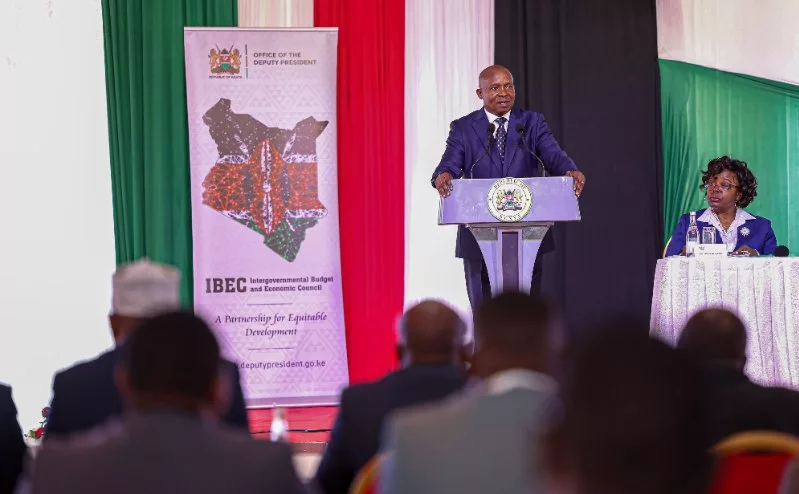
Kindiki said significant progress had been made in implementing an Intergovernmental Budget and Economic Council (IBEC) resolution on pending bills, but stressed that counties must maintain momentum in settling legitimate debts.
“Accumulation of pending bills undermines service delivery, damages the credibility of government and adversely affects businesses that depend on government contracts,” Kindiki said.
He spoke on Monday while opening the 30th Ordinary Session of IBEC at his official residence in Karen, Nairobi.
The Deputy President said County Governments’ Pending Bills Action Plans had been approved and ratified as part of efforts to address outstanding obligations.
By March 31, 2026, he said, 35 county executives and county assemblies had submitted their pending bills universe, while 29 had submitted action plans.
The Controller of Budget had also approved pending-bills Exchequer requests amounting to Sh34.46 billion, according to Kindiki.
“I commend the counties that have taken steps to verify, prioritize and settle eligible pending bills. However, this remains an area requiring sustained attention,” he said.
Kindiki’s remarks come as counties continue to face pressure over financial obligations, with delayed payments potentially affecting contractors and suppliers involved in the delivery of public services.
He urged counties to ensure that pending bills were properly verified and prioritised, saying responsible management of public finances was critical to maintaining confidence in government.
The Deputy President also used the IBEC meeting to highlight the allocation of resources to county governments.
He said Parliament had approved an equitable share of Sh428 billion for counties for the 2026/27 financial year.
Despite the country’s fiscal constraints, Kindiki said the National Treasury had disbursed all amounts due to county governments as equitable share by the close of the previous financial year.
“This demonstrates the commitment of Kenya Kwanza to support Devolution,” he said.
Kindiki said the focus of intergovernmental relations should go beyond agreements and resolutions to their actual impact on citizens.
He said the council’s deliberations must remain focused on “results, fiscal responsibility, predictability of resources, efficient use of public funds” and protecting the gains made under devolution.
The Deputy President also reported progress in other areas, including drought response, healthcare, affordable housing land titling and the County Aggregation and Industrial Parks programme.
On industrial parks, he said their success should not be measured solely by physical construction but by the number of enterprises established, jobs created, products processed, markets accessed and livelihoods transformed.
Kindiki said strengthening cooperation between the national and county governments remained essential to improving public financing and accelerating priority development programmes.
He urged members of IBEC to engage in “frank, constructive and solution-oriented deliberations” as they reviewed implementation of previous resolutions and considered measures to improve service delivery across the country.