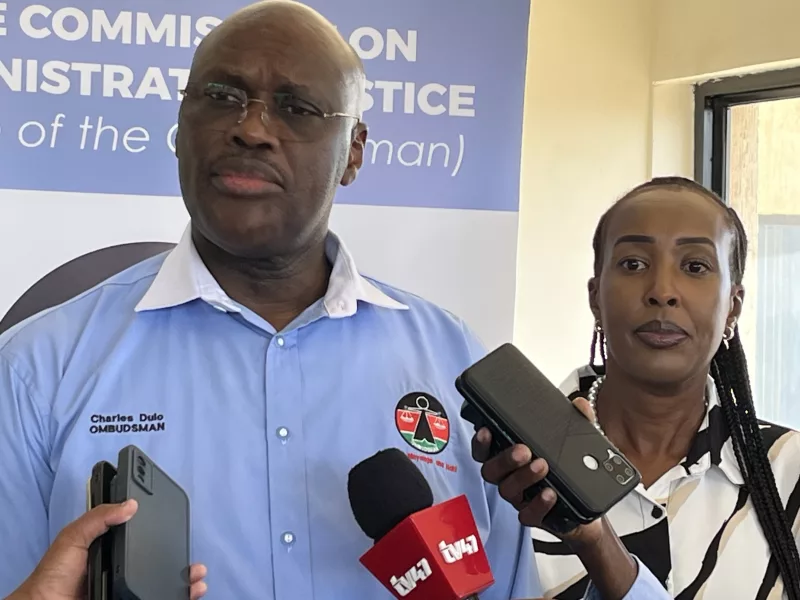
 Ombudsman Charles Dulo during a past event/FILE
The Commission on Administrative Justice has moved to clarify its role in growing concerns surrounding the proposed nuclear power project in Siaya, saying it is handling two separate access-to-information cases while remaining neutral on whether the project should proceed.
Commission Chairperson Charles Dulo said the Ombudsman had received complaints and concerns from community groups questioning access to information, public participation, land acquisition, environmental safeguards, and nuclear safety.
In a press statement issued Tuesday, Dulo said the concerns were raised during a meeting with representatives of the Friends of Siaya Anti-Nuclear Plant Interim Coordinating Committee and other community members.
The meeting followed concerns surrounding a planned “Occupy Kisumu Ombudsman Office” people's march.
Dulo said residents had expressed anxiety over the status, scope, location, and possible implications of the proposed nuclear project and demanded timely disclosure of information by relevant public institutions.
“The concerns presented were broad, but largely centred on access to information and meaningful public participation; the potential acquisition of land, valuation, compensation, resettlement and protection of livelihoods,” Dulo said.
“They also raised concerns about environmental and social safeguards, including potential impacts on the Lake Victoria Basin, and nuclear safety, emergency preparedness and radioactive waste management.”
However, the Ombudsman cautioned that the allegations presented by the community had not been established.
“I wish to emphasise that these are concerns and allegations presented to the Commission by the representatives and no finding has been made on their veracity,” Dulo said.
“Where specific complaints are brought before us, we will examine the facts and evidence and determine whether the matters fall within our constitutional and statutory mandate.”
The Commission is currently dealing with two separate Access to Information matters related to the proposed project.
The first involves the Friends of Siaya Anti-Nuclear Plant Interim Coordinating Committee and the Nuclear Power and Energy Agency (NuPEA).
According to Dulo, FSANP lodged an application for review with the Commission on August 24 after receiving a consolidated response from NuPEA regarding an earlier request for information on the proposed Siaya Nuclear Energy Project.
The group had sought information covering site selection, technical and feasibility studies, environmental and social assessments, land acquisition, resettlement, livelihoods, nuclear safety, radioactive waste management, public participation, financing and procurement.
NuPEA responded to the request on August 20, addressing several issues and providing access to a repository containing some of the requested documents.
However, FSANP subsequently complained that some information had not been provided and requested additional disclosure and the transfer of some requests to other relevant public institutions.
Among the documents sought are the Strategic Environmental Assessment Report, review comments by the Netherlands Commission for Environmental Assessment and the KenGen Resettlement and Compensation Framework.
Dulo said the application was filed within the statutory period and remained under review.
“As at August 31, only seven days had elapsed since the application was received. The matter remains within the statutory review process,” he said.
“A ruling is currently being prepared.”
The second matter involves the Western Kenya Social Justice Centres Working Group, acting on behalf of the Our Energy, Our Voice Campaign, and the County Government of Siaya.
The group had requested information from the county government in March concerning the project's status, consultations, environmental and technical studies, risk assessments, emergency preparedness, public participation, land acquisition and county-level decisions.
After an alleged failure to receive a response, the matter was referred to the Commission.
Dulo said the County Government of Siaya later informed the Commission that it did not possess correspondence, agreements, reports, studies or other records relating to the proposed nuclear plant.
“The County Government further stated that it had not undertaken, commissioned or received environmental, social, economic, technical or feasibility studies concerning the proposed project,” he said.
Dulo emphasised that the two cases were separate and should not be conflated.
He also made it clear that the Ombudsman was neither supporting nor opposing the proposed nuclear power project.
“Our role is not to determine whether Kenya should have a nuclear power plant, whether Siaya should host one, or whether the technical merits of the project warrant implementation,” he said.
“Our responsibility is to ensure that public institutions act lawfully, fairly, transparently and accountably, and that citizens are able to exercise their constitutional and statutory rights.”
Dulo urged residents to continue documenting concerns and submit evidence where they believe there has been maladministration, unfair administrative action or denial of access to information.
“Citizens have a right to ask questions, a right to seek information, a right to participate and a right to fair administration,” he said.
“Public institutions have a responsibility to listen, respond and account for the manner in which they exercise public power.”