
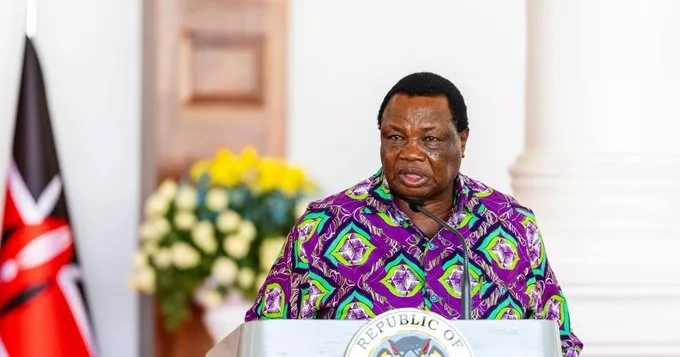
Central Organisation of Trade Unions (COTU) Secretary-General Francis Atwoli has raised concerns over the preparedness of trade unions to keep pace with the rapid technological changes transforming workplaces.
Atwoli said unions must urgently strengthen their digital capabilities and acquire the expertise needed to protect workers as artificial intelligence (AI) increasingly influences employment.
“As COTU (K), we are deeply concerned about the preparedness of trade unions themselves for the speed of technological change that is taking place,” Atwoli said.
He spoke on Monday during a three-day high-level trade union workshop on AI governance, workers’ rights and the future of work at Radisson Blu, Upper Hill.
Atwoli said AI was no longer a future phenomenon but a present reality already affecting workplaces by influencing recruitment, allocation of work, supervision, productivity measurement, wages and, in some cases, whether workers retain their jobs.
He said the changing nature of work requires trade unions to rethink how they organise and represent workers.
“We must use technology to organise workers, digital platforms to communicate with members, develop databases that enable us to understand the changing composition of our membership, use digital tools for education, research, recruitment and servicing members,” he said.
Atwoli said unions must also develop expertise to scrutinise technological systems being introduced by employers.
He cited the growing prevalence of workers based in Kenya while their employers are located in other countries, with some workers receiving instructions through applications and being supervised by algorithms.
“Furthermore, it is also becoming standard practice that the supervisor may be an algorithm, instructions may come through an application, wages may be determined by a platform, discipline may be automated and dismissal may take the form of simply being deactivated from an application,” he said.
Atwoli warned that if workplaces are evolving, trade unionism must evolve with them.
“If that is the workplace of the future, then trade unionism must also evolve and that is why this workshop must challenge us internally and make all of us become more digitally capable organisations,” he said.
He said COTU was working to ensure its affiliates understand AI, shop stewards understand algorithmic management, negotiators understand workplace data and researchers understand digital labour platforms.
Atwoli also welcomed the development of Kenya's Artificial Intelligence Bill, 2026, saying AI governance must take into account the interests of workers whose jobs, incomes and working conditions could be affected by the technology.
He called for workers to have a formal role in the country's AI governance framework and urged regulation of algorithmic management.
“We cannot allow a situation where a worker does not know why his or her wages have changed, why work has been reduced, why productivity has been downgraded, or why he or she has been suspended or dismissed because ‘the system made the decision’,” he said.
Atwoli further opposed the unilateral introduction of AI systems by employers where such technology could eliminate jobs, alter wages, increase surveillance or significantly change working conditions.
He said trade unions must also prepare for the growth of platform work and other non-standard forms of employment, arguing that workers should not lose labour protections because they are labelled independent contractors or service providers.
Atwoli urged the International Labour Organization (ILO) to support sustained programmes aimed at strengthening unions' capacity in AI governance, digital organising, algorithmic management, collective bargaining and worker data rights.
He said COTU also wants Kenyan workers involved in data and content moderation for international technology and outsourcing companies to receive decent wages, social protection, occupational safety and health protections, freedom of association and dignity at work.
“We need to build a generation of trade union leaders and technical officers who can sit across the negotiating table from technology companies and employers and understand the systems being discussed,” Atwoli said.







