The opposition has intensified calls for international intervention over rising political violence, warning instability ahead of the 2027 election could threaten regional peace and security.
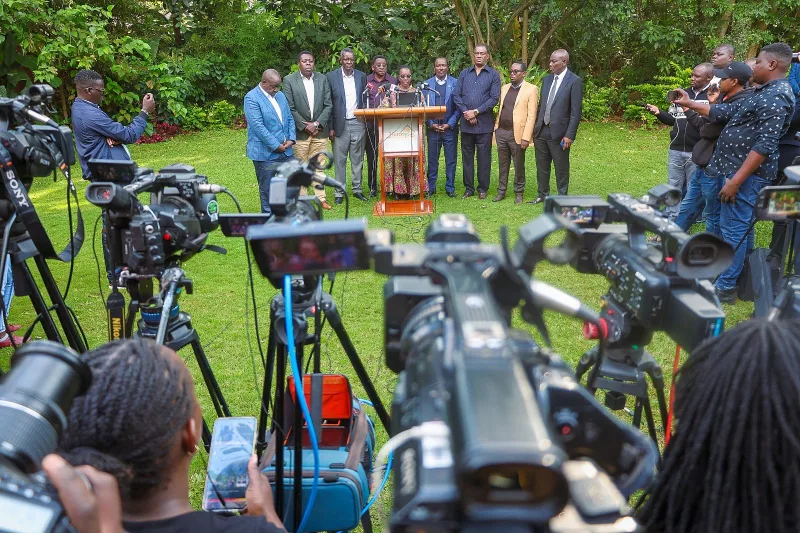
The United Opposition and the Linda Mwananchi Movement this week urged the international community to pay attention to what they describe as rising political violence and intimidation ahead of the 2027 General Election.
In a joint statement in Nairobi, the two opposition formations condemned recent attacks targeting opposition leaders, journalists and ordinary citizens in different parts of the country, and invited the international community and the International Criminal Court to pay close attention on Kenya’s developments.
“We call upon Kenyans, religious leaders, civil society, the media and the international community to remain alert and to stand firmly against violence, intimidation and any attempt to steal our democratic freedoms,” the United Opposition said in the joint statement.
Among those present were Wiper leader Kalonzo Musyoka, PLP’s Martah Karua, Jubilee presidential aspirant Fred Matiang’I, Siaya Governor James Orengo and DAP-K’s Eugene Wamalwa.
They described the incidents as part of what they called a “deliberate and organised pattern” taking root ahead of the elections.
“This is not by accident. It is a deliberate and organised pattern taking root ahead of the 2027 General Election, and we will not look away from it,” they said.
The opposition demanded prompt, independent and transparent investigations into all reported incidents and called for those responsible to be held accountable.
The remarks came a day after DCP leader Rigathi Gachagua on Wednesday called on the US, Britain, Germany and France to intervene in Kenya.
Speaking during his meeting with Wiper leaders, he accused President William Ruto's administration of allowing a political environment that could degenerate into anarchy.
“We urge the international community to rein in William Ruto,” Gachagua said.
“There is no way our development partners, who are our friends, can allow instability in the Horn of Africa. The chaos being planned by Murkomen and Ruto will have a destabilising factor in the whole region in terms of peace and stability.”
Gachagua specifically appealed to the American, British, German and French governments to intervene, recalling the role Western governments played in Kenya's political reforms in the 1990s.
“We are asking the American, British, German and France governments to intervene. They intervened for us in the 1990s during the [US Ambassador Smith] Hempstone period,” he said.
“They can still do it again because the way we are going, there will be no country. There will be anarchy.”
The opposition leaders also invited the ICC to closely monitor developments in Kenya.
In a statement read by PLP leader Martha Karua, they urged the ICC prosecutor to undertake a preliminary assessment of whether credible information exists warranting a probe under the Rome Statute.
“Should evidence emerge demonstrating that widespread and systematic attacks against civilians are being organised, financed, directed or tolerated by those in positions of authority,” Karua said.
“We urge the prosecutor to exercise the powers under Article 15 of the Rome Statute to initiate an investigation, especially against the person bearing the greatest responsibility, President William Ruto, a former ICC inductee.”
The opposition also called for a review and determination of the status of the previous charges against Ruto following the 2007–08 post-election violence.
Article 15 of the Rome Statute empowers the prosecutor of the International Criminal Court to initiate investigations proprio motu (on their own initiative) based on information on crimes within the court’s jurisdiction, rather than waiting for a state or UN Security Council referral.