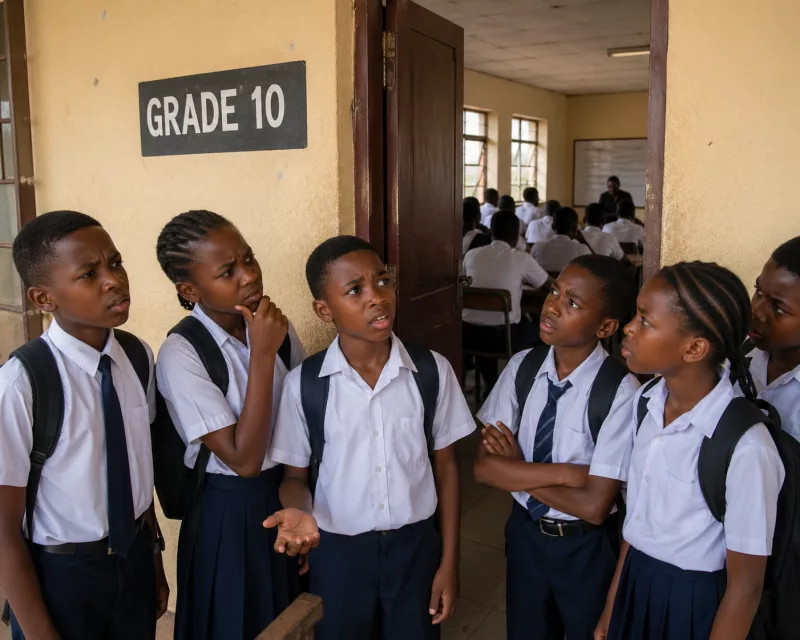
 Grade 10 learners outside a classroom. /AI ILLUSTRATION
Kenya's education sector has undergone significant reforms since the Competency-Based Curriculum (CBC) was introduced to phase out the 40-year-old 8-4-4 system, which was criticised for promoting rote memorisation over critical thinking.
By the end of 2022, when President William Ruto and his Kenya Kwanza administration came into office, the curriculum was five years old, counting from its initial piloting in 2017, and four years into its classroom rollout, which began in 2019.
On September 29, 2022, two weeks after taking the oath of office, Ruto appointed the Presidential Working Party on Education Reform (PWPER) to evaluate the CBC and recommend appropriate reforms across the education sector.
Its mandate included reviewing laws governing basic education and recommending changes to address duplication, ambiguities and efficiency constraints, as well as reviewing public school categorisation and the management of bursaries.
The team was also tasked with reviewing laws governing tertiary education and recommending changes to improve effectiveness and efficiency in the subsector.
“The Working Party shall have the powers and carry out such other functions necessary to undertake any matter incidental or ancillary to the foregoing,” Ruto said in a Gazette Notice.
On August 1, 2023, the 42-member team, chaired by Prof Raphael Munavu, submitted its report with far-reaching recommendations, including rebranding CBC as Competency-Based Education (CBE).
The team also recommended restructuring primary education into lower primary (Grades 1-6) and Junior School (Grades 7-9), with Junior School domiciled within existing primary school compounds.
This created a unified comprehensive school model under single headteachers.
The separation also led to the renaming of secondary schools as Senior Schools, covering Grades 10 to 12. The curriculum was subsequently rationalised and the workload reduced.
The number of learning areas in lower primary was cut from eight to seven, upper primary from 11 to eight, and Junior School from 14 to nine by integrating overlapping subjects such as Agriculture and Nutrition and Integrated Science.
The learning areas were organised into three major specialisation pathways based on learners' preferences and talents, alongside compulsory core subjects, including English, Kiswahili or Kenya Sign Language, Mathematics, Physical Education and Community Service Learning.
The STEM pathway comprises three tracks: the Pure Sciences Track, covering Mathematics, Physics, Chemistry and Biology; the Applied Sciences Track, covering Agriculture, Computer Science/ICT and Home Science; and the Technical and Engineering Studies Track, covering areas such as Aviation, Building Construction, Woodwork, Metalwork and Electricity.
The Social Sciences pathway also has three tracks. The Languages and Literature Track covers Literature in English, Kiswahili/Kenya Sign Language Literature and foreign or indigenous languages such as French, German, Mandarin and Arabic.
The Humanities Track covers History and Citizenship, Geography and Religious Education (CRE/IRE/HRE), while the Business Studies Track covers Business Studies, including entrepreneurship, economics and accounting.
The Arts and Sports Science pathway comprises the Performing Arts Track, covering Music and Dance and Theatre and Film; the Visual Arts Track, covering Fine Art, Graphic Design and textile and craft-based design; and the Sports Science Track, covering Sports and Recreation, physical training and coaching.
Assessment and evaluation of learners also changed, with greater emphasis on school-based continuous assessment.
Formative teacher assessments now account for a significant share of progression scores alongside national assessments.
National competency-based assessments use an eight-level achievement scale mapped across four main categories: Exceeding Expectations (EE), Meeting Expectations (ME), Approaching Expectations (AE) and Below Expectations (BE).
Learners sit three national assessments in Grade 6 (KPSEA), Grade 9 (KJSEA) and Grade 12 (KCBE). School-based assessments from Grades 4, 5 and 6 account for 60 per cent of the KPSEA score, while the final national summative assessment accounts for 40 per cent.
For the KJSEA, school-based assessments from Grades 7 and 8 contribute 20 per cent, the final Grade 9 national assessment accounts for 60 per cent, while the KPSEA score provides the remaining 20 per cent.
The Grade 12 national summative examination, which will replace KCSE in 2028, will account for 70 per cent of the final score in the Kenya Certificate of Basic Education (KCBE).
School-based continuous assessments will contribute the remaining 30 per cent, split evenly between Grade 10 and Grade 11, at 15 per cent each.
To accommodate the transition, the government has constructed more than 23,000 new classrooms and initiated the construction and equipping of more than 1,600 science laboratories to ease congestion as cohorts move through Junior and Senior School.
Data from the Kenya National Examinations Council (KNEC) shows high progression rates, particularly in the early primary levels, boosted by the government's 100 per cent transition policy.
Grade 3 to Grade 6 recorded a 96.90 per cent transition rate between 2022 and 2025, although the overall retention and transition rate to Grade 9 dropped sharply to 88.17 per cent.
More than 151,000 learners from the pioneer cohort dropped out of the system before completing Grade 9, with boys accounting for nearly two-thirds of the dropouts.
Transition from Grade 9 to Grade 10 reached approximately 85 to 93 per cent following mop-up campaigns in January 2026.
Over the same period, the government hired 100,000 additional teachers, 76,000 of whom were deployed specifically to address the staffing demands of Junior Schools, backed by continuous retooling of existing teachers.
The policy shift has come at a heavy cost, pushing overall State expenditure on education from Sh544.4 billion in the 2022/23 financial year to Sh784.5 billion in the 2026/27 financial year.
The State Department for Basic Education, which is responsible for sustaining CBE, received Sh136.6 billion, up from Sh130.46 billion in the 2022/23 financial year.
The changes have also placed significant financial pressure on parents, with surveys such as an Infotrak poll highlighting that roughly 39 per cent of parents view the high cost of school fees, specialised uniforms and learning materials as major obstacles.
Unlike the older 8-4-4 framework, where heavy costs were concentrated at upper secondary and tertiary levels, CBE demands higher investment much earlier, with continuous assessments, hands-on projects, digital tools and subject-specific practical materials accounting for much of the out-of-pocket spending by households.
Public school funding gaps and delays in disbursements have also meant that parents frequently face supplementary levies for development contributions and specialised equipment for STEM and arts laboratories.