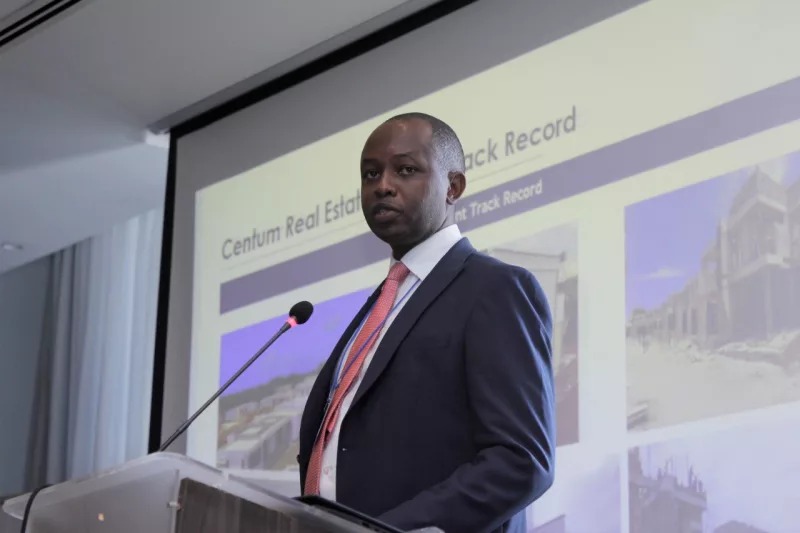
 Centum Real Estate Managing Director Kenneth Mbae /FILE
Centum Re has received an international endorsement for its plans to raise and manage money through green bonds, after Moody’s Ratings awarded its Green Bond Framework the highest possible sustainability quality score.
The real estate development arm of Nairobi Securities Exchange-listed Centum Investment Company received an SQS1 “Excellent” score from Moody’s, signalling that its proposed system for raising money for environmentally sustainable projects meets high international standards.
The assessment, makes Centum Re the first real estate developer in East Africa to receive Moody’s highest Sustainability Quality Score.
The rating is expected to boost Centum Re’s credibility among investors as it seeks to use green bonds to finance large-scale property developments in Kenya and Uganda.
Green bonds are debt instruments used to raise money specifically for projects that have environmental benefits.
Investors buy the bonds and the company uses the proceeds to finance qualifying projects.
Centum Re has developed a framework setting out how it will select green projects, spend the money raised, track the funds and report to investors on the environmental impact of the projects.
Moody’s said the framework meets the four key requirements of the International Capital Market Association’s Green Bond Principles 2025, which are widely used as global guidelines for green financing.
These cover how the money raised will be used, how projects will be selected, how the funds will be managed and how the company will report back to investors.
Centum Re Managing Director Kenneth Mbae said the rating gives the company international recognition for the systems it has put in place to support sustainable financing.
“Receiving an SQS1 ‘Excellent’ assessment from Moody’s is a significant milestone for Centum Re and a strong endorsement of the sustainability standards underpinning our Green Bond Framework,” said Mbae.
“It demonstrates that we are building a financing platform that meets internationally recognised standards while supporting the development of more sustainable communities and real estate assets in East Africa.”
The assessment could help Centum Re appeal to a growing pool of local and international investors looking for opportunities that combine financial returns with environmental benefits.
Green financing has become increasingly important globally as investors pay closer attention to how companies use borrowed funds and whether projects deliver measurable environmental benefits.
For property developers, this includes investments in buildings and infrastructure designed to use less energy and water, reduce environmental impact and improve the long-term sustainability of urban developments.
Moody’s said Centum Re’s framework showed a high contribution to sustainability and clearly defined the environmental objectives and expected benefits of projects that will qualify for green financing.
The framework covers four categories of eligible projects across Centum Re’s operations in Kenya and Uganda.
Among the strengths highlighted by Moody’s was Centum Re’s commitment to carry out assessments covering the environmental impact of eligible green buildings throughout their life cycle.
The company has also committed to having independent experts verify reports measuring the environmental benefits of projects financed through the green bonds.
Centum Re has established a process for screening and approving projects before they can receive money raised through green bonds.
Projects will undergo environmental and social checks, after which a Green Bond Project Team will evaluate and recommend qualifying investments. Final approval will be made by the company’s Executive Committee and Board of Directors.
The developer has also put in place a system for tracking the money raised from green bonds.
Funds will be recorded in a dedicated Green Bond Register managed by the Finance Department and are expected to be allocated to qualifying projects within 24 months after a bond is issued.
Centum Re has further committed to publishing annual reports showing investors how the money has been spent and the environmental impact achieved.
The reports will disclose the amount allocated to projects, any money that remains unspent and the share used for new projects or refinancing existing investments.
Mbae said the framework goes beyond simply meeting the requirements needed to issue a green bond.
“For us, sustainability is not simply about meeting a set of requirements for a financing instrument. It is about how we design and develop projects that are resilient, resource-efficient and responsive to the needs of the communities and businesses that use them,” he said.
Mbae said the assessment would strengthen the company’s engagement with investors seeking credible green investment opportunities in the region.
“We see green finance as an opportunity to align capital with developments that deliver measurable environmental benefits,” he said.
“This assessment strengthens our ability to engage investors who are looking for credible and transparent sustainability-linked opportunities in the region.”