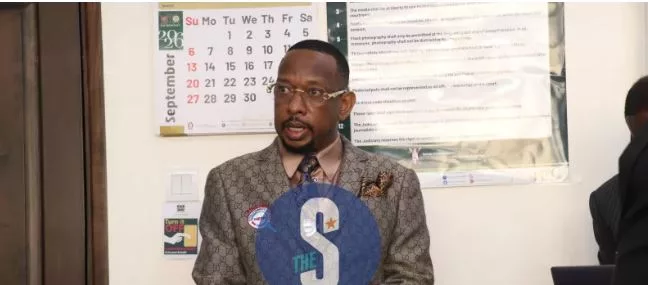
As a child, Ngari Mbugua would pester his father with questions whenever politicians appeared on television.
Who were these men? What were they saying? And why did their words matter so much to the people watching them?
Mbugua was fascinated by the way political leaders communicated with the public, an interest that would quietly follow him into adulthood.
When his father died in September 2002, just three months before that year’s General Election, holding on to those memories became deeply personal.
His father had been a Kanu grassroots mobiliser, and their home was often filled with party paraphernalia.
For the young Mbugua, politics was therefore not something distant or confined to television screens. It was part of the environment in which he grew up.
That childhood curiosity eventually evolved into student leadership roles in high school and university before Mbugua moved into the software development industry.
But it was the youth-led protests of 2024 that pushed him towards elective politics.
Watching young people die during demonstrations against government economic policies convinced the tech entrepreneur that street-level activism alone could not deliver the change he wanted.
For Mbugua, the lesson was clear: if laws were at the centre of the grievances that had brought young people onto the streets, then perhaps the solution was to get into the rooms where those laws are made.
"I settled on the senatorial seat because of the 2024 protests and I believe that the very bad laws which we were protesting against are a reason of poor representation," Mbugua says.
Now, the technology entrepreneur is seeking to translate that conviction into political office.
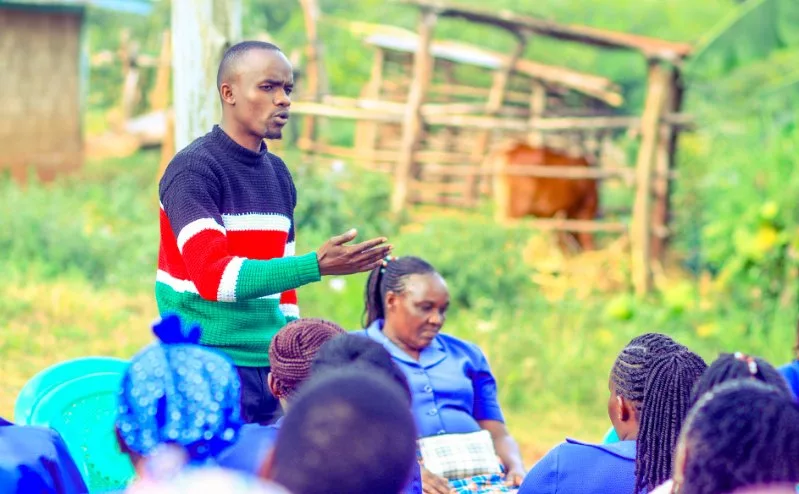
Dressed in a Kenya flag sweater during his grassroots outreaches, Mbugua is challenging the traditional image of the Senate by seeking election as Senator for Kirinyaga, hoping to become one of the youngest people to represent the county in the chamber that has long carried the reputation of being a ‘Nyumba ya Waze’ (house of elders).
He sees the evolution of Kirinyaga's Senate representation as evidence that voters may already be opening the door to younger leadership.
The county's first senator, the late Daniel Karaba, was elected at about 67 years of age. He was succeeded by Charles Kibiro, popularly known as CK, who also served in his 60s before becoming chief executive officer of Thika Greens.
The current senator, Kamau Murango, was elected at approximately 40.
For Mbugua, the progression represents a gradual generational shift.
"For a long time, the Senate has been referred to as ‘Nyumba Ya Waze’," he says.
"But having youthful leaders such as Nairobi Senator Edwin Sifuna and Nyandarua's John Methu, it's no longer the Nyumba Ya Waze. It's the nyumba of anyone who can stand up and represent the people very well, and I think for Kirinyaga county, I'm that person."
For a young aspirant, however, conviction is only one part of the battle.
The other is money.
Mbugua says the cost of conventional political campaigning puts young candidates at a disadvantage because successful campaigns often require money for public meetings, security, transport and other logistics.
"Politics is a very expensive endeavour to begin with," he says.
"I always joke and tell people that I need money to go and tell people that I do not have money."
Without the resources to mobilise people for meetings, he says, young candidates have to find opportunities where communities are already gathered — whether at funerals, burials or community self-help groups.
Even then, he says, there is often an expectation that a politician should not arrive empty-handed.
Mbugua says he has deliberately avoided seeking financial backing from established politicians or wealthy sponsors, instead relying on a small circle of friends who contribute modest amounts when they can.
He believes the playing field could be made fairer through state-sponsored civic education and debates for candidates.
If such platforms can be provided for presidential candidates, he argues, similar opportunities should be extended to those seeking Senate and gubernatorial seats.
Technology has become central to Mbugua's campaign — not merely as a way of reaching voters but as a glimpse into how he says he would approach governance.
He uses artificial intelligence to generate campaign posters and content calendars, reducing his reliance on expensive graphic design services.
He has also developed a small system to organise his network of agents across Kirinyaga.
The county has 87 sub-locations and Mbugua aims to have at least three agents in each.
Rather than keeping their details in an Excel spreadsheet, he is using software to collect and manage the information, creating a digital network that he hopes will make communication and team coordination easier.
"I'm in the tech space," he says. "We have a small system where we are inputting the details of each and every agent for every sub-location."
But beneath the technology, Mbugua says, his campaign is ultimately about the everyday economic challenges facing residents.
Agriculture sits at the centre of his political pitch.
Mbugua identifies what he describes as a productivity gap in Kirinyaga's agricultural sector, particularly coffee and rice.
While the global average coffee yield is 680 kilogrammes per hectare, he says farms in Kirinyaga produce between 270 and 275 kilogrammes.
He says a similar challenge affects rice farmers, who struggle to compete with imports from Pakistan and Brazil.
Then there is the question of value addition.
Mbugua says 90 per cent of coffee produced in Kirinyaga is exported without local value addition, denying the county an opportunity to capture more of the value generated by its agricultural products.
If elected, he says he would seek to change the way the Senate's oversight role is felt at grassroots level.
His vision is to take county financial oversight closer to residents through regular public meetings.
"Previous senators in Kirinyaga have not been holding barazas in terms of doing oversight," he says.
"I think what I'll do differently is that I'll want to bring the county finances to the Mwananchi. I'll want the office of the senator to sit in every ward, explain to the people this is how your money was spent, and do it for five years so there will be accountability."
For Mbugua, the Senate should not only exist in Nairobi.
He wants the office to become a conduit through which residents can understand how public resources are being used in their own wards.
Yet as the 2027 political contest approaches, his concerns extend beyond policy and representation to the integrity of the electoral process.
He points to bouts of violence and the emergence of masked groups as worrying signs, warning that the trend must not escalate into voter intimidation or suppression.
For a man whose political journey began with questions about the men he watched on television as a child, the next chapter is now about whether he can move from watching politics to becoming one of the people making the decisions.
And in a county where the Senate has gradually moved from the hands of older politicians to a younger generation, Mbugua believes his moment may have arrived.
INSTANT ANALYSIS
Ngari Mbugua’s Senate bid captures a wider generational shift in Kenyan politics, where younger voters and leaders are challenging the traditional dominance of older politicians. His campaign combines youth activism, technology and agricultural concerns, offering a different model of political engagement. However, his biggest test will be translating digital appeal and reformist rhetoric into grassroots support in a political environment where money, networks and established structures remain powerful.