
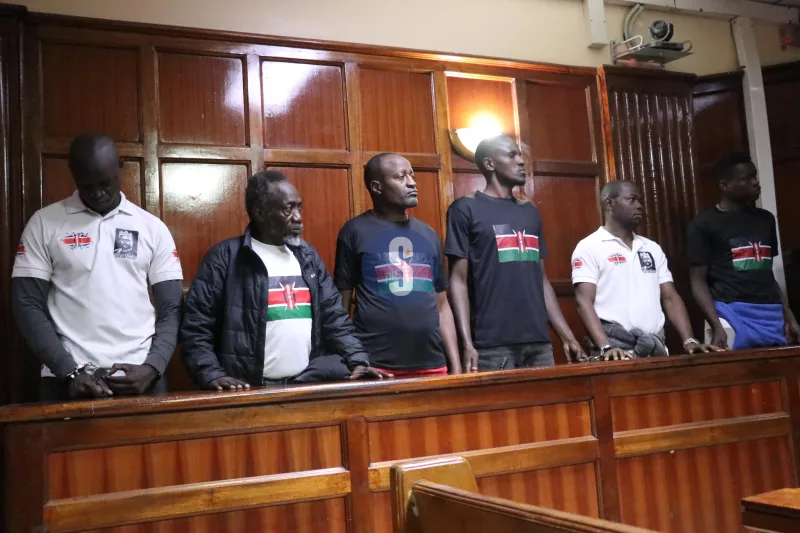
 Activists Elisha Ochieng, Michael Ngige, Julius Kamau, Mulinge Muteti, Nyanjom Joshua and Collins Otieno take plea before Senior Resident Magistrate Irene Thamara on charges of obstructing the operation of vehicles on a road contrary to section 58 (C) of the Road Act, Chapter 408, Laws of Kenya, at Milimani Law Courts, Nairobi on August 18, 2026. /LEAH MUKANGAI
Six activists have been arraigned at the Milimani Law Courts over a demonstration in Nairobi during which traffic along Taifa Road was disrupted.
The six, including Julius Kamau, Collins Otieno, Nyanjom Joshua, Mulinge Muteti, Michael Ngige and Elisha Ochieng, face charges under Section 58(c) of the Road Act, which prohibits deliberate obstruction of vehicle movement.
The charge sheet presented by the Office of the Director of Public Prosecutions alleges that the six, together with others who have not been arrested, barricaded Taifa Road on August 17.
The prosecution said the protesters placed two dummy wooden caskets and two small wooden crosses on the road, causing traffic to stop and forcing motorists to use alternative routes.
State Counsel Kiragu told the court that the demonstration interfered with the movement of other road users and constituted an obstruction.
The six were arrested without a warrant by officers from Central Police Station during the protest.
The defence, led by Advocate Kevin Kang'ethe, asked the court to grant the activists lenient bail, arguing that they were exercising their constitutional rights to assemble, picket and petition the government.
Kang'ethe told the court that the use of mock coffins was a form of protest intended to communicate the group's grievances and that there was no violence or destruction involved.
The prosecution did not oppose the release of the accused but asked the court to impose a condition barring them from participating in demonstrations while out on bail.
The magistrate declined to impose the condition, instead granting each of the six accused a bond of Sh40,000 or an alternative cash bail of Sh3,000.
The case will be mentioned on August 31 for further directions.
The charges stem from a protest on August 17 in which the six activists demonstrated outside the office of Inspector General of Police Douglas Kanja at Jogoo House.
The activists carried white coffins marked “Why kill Kenyans?” and placards calling for Kanja's resignation.
They also carried crosses and displayed messages raising concerns about alleged abductions, killings and what they described as police failure to protect Kenyans.
During the protest, Julius Kamau chained himself to the Jogoo House gate as officers moved to disperse the group.
In video footage from the scene, Kamau is seen addressing those gathered around him and chanting messages calling for freedom, justice and equality before officers eventually removed him from the gate.
The six were subsequently arrested and taken into police custody before being presented in court.






