

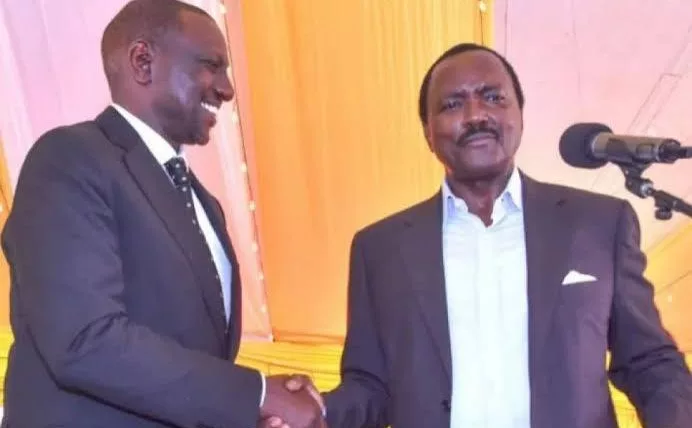
 President William Ruto and Wiper boss Kalonzo Musyoka /HANDOUT
Details have emerged of behind-the-scenes manoeuvres by President William Ruto to split and scuttle the opposition unity bid as he seeks to steady his bumpy path to a second term.
Ruto’s troops are reportedly reaching out to key opposition chiefs in a bid to either draw them into his camp or keep them in the presidential race if they fail to secure the opposition’s joint ticket.
The strategy is designed to fragment the anti-Ruto vote and prevent the opposition from consolidating behind a single candidate capable of mounting a serious challenge to the President in 2027.
Ruto’s allies are luring the opposition chief with mega development in their regions, plum state jobs and other personal treats.
“We know the only card President Ruto wants to play is to divide this team. He knows that without this team being divided, he is one term,” Wiper leader Kalonzo Musyoka said last month.
The Star has established that Ruto’s camp is aggressively pursuing Fred Matiang’i, who has emerged as one of the strongest contenders for the opposition presidential ticket.
Sources familiar with the manoeuvres said a senior Kenya Kwanza operative recently met a first-term MP from Nyamira allied to Matiang’i at Tamarind Hotel on Lang’ata Road in Nairobi.
According to the sources, the MP was tasked with persuading Matiang’i to accept a Cabinet position and two other influential government appointments as part of a political deal.
Should that proposal fail, the emissaries reportedly want Matiang’i to remain in the presidential race even if he fails to secure the opposition’s joint ticket.
The strategy would effectively split the Gusii vote and weaken the opposition’s chances of consolidating its support behind a single candidate.
“The MP has already delivered the message to Matiang’i. He later met him at the Jubilee Party offices in Karen, where he was meeting a delegation from Kakamega,” a source familiar with the discussions said.
The source said Matiang’i neither accepted nor rejected the proposal.
The MP, who is believed to have business links with senior figures in the Kenya Kwanza administration, did not respond to text messages or repeated phone calls seeking comment.
Kisii Senator Richard Onyonka confirmed that government operatives had repeatedly approached Matiang’i’s camp.
“It is true. We are constantly being persuaded, wooed or even blackmailed to join the government, but we have said that all of us cannot fit in one government,” Onyonka told the Star.
“So, that will not be the first or the last attempt. We have constantly received invitations and persuasions to join the broad-based government, but we have said no.”
Onyonka said Matiang’i remained firmly in the opposition and was focused on securing the coalition’s presidential ticket ahead of the 2027 general election.
Once regarded as former President Uhuru Kenyatta’s most powerful administrator, Matiang’i has steadily built his political profile since leaving government.
He is now viewed as a leading contender for the opposition ticket and has established himself as a formidable political force in the Gusii region.
Political observers say winning over Matiang’i would give Ruto a major strategic advantage in the region, which has more than 960,000 registered voters.
For years, the Gusii vote largely backed former Prime Minister Raila Odinga (now deceased).
The united opposition has several presidential hopefuls, each with a regional base and presidential ambitions.
If they fail to agree on a single candidate, the President could benefit from a divided vote.
However, their unity could be detrimental to Ruto’s re-election chances.
A Tifa Research poll released late last month placed Ruto as the most preferred presidential candidate with 24 per cent support, but far below the 50 per cent plus one mark required to win the presidency.
Nairobi Senator Edwin Sifuna followed with 15 per cent, Matiang’i with 14 per cent and Kalonzo with 13 per cent.
While the figures show Ruto maintaining an early lead, the combined support of the opposition figures would upset the President.
The President’s camp is also understood to have targeted Kalonzo and DAP-Kenya leader Eugene Wamalwa.
The three are among the opposition figures positioning themselves for the 2027 presidential contest, with their support bases spread across some of the country’s most politically influential regions.
Kalonzo has been forced to deny claims he recently held a private meeting with Ruto at State House.
The claims sparked speculation within opposition circles that the Wiper leader could be the latest major opposition figure to enter negotiations with the President.
Ruto’s allies maintained that Kalonzo had held a closed-door meeting with the President, but the Wiper leader and his troops quickly dismissed the claims.
“We must step up our national political discourse beyond President Ruto's desperation for re-election. Kalonzo is keen on contesting and winning the presidential race next year,” Kitui Senator Enoch Wambua, a close ally of Kalonzo, said.
“For the avoidance of doubt, Kalonzo is not interested in any conversation about working with President Ruto. We are busy building a political coalition with like-minded leaders to form the next government.”
But even as Wambua rejected reports of a deal, Makueni Senator Dan Maanzo disclosed that the President had made several attempts to woo Kalonzo.
“He wants to divide the opposition, but we will not give him the space. Kalonzo will be the President of this country next year,” Maanzo said.
Earlier, DCP leader Rigathi Gachagua claimed Ruto was using allies to persuade Kalonzo to join the government.
“There have been many efforts by Ruto and his allies to woo Kalonzo, with people trailing him everywhere and inviting him to join them,” Gachagua said.
Kalonzo remains a crucial political asset because of his influence in Ukambani.
In three successive elections since 2013, he has delivered more than one million votes from the region to Raila, making him one of the opposition’s most valuable bargaining chips.
His decision to back Ruto would therefore have a significant impact on the shape of the 2027 contest.
It is this political arithmetic that makes Kalonzo a prime target for both sides.
But the President’s reported charm offensive does not stop with the Wiper leader.
INSTANT ANALYSIS
President William Ruto’s allies will be looking to exploit divisions, competing ambitions and disagreements over who should carry the opposition flag. The opposition, meanwhile, faces a difficult choice: unite early and risk internal power struggles, or remain fragmented and allow Ruto to benefit from the arithmetic of a divided field. With 2027 drawing closer, the political contest is increasingly shifting from who can attract the biggest following to who can prevent rivals from consolidating theirs.







