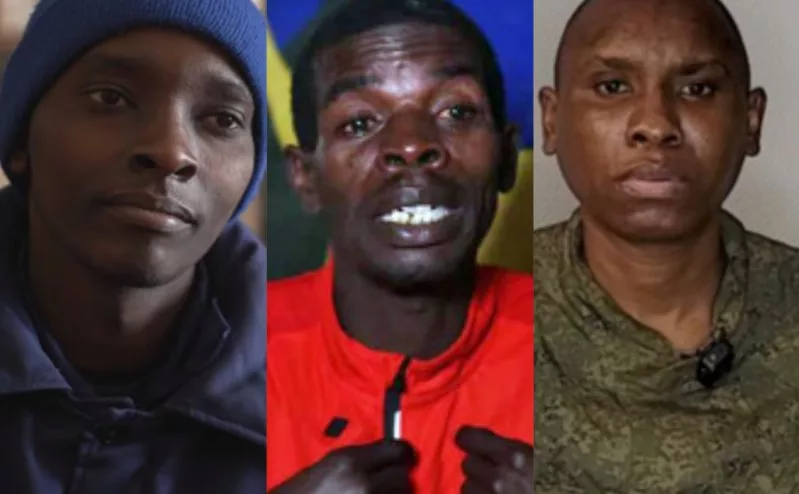
 Kenyans held in Ukraine as POWs, Willy Macharia, Evans Kibet and Francis Ndarua./HANDOUT
At least four Kenyans captured by Ukrainian forces while fighting for Russia could be protected by international laws governing the treatment of prisoners of war as the Kenyan government intensifies efforts to secure their release and repatriation.
Evans Kibet, Joseph Kabugi, Willy Macharia and Francis Ndarua are among Kenyans known to be held as prisoners of war (POWs) in Ukraine after being captured by the Ukrainian military.
Their cases have brought renewed attention to the growing number of Kenyans who have travelled to Russia and ended up on the battlefield in the war against Ukraine.
Under Article 4 of the Third Geneva Convention, a prisoner of war is generally a member of armed forces or other qualifying personnel captured by an enemy during an international armed conflict.
The convention provides protections for captured combatants, provided they fall within the categories covered by the treaty.
Thousands of Kenyans are believed to have been recruited to fight for Russian forces, although the Kenyan government has put the official figure at about 291.
Foreign Affairs Cabinet Secretary Musalia Mudavadi has acknowledged that Kenyans who joined foreign military forces without government approval broke Kenyan law.
“In Kenyan law, Section 68 of the Penal Code makes it clear that it is wrong for any Kenyan to join a foreign military and get into a war without the express consent of the President as the Commander-in-Chief of the Kenya Defence Forces,” Mudavadi said.
“Those who went to fight for Russia broke the law.”
Despite the legal position, Mudavadi said the government had adopted a humanitarian approach towards the Kenyans caught up in the conflict.
The priority, he said, was to ensure their safe return and subsequent reintegration rather than pursue punitive measures against them.
The position has placed the government in a delicate position as it seeks to protect Kenyan citizens while acknowledging that their decision to participate in the war contravened national law.
For Kibet, Kabugi, Macharia and Ndarua, their immediate status remains that of POWs while diplomatic efforts continue to secure their release.
President William Ruto has raised the issue directly with Ukrainian President Volodymyr Zelensky, seeking Kyiv's assistance in facilitating the return of Kenyans in Ukrainian custody.
“We expressed concern over young Kenyans who have been illegally recruited to fight in the war in Ukraine and agreed to raise awareness of the dangers of such ventures,” Ruto said.
“I have requested President Zelensky to facilitate the release of any Kenyan in Ukrainian custody. I am grateful to His Excellency for acceding to my appeal.”
The request marks an important diplomatic step in efforts to resolve the cases of Kenyans captured on the battlefield.
Ukraine's Ambassador to Kenya, Yurii Tokar, has also confirmed that discussions over the prisoners are being handled through official diplomatic channels.
“At this stage, I am not in a position to share specific details, but once the process advances and verified information becomes available, it will be communicated through the appropriate official sources,” Tokar said.
While the diplomatic process unfolds, the Geneva Conventions provide a framework for how prisoners should be treated during armed conflict.
The Third Geneva Convention of 1949 establishes international standards for the humane treatment of POWs. It requires detaining powers to protect prisoners against violence, intimidation, insults and public curiosity.
It also prohibits retaliation against prisoners.
Under the convention, POWs are entitled to adequate food, clothing, accommodation and necessary medical care without charge. Their conditions of detention should meet prescribed standards and, in relevant respects, be comparable to those provided to the detaining country's own forces.
The convention also limits the information prisoners can be compelled to provide during questioning.
A POW is required to give basic identifying information, including their name, rank, date of birth and service number. Physical or mental coercion to obtain additional information is prohibited.
The protections extend beyond physical safety.
POWs retain rights to communicate with their families, practise their religion and choose representatives to assist in matters relating to their detention.
The convention also provides special protections for prisoners who are seriously ill or injured.
Such prisoners may qualify for repatriation, while broader arrangements for the release and repatriation of POWs arise when active hostilities come to an end.
For the four Kenyans held in Ukraine, however, the timing and circumstances of their release remain unclear.
Their cases also highlight the risks faced by Kenyans recruited into foreign military service through promises of employment and financial rewards.
The Kenyan government has repeatedly warned against such recruitment, while seeking to establish the scale of the problem and assist citizens caught up in the conflict.
For now, Kibet, Kabugi, Macharia and Ndarua remain in Ukrainian custody as POWs, with their fate dependent on the diplomatic process between Nairobi and Kyiv.