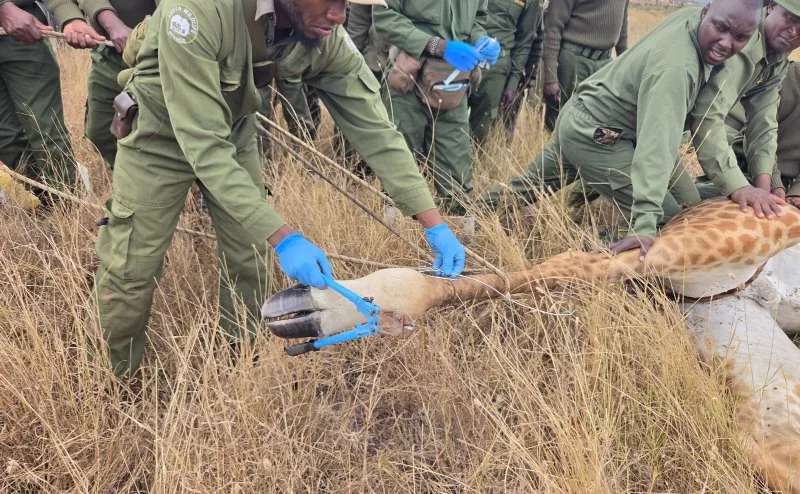
 KWS officers carefully remove a wire snare from an adult giraffe's injured right hind limb after safely immobilising the animal during a rescue operation at ILRI Athi Kapiti ranch /FILE
Kenya Wildlife Services
director-general Dr
Erustus Kanga’s call to revive the dormant wildlife reserves of Garissa and
strengthen wildlife conservation in Wajir deserves recognition.
For too long, Northeastern’s extraordinary wildlife heritage has received far less investment and institutional attention than it deserves. Kanga is therefore right to recognise Garissa, Wajir and the wider northern landscape as important refuges for the reticulated giraffe, hirola, Grevy’s zebra, Somali ostrich and other threatened species. He is also right that Arawale, Rahole and Boni National Reserves require urgent intervention.
But recognising the problem is the easy part. The difficult question is how KWS intends to implement this vision.
Arawale, Rahole and Boni have existed for decades. Their present condition did not develop overnight. They have suffered years of inadequate investment, weak protection, encroachment and limited conservation infrastructure.
So when we speak of “reviving” these reserves, what exactly does revival mean?
Where is the implementation plan? Where are the rangers, stations, roads, water infrastructure, management plans and budgets? Most importantly, where are the communities?
People living around these conservation areas have carried the cost of wildlife for generations. Livestock compete with wildlife for increasingly scarce water and pasture. Communities experience human-wildlife conflict. Yet many have seen little tourism revenue, employment, compensation or other tangible benefits from keeping wildlife alive.
Kenya’s wildlife law itself recognises that conservation benefits should reach land users to offset the costs of living with wildlife. It also requires management planning to address neighbouring communities, anticipated benefits and beneficiaries.
You cannot revive a reserve while ignoring the people living around it.
The proposal for Wajir raises an even more fundamental question.
Kanga proposes establishment of game reserves in Wajir. But much of Wajir is community land. The Community Land Act places communities at the centre of conservation and management of natural resources on their land. The Wildlife Conservation and Management Act similarly recognises the right of communities and landowners to establish wildlife conservancies and sanctuaries.
This creates an uncomfortable contradiction.
Why propose new protected areas on community land while KWS has struggled to build meaningful working relationships with the community conservancies that already exist across Northeastern?
These conservancies are not obstacles to conservation. They are potentially its strongest foundation.
If KWS wants wildlife corridors protected, then the conversation must begin with the people whose livestock, settlements, water points and livelihoods occupy those landscapes.
A corridor drawn on a map is easy. A functioning corridor on community land requires consent, negotiated land use, incentives, conflict mitigation and trust.
The Wildlife Act provides tools for precisely this approach. It recognises community conservancies, cooperative wildlife management, community scouting, benefit sharing and mechanisms for addressing human wildlife conflict.
Why, therefore, reinvent conservation structures instead of strengthening those already created by communities?
And then there is Malka Mari National Park in Mandera.
Before creating new protected areas, KWS should explain what it has achieved with the national park it already has in this region.
Malka Mari was gazetted in 1989 and covers approximately 876 square kilometres. KWS currently advertises it as a national park.
Yet KWS itself acknowledged in court proceedings that the park had suffered encroachment and had not been fully operationalised because of inadequate resources, infrastructure, manpower and security challenges.
Thirty-seven years after gazettement, what is the current operational status of Malka Mari? How many permanent KWS personnel are deployed there? What infrastructure exists? What budget has been allocated? What measurable conservation outcomes have been achieved?
These are not hostile questions. They are necessary questions.
Northeastern does not need more conservation areas that exist principally on maps and in Gazette notices.
We need functioning conservation landscapes.
Kanga has started an important conversation, and for that he deserves credit. KWS now has an opportunity to turn that conversation into a fundamentally different conservation relationship with Northeastern.
Come to the communities. Sit with the elders, conservancies, counties,
pastoralists, youth and landowners. Discuss corridors with the people whose
land forms those corridors. Address compensation and human wildlife conflict.
Invest in existing protected areas. Strengthen community conservancies. Put
permanent conservation capacity on the ground.
The wildlife has been waiting.
So have the communities.
The question now is whether KWS is finally ready to work with both.
CEO, NorthEastern Wildlife Conservancies Association