
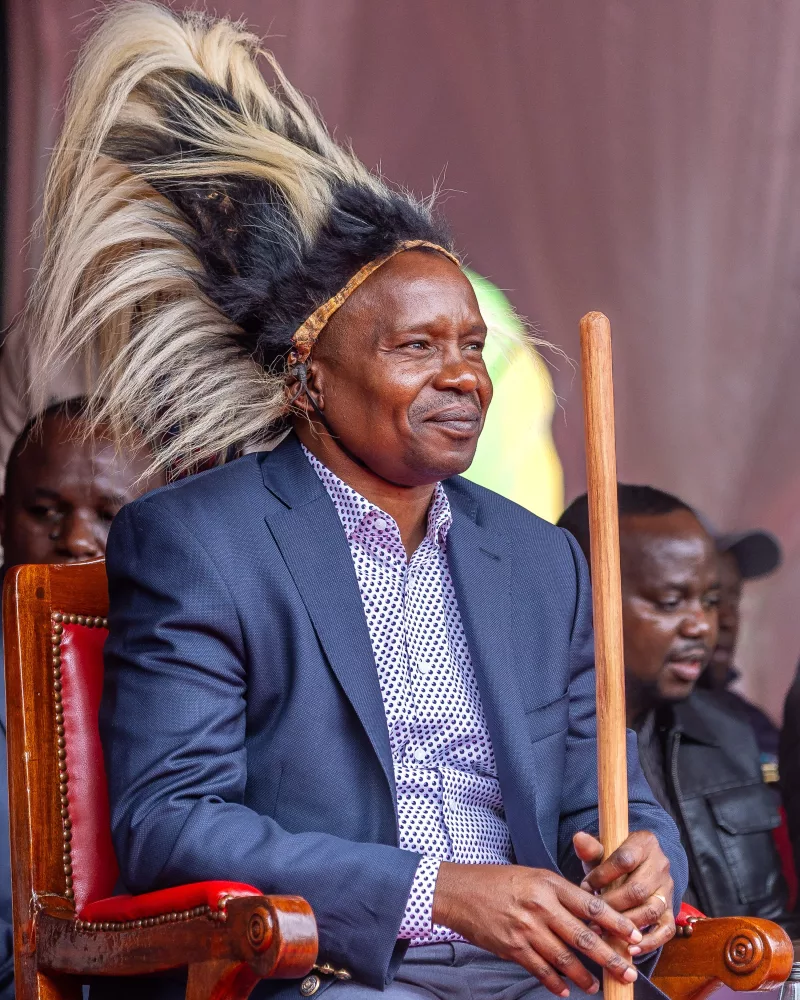
The DP has rolled out a mobilisation campaign that allies see as an attempt to settle the question of whether he has sufficient support in the mountain to retain the Deputy President’s position.
At the weekend, hundreds of elders from Mt Kenya East met in Embu and declared their support for President William Ruto’s re-election, while throwing their weight behind Kindiki as the region’s political kingpin.
The elders described Mt Kenya East as one family united by history, culture, geography and shared interests.
In the 2022 general election, Meru had 772,139 registered voters, Embu 334,302 and Tharaka Nithi 231,932, giving the three core Mt Kenya East counties a combined 1,338,373 voters, according to IEBC figures.
This makes the bloc an important prize in any contest for the presidency and the deputy president’s office.
The elders sought to turn that numerical strength into a political bargaining position, arguing that Mt Kenya East had for decades supported leaders from Mt Kenya West.
They cited Jomo Kenyatta, whom they said they supported for 15 years, Mwai Kibaki, who served as Vice President for 12 years and President for 10 years, and Uhuru Kenyatta, who was President for 10 years.
They also listed Vice Presidents Joseph Karanja and George Saitoti, as well as Gachagua.
Their message was that the political debt now needed to be repaid.
The elders urged Mt Kenya West to support Kindiki unconditionally as Deputy President and in his future ambition of becoming the first President of Kenya from Mt Kenya East.
They also sought to establish Kindiki as the principal channel through which the mountain should engage the national leadership.
The elders declared that individuals and communities seeking to engage Mt Kenya on political or development matters should do so through him.
The declaration comes hot on the heels of Kindiki being crowned a Njuri Ncheke elder and endorsed as Ruto’s running mate.
The separate events have deepened perceptions the DP is being positioned as the administration’s preferred face in the mountain.
It also comes against the backdrop of political claims that Kindiki had been stripped of some of his powers and influence.
But the public record has offered little evidence of a retreat from his role, which some quarters suggested had been offloaded to Prime CS Musalia Mudavadi.
Kindiki has continued to represent Ruto at high-level international engagements, including in Uganda and Tanzania, reinforcing his visibility as the President’s deputy.
Ruto has also publicly assigned Kindiki important coordination and explanatory roles.
During a recent meeting in Bungoma, the President referred to the Deputy President while discussing the government’s talent search programme.
He said the DP, “who coordinates between the national government and counties”, would ensure the initiative received full government support and coordination at both levels.
The role has fed into an emerging description of Kindiki as Ruto’s ‘explainer-in-chief’ as the regime seeks to make development its central message.
At the Naivasha Broad-Based Joint Parliamentary and Governors retreat, Kindiki was given 45 minutes to outline government development projects and programmes.
He delivered it without notes and without a speech, presenting an articulate, persuasive and analytical account of the administration’s agenda.
The DP performed a similar role during the launch of Vision Beyond 2030.
His mastery of government policy also played out during the first anniversary of the broad-based government at KICC and at the UDA aspirants’ forum at State House.
Ruto has repeatedly praised his deputy’s grasp of government operations and the administration’s aspirations, giving Kindiki an important platform at a time when political alignments are beginning to harden.
“On where we stand today, there is no better person who can connect between the economy, social issues, education, devolution, diplomacy better than my deputy,” Ruto said.
The declaration by the elders served to defend Ruto’s support while laying an early claim for Kindiki’s political future. It was not limited to politics.
They also asked Ruto to prioritise a dual-carriageway from Makutano through Embu, Chuka, Meru and Maua, as well as the construction of Nithi Bridge.
They argued the projects would improve connectivity, road safety and trade while easing congestion and supporting economic development across the region.
For Kindiki, the meeting sought to demonstrate that Mt Kenya East is an organised political constituency with a clear voice in the upcoming political battle, said Steve Ngari, a political analyst.
He held that the “message is particularly important as parties outside Kenya Kwanza seek to build alliances and penetrate the mountain”.
Taveta MP John Bwire said Kindiki’s strongest asset was his intellectual ability.
“One thing that stands out about Kindiki, is that even among his opponents and fiercest critics, his brilliance is difficult to dispute. This is a gifted leader. A sharp, analytical mind,” Bwire said.
He described Kindiki as “a moving brain…bright to the core.”
The challenge for the DP will now be to translate the elders’ declaration into wider popular support, particularly among younger voters and communities.
Over time, Mt Kenya has showed that political loyalties may not necessarily follow traditional elder-led endorsements.
With more than 1.33 million registered voters in Meru, Embu and Tharaka Nithi alone, Mt Kenya East is too large a bloc to ignore.
INSANT ANALYSIS
Kindiki’s fightback is therefore not simply about defending his current office but also an attempt to establish that the region has both the numbers and political organisation to demand a decisive role in the 2027 contest and in the post-2027 succession.







