Kenya’s paint manufacturers are facing growing pressure to expand production capacity as rising construction activity and increased renovation of existing properties push demand for paints and coatings to double every six to seven years.
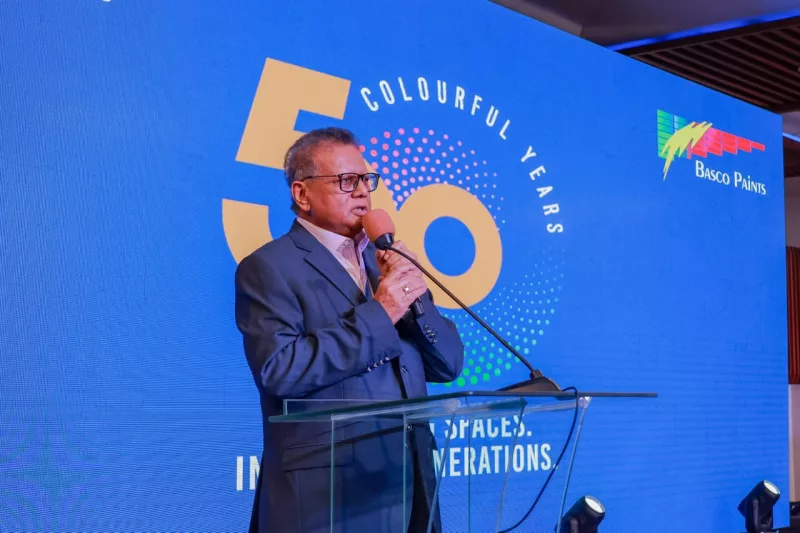
Basco Paints Managing Director Kamlesh Shah said the industry will need continued investment in factories, technology and production capabilities to keep pace with the projected growth in consumption.
“Paint being a very bulky range of products, we do need to keep on adding new production capacities and capabilities every six or seven years or so, because it tends to double up in six to seven years,” Shah said.
The expected increase in demand comes as Kenya’s construction industry continues to recover from its recent slowdown.
Data from the Kenya National Bureau of Statistics shows that the construction sector grew by 6.6 per cent in the first quarter of 2026, compared with 5.3 per cent growth for the wider economy.
The sector expanded by 6.8 per cent in 2025 after contracting by 0.7 per cent in 2024, signalling a recovery in one of the key sources of demand for paints and other construction-related products.
However, Shah said the industry's growth is not dependent solely on new buildings.
Paint consumption is also being driven by the maintenance and refurbishment of existing homes, offices and commercial properties, creating a recurring source of demand even when new construction slows.
“The consumption is more than the GDP growth of the country. It’s more like double-digit consumption, and we are fortunate to be in line with that,” Shah said.
The growth outlook is likely to require manufacturers to make large and regular capital investments because paint production is capital intensive and new plants and equipment take time to pay back.
Shah said manufacturers cannot expect to recover investments in production facilities within a few years, meaning companies have to take a long-term approach when planning capacity expansion.
“The amortisation of the capital expenditure is not very quick. You can’t say in three, four years I’ll have freed my plant. It takes you much longer,” he said.
Kenya already has one of Africa’s largest paint markets, providing a sizeable base for further investment.
According to IndexBox data cited by the company, Kenya consumed about 156,000 tonnes of paints and varnishes in 2024, making it Africa’s second-largest consumer after Algeria, which consumed about 168,000 tonnes.
Kenya was also the continent’s largest producer, with estimated output of 162,000 tonnes in the same year, ahead of Algeria at 152,000 tonnes and Uganda at 89,000 tonnes.
In value terms, Kenya’s paint and varnish market was estimated at about Sh43.9 billion in 2024, highlighting the scale of the industry and the potential returns for manufacturers able to capture rising demand.
The capacity expansion push is also being driven by the need for manufacturers to remain competitive in regional markets.
Kenyan producers exported about 6.76 million kilograms of water-based paints and varnishes worth approximately Sh1.1 billion in 2024, according to World Bank trade data.
The Democratic Republic of Congo was the largest destination, followed by South Sudan, Rwanda, Burundi and Uganda.
Kenya also exported about 1.19 million kilograms of non-water-based paints and varnishes valued at roughly Sh200 million, with DRC, Uganda and Tanzania among the main markets.
This regional demand gives manufacturers an additional incentive to invest in production capacity beyond the domestic market.
However, expanding capacity comes against a backdrop of continued competition from imported products.
Kenya imported about 1.01 million kilograms of non-water-based paints and varnishes worth approximately Sh453 million in 2024. Italy, the United Arab Emirates, China, India and Egypt were among the main suppliers.
The industry's investment requirements also extend beyond factories and machinery. Manufacturers are increasingly investing in research and development as consumers demand more specialised products, including waterproof coatings, water-based gloss paints and lead-free products.
Shah said at least 20 per cent of Basco’s combined advertising, brand perception and research and development budget goes towards research and development.