KENYAN businesses are pushing for urgent reforms to unlock the East African Community (EAC) market.
This, as they warn that non-tariff barriers, border delays, high logistics costs and fragmented regulations are undermining the region’s potential to become a major investment and production hub.
The call emerged from the CEOs–Trade and Investment Roundtable held in Nairobi, where business leaders and policymakers said East Africa’s estimated $400 billion (Sh51.7 trillion) economy presents a significant growth opportunity for Kenyan companies seeking to expand beyond the domestic market.
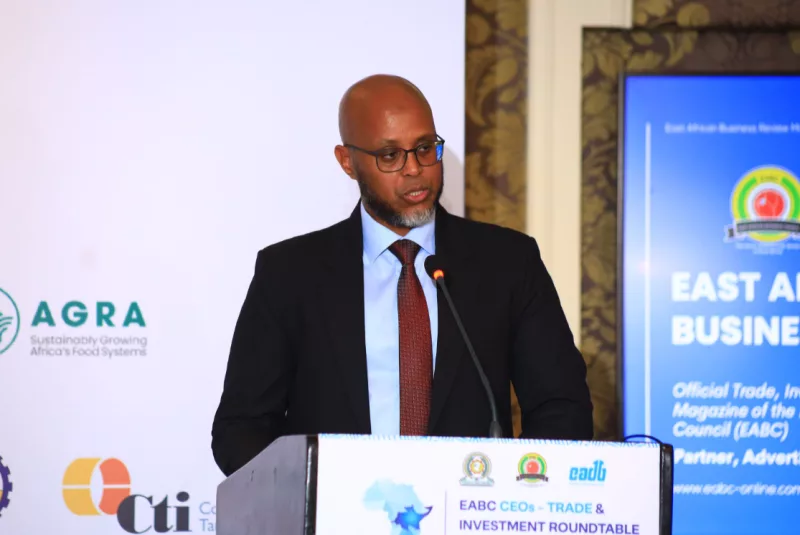
East African Business Council (EABC) executive director, Ahmed Farah, said the regional bloc should be viewed as Kenya’s next major growth frontier.
With intra-EAC trade at about $19.7 billion (Sh2.5 trillion) , representing roughly 12.5 per cent of total EAC trade, Farah said there was considerable room to expand commerce, investment and production across the region.
“Our priority must be to make the EAC a more competitive and predictable market for business,” Farah said, calling for the removal of non-tariff barriers, harmonisation of standards, lower logistics costs and consistent implementation of regional commitments.
The private sector argues that improving regional integration could allow Kenyan manufacturers and service providers to access a much larger consumer base while encouraging investment in regional value chains.
Kenya Investment Authority (KenInvest) CEO John Mwendwa said East Africa is already attracting a significant share of investment flowing into the continent.
According to figures cited at the meeting from a recent UNCTAD report, Africa attracted about $70 billion in foreign direct investment, with East Africa receiving approximately $14.6 billion, equivalent to about 21 per cent of the continental inflows.
Mwendwa said investors are looking for scale, predictability, talent, market access and opportunities to participate in regional value chains.
He urged EAC countries to move away from competing against each other for investment and instead build complementary production networks in which countries source inputs across borders and specialise in areas where they have competitive advantages.
He also called for greater digital integration and interoperability of government systems to reduce the cost and time involved in cross-border trade.
The concerns were echoed by Duncan Onyango, chief executive of Trade Catalyst Africa, who said competitiveness goes beyond the ability of a company to manufacture quality products.
For businesses, he said, the critical questions are whether they can finance production, fulfil orders, receive payment and make a profit after navigating the costs of moving goods across borders.
Onyango identified trade corridors, SME financing and systems of trust, liquidity and investment as three areas requiring urgent attention.
He warned that poor transport infrastructure, clearance requirements and weak systems can erode the competitiveness of businesses even after they have invested in modern machinery and production capacity.
The challenge, he added, extends beyond physical infrastructure.
Different currencies, inflation conditions, financial systems, reserve constraints and risk profiles continue to complicate cross-border trade and investment, making financial integration an important component of the regional integration agenda.
The meeting also highlighted the size of the opportunity available to East African businesses.
Ashif Kassam, executive chairman of RSM Eastern Africa LLP, said the EAC had eight Partner States and a population of more than 360 million, but warned that the region had yet to convert this scale into a genuinely integrated market.
Intra-regional trade accounts for only about 15 per cent of total EAC trade, according to figures presented by Kassam, although it grew by 28 per cent in 2025.
He estimated that between 30 and 50 per cent of the region’s trade potential remains unrealised.
Kenya’s economy was put at approximately $136 billion, with exports valued at $8.3 billion against imports of $20.2 billion.
Kenya recorded GDP growth of 5.3 per cent in the first quarter of 2026, up from 4.9 per cent during the same period in 2025, while foreign exchange reserves stood at $15.4 billion, equivalent to 6.5 months of import cover.
Kassam identified non-tariff barriers, regulatory fragmentation, border delays, high logistics and electricity costs, weak digital integration, cross-border payment difficulties and policy uncertainty among the major constraints holding back regional investment.
For Kenyan companies, the removal of these barriers could open opportunities in manufacturing, logistics, agriculture, tourism, financial services and other sectors where regional demand is growing.
The private sector has also urged governments to move beyond signing regional agreements and focus on implementation.
Among the proposals emerging from the roundtable were time-bound mechanisms for resolving non-tariff barriers, including compensation for businesses affected by unjustified trade disruptions.
Business leaders also want increased investment in port, road, rail and multimodal transport infrastructure, alongside simplified border procedures and stronger freedom of transit.
They called for harmonisation of standards, regulations, licensing requirements and professional qualifications to enable companies and skilled workers to operate more easily across borders.
Another major priority is the development of interoperable regional payment systems to lower the cost of cross-border transactions.
The tourism sector also stands to benefit from deeper integration. Participants proposed expanding and digitalising the East Africa Tourist Visa, advancing open skies to reduce regional air travel costs and promoting mutual recognition of tour guides and professional services.
The recommendations are particularly significant for Kenya, which has positioned itself as a regional logistics, financial and commercial hub.
The business community wants the country to strengthen that position by developing regional value chains and using its infrastructure, financial services and entrepreneurial ecosystem as a platform for companies serving the wider East African market.
Angela Muga, country manager at the East African Development Bank (EADB), said the bank was supporting private-sector expansion through long-term financing and sector expertise in areas including agriculture, agro-processing, manufacturing, infrastructure, renewable energy and climate-related investments.
She encouraged businesses and small and medium-sized enterprises to engage with EADB to explore financing opportunities for expansion across East Africa.
The private sector forum also brought together representatives from the Kenya Association of Manufacturers, Shippers Council of Eastern Africa and Kenya Association of Tour Operators.
They identified inadequate infrastructure, high transport costs, regulatory fragmentation, costly regional air travel, limited payment interoperability and differences in standards and professional qualifications as key obstacles to competitiveness.