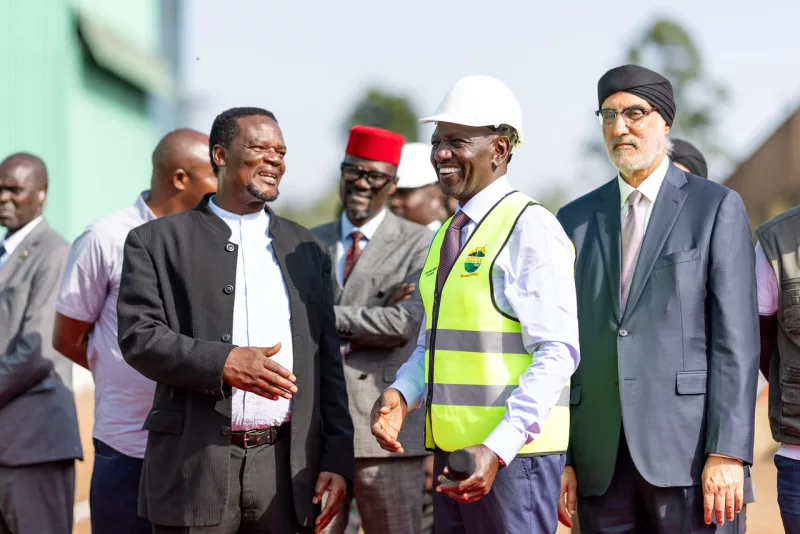
 Sirisia MP John Waluke, Didmus Barasa, President William Ruto and businessman Jaswant Rai at Nzoia sugar factory on August 14, 2026/PCS
When William Ruto took office in September 2022, he inherited an economy under severe pressure, a sharply weakened shilling, high inflation and a public anxious about the cost of food, fuel and basic services.
Four years later, the president can point to a substantial list of achievements: inflation has fallen, the currency has stabilised, subsidised fertiliser is considerably cheaper, infrastructure construction has accelerated, thousands of teachers have been recruited and millions of Kenyans have been registered under the new Social Health Authority.
But the same four years have also exposed the limits of the administration's “bottom-up” economic promise.
The cost of living remains politically sensitive, youth employment remains unresolved, healthcare reforms have been troubled and some of the government's most impressive statistics have been challenged by independent fact-checkers.
The fairest assessment of the Ruto presidency at four is therefore neither triumphalist nor dismissive. It is a record of substantial progress, several delivered reforms and a large number of promises still underway.
The government's strongest case is the economy. Inflation, which stood at about 9.2 per cent when Ruto took office, has fallen to about 4.1 per cent by 2026, according to the president's own current scorecard.
The administration says the figure has remained within the Central Bank's target band, while the shilling has stabilised around Sh129 to the dollar after a period of severe depreciation.
That is a meaningful achievement. Lower inflation gives households and businesses greater predictability, while a more stable currency reduces pressure on imported goods and foreign-currency debt.
The government also points to foreign-exchange reserves of more than $15 billion and stronger exports as evidence that macroeconomic stability has been restored. On economic stabilisation, the verdict is substantially delivered.
But macroeconomic stability has not automatically translated into a cheap cost of living. This is one of the central contradictions of Ruto's first four years.
Inflation falling means prices are increasing more slowly; it does not mean that prices have returned to what they were before 2022. Fuel, food, housing and taxation have continued to weigh heavily on households. In April 2026, for example, the government was forced to respond to renewed fuel-price pressure by cutting some taxes for a limited period.
Africa Check also found several of Ruto's claims about fuel prices and Kenya's paved-road network misleading or incorrect.
“That makes the pledge to transform the lives of ordinary households underway rather than delivered,” Africa Check stated.
Agriculture provides a more tangible example of the administration's policy shift. In 2022, a 50-kilogramme bag of fertiliser cost more than Sh7,000, while maize flour reached around Sh250 for a two-kilogramme packet.
The government introduced a fertiliser subsidy that brought the price down to about Sh2,500. It also expanded the digital registration of farmers through KIAMIS, with millions now registered. The attached government scorecard records the maize flour price at Sh165, while the fertiliser price is recorded at Sh2,500.
These are substantial interventions, and farmers have clearly benefited from cheaper inputs.
The administration can also point to higher agricultural production and increased dairy and livestock exports. However, this is an area where caution is necessary. Independent fact-checking has challenged some of the government's claims about maize production, imports and agricultural earnings. Africa Check's examination of Ruto's broader scorecard found that several agricultural claims were unsupported or incorrect.
“The agricultural transformation should therefore be rated substantially delivered, rather than fully delivered. The policy reforms are real, but the government's claims about their scale should be treated more carefully.”
Affordable housing is arguably the defining project of the Ruto administration. The original promise was ambitious: hundreds of thousands of affordable homes every year, eventually reaching one million units during the first term.
Government figures supplied in the attached scorecard show more than 260,000 units launched or under construction, compared with 8,872 in the 2022 baseline. The current presidential scorecard puts the figure at more than 262,000 units under construction across all 47 counties.
The programme has also become a major part of the government's economic strategy, linking housing to construction, manufacturing, small businesses and employment.
But there is a crucial difference between homes under construction and homes completed and occupied. Independent fact-checking has also questioned the administration's changing claims about jobs created by the housing programme.
Africa Check found that the government's earlier claims of hundreds of thousands of new construction jobs were not supported by available employment data.
The housing programme is therefore best rated underway. It is one of the clearest examples of a manifesto promise moving from rhetoric into a large physical programme, but it has not yet achieved the full annual delivery target.
Infrastructure presents a similar picture. According to the attached scorecard, more than 2,669 kilometres of new tarmac roads had been built by March 2026.
The administration has also expanded markets, railway cargo, port operations and aviation capacity. SGR and MGR cargo haulage has risen to more than eight million metric tonnes, while Mombasa port container traffic reached two million TEUs. Passenger traffic through Kenyan airports has also increased.
These developments demonstrate real investment in transport and logistics. Yet the administration itself has acknowledged that much more remains to be done.
Ruto's government has spoken of constructing 6,000 kilometres of new roads and upgrading more than 100,000 kilometres of existing roads. The 2,669 kilometres reported so far therefore represent significant progress, but not completion of the wider pledge.
The infrastructure verdict is underway.
Healthcare is perhaps the most politically complicated reform. The government abolished NHIF and replaced it with the Social Health Authority, seeking to create a universal health insurance system. More than 28 million Kenyans had been registered according to the scorecard supplied, while the administration's current figures put registration above 31 million.
Registration is an important achievement, but it is not the same as universal access to quality healthcare.
The SHA has faced complaints about registration, claims processing, reimbursement delays and access to services. The central promise was not simply to create a new institution; it was to ensure that Kenyans could obtain healthcare without the financial hardship that has historically accompanied illness.
On that test, the reform remains underway, while the promise of truly seamless and comprehensive universal healthcare is still unmet.
Education has produced a more straightforward result. Ruto's administration has recruited tens of thousands of teachers to address shortages created by increasing enrolment and the expansion of Junior Secondary School under the competency-based system. Parliament reported that 76,000 teachers had been hired, with another 24,000 targeted, bringing the total to about 100,000.
That is a significant intervention, although Kenya still faces a major teacher shortage. The verdict is therefore substantially delivered: the government has made a serious dent in the problem but has not eliminated it.
Ruto's political identity was built around the hustler economy and the pledge to expand opportunities for young people. The administration can point to digital employment, the Hustler Fund, overseas labour placement and housing-related employment. Its current scorecard says hundreds of thousands of Kenyans have secured overseas jobs, while more than 300,000 have benefited from digital-work programmes.
The Hustler Fund has also become one of the administration's flagship financial-inclusion programmes, providing small loans to millions of borrowers. These are meaningful interventions. But they do not amount to solving Kenya's structural unemployment problem.
This is where the administration's promise is best rated underway. It has created programmes and opportunities, but the larger political promise of mass, secure employment for young Kenyans remains unfinished.
Governance is another weak point. Ruto campaigned on reducing waste, improving accountability and running a more efficient government. Instead, his administration has repeatedly faced controversy over taxation, public spending, appointments and the size of government.
The 2024 Finance Bill became the defining crisis of his presidency. Faced with nationwide protests, the president withdrew the legislation, demonstrating that public resistance could force a major policy reversal.
The episode exposed a fundamental problem; fiscal consolidation may be economically necessary, but it becomes politically difficult when citizens believe they are being taxed without receiving sufficient improvements in services and living standards.
On governance reform, the verdict is stalled.
So, what should Kenyans make of the Ruto record after four years?
The evidence points to a presidency that has delivered more than its critics sometimes acknowledge, but less than its supporters sometimes claim.
Its strongest achievements are macroeconomic stabilisation, cheaper fertiliser, expansion of teacher recruitment, large-scale housing construction, infrastructure investment, digital employment programmes and the creation of new institutions such as SHA. Several of these programmes are already changing the physical and institutional landscape of the country.
But the administration's weaknesses are equally significant. The cost of living remains a political vulnerability. Youth unemployment has not been solved. Universal healthcare remains an aspiration rather than a seamless reality. Housing targets have not been fully achieved. Governance reforms have been slowed by legal, political and constitutional obstacles. And some of the government's headline statistics have not survived independent scrutiny.
Ruto's first four years have not been a story of failure, nor have they fulfilled the sweeping transformation promised in 2022. They have been years of major economic and institutional reforms, visible construction and significant policy experimentation, alongside public frustration over taxation, jobs and the cost of living.
The president's own 2026 message is revealing; he says the country has laid the foundation and that the next phase will focus on completing major infrastructure, expanding irrigation, creating jobs and consolidating economic transformation.