
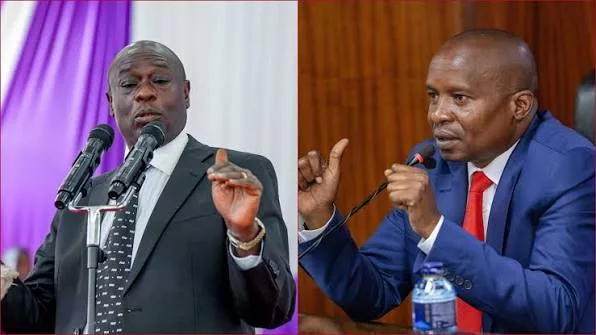
 A collage of former deputy president Rigathi Gachagua and his predecessor Kithure Kindiki./FILE
Former Deputy President Rigathi Gachagua and his successor Kithure Kindiki have traded barbs over the unity of Mt Kenya, with Gachagua accusing the Deputy President of allowing himself to be used to divide the region.
Speaking during a tour of Kiambu County, Gachagua said Kindiki could not claim to be his brother while supporting efforts to split Mt Kenya into eastern and western political blocs, warning that such a move would weaken the region.
“You cannot be my brother when you are dividing the mountain. You cannot be my brother when you are joining others to send poisonous alcohol to kill my people. If you want to be my brother, stop dividing the mountain and stop hurting Kikuyu people with illicit alcohol,” Gachagua said.
Gachagua's remarks came days after Kindiki visited Murang’a County, where he called for unity among Mt Kenya communities. However, Kindiki later posted a cryptic message on Facebook saying, "The fathers of the land, the landlords, have spoken. East first, West next, then Kenya will speak.”
The former deputy president interpreted the developments as part of a wider attempt to weaken Mt Kenya's political unity, insisting that dividing the mountain was as difficult as cutting down a Mugumo tree with a razor blade.
Gachagua also accused the Deputy President of failing to protect Central Kenya from illicit alcohol.
He claimed young people were dying from poisonous alcohol, saying families in the region were burying young people every week because of the illicit brews. He linked the problem to what he described as failures by the government to deal with the crisis.
But Kindiki responded to Gachagua through social media, dismissing the former deputy president's attacks and accusing him of having an unimpressive record in public service and leadership.
“Talking about my voice is the only contribution your emptiness and incompetence can make in matters of politics, policy and leadership,” Kindiki said.
The Deputy President also rejected Gachagua's account of their time in government, saying that while he served as Interior Cabinet Secretary, his focus was on fighting banditry, terrorism and crime rather than political mobilisation.
“I was focused on protecting Kenya from bandits, terrorists and criminals as you were building hotels, acquiring land and inciting people against the same government that you were serving as Deputy President,” Kindiki said.
Kindiki accused Gachagua of attempting to undermine the government they helped form after falling out with Ruto. He said he had advised the former deputy president to repair his relationship with the President and other leaders but was ignored.
He said he had instead chosen to remain in government and pursue the interests that had motivated their election campaign, including roads, markets, electricity and better returns for coffee and dairy farmers.
The clash comes amid a growing campaign over the political future of Mt Kenya. The proposed division centres on Mt Kenya East—Meru, Embu and Tharaka Nithi—and Mt Kenya West, comprising Kiambu, Murang’a, Nyeri and Kirinyaga.
Leaders from the Eastern part of the region have been increasingly calling for the splitting of the mountain, claiming that the West has historically dominated the region's political leadership, while the East has often been expected to provide votes without receiving a proportionate share of power.
Gachagua and his allies maintain that splitting the mountain would diminish its bargaining power.
The dispute has placed Kindiki, who comes from Tharaka Nithi, at the centre of the debate, even as he has publicly called for unity among Mt Kenya communities.
Gachagua, meanwhile, has intensified his mobilisation through his party as the united opposition seeks to expand its support in Central Kenya and attract leaders from the Kenya Kwanza camp.
With rival camps seeking to shape the region's political direction, the Gachagua-Kindiki exchange is likely to deepen the contest over whether Mt Kenya remains united or enters the next election divided along eastern and western lines.







