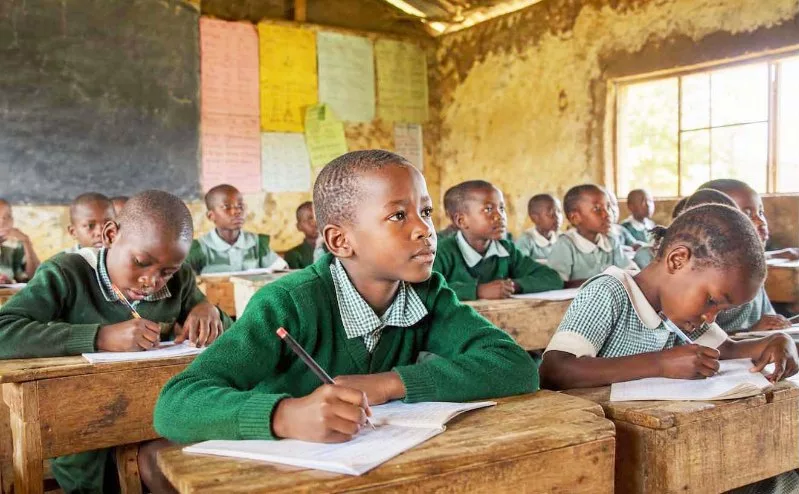
A desire to do something provides a powerful motivation for a student to learn more than the expectation to become something /AI IMAGE
"The test of any man lies in action." —Pindar
Last year, I attended a prayer session for KCSE exam candidates at a school in Kakamega county.
The guests who spoke before me urged the students to do well and become engineers, doctors, lawyers, teachers, nurses and other occupations available in the job market. The careers would be theirs to study in universities and middle-level colleges.
This was a familiar theme I had heard for more than 30 years of my working life. Most of the speakers who addressed students during district education days or annual general meetings almost always urged the students to aim at becoming this or that professional.
There was nothing really new that the students had not heard—from their parents, guardians, teachers and motivational speakers.
Excelling in KCSE meant a student was likely to study courses that led to engineering, medical, legal and teaching professions, among others.
What the students did not know or were not told was that ambition or dream should go beyond becoming engineers, doctors, lawyers, teachers or nurses. It should be more about what the students want to do with their lives after formal education and training.
But a bright student with sufficient motivation and a functioning primary and later, secondary school, can excel in KCSE and qualify for university education.
The more challenging part, however, is what the student will do with himself once he becomes what he worked hard for.
Whatever a student wants to become is easy to attain. Hard work, diligence, focus and discipline. Instilled with all these, the student wakes up one day at a graduation ceremony and later finds himself in the occupation he dreamt of. Or in another totally different profession that is equally clearly exciting and rewarding.
However, the excitement slowly loses its power or sheen immediately after. Why? The power to earn a living is not the essence of life. One gets to learn this when his job or work sufficiently provides the material comforts of life.
A listening and kindly God answer his prayer or dream. Once the dream is attained, he has nothing to live for thereafter. What drives him thereafter?
What remains for the majority of us is a feeling of triumph, of having arrived. The danger is, we fall into what English poet William Wordsworth termed in his poem, The world is too much with us. The danger is that all we do is “Getting and spending, we lay waste our powers/ Little we see in Nature that is ours. We have nothing to live for anymore."
Former Liberian President Ellen Johnson Sirleaf warned Harvard University students against embracing small dreams in a graduation speech in 2011.
She observed: “If your dreams do not scare you, they are not big enough. If you start off with a small dream, you may not have much left when it is fulfilled because along the way, life will challenge your dreams and make demands on you.”
Little dreams do not spawn heroic men and women. Rather, men who have little capacity to, in the words of Wordsworth’s other poem entitled London, “raise us up, return to us again/And give us manners, virtue, freedom, power.”
Where can students get the motivation to think about big dreams, big aspirations? They can glean big dreams from books. Excellent fictional and nonfictional works. Works of this kind teem with issues, problems, challenges and crises.
Within their immediate environment are people doing things that greatly improve the lives of others. Within the mass media are people working on or for causes. The environment—social, physical and political and economic—is ever teeming with issues, problems, challenges and crises. They need people to address them.
An intelligent student looks around and gets annoyed. He or she may resolve: “When I get the opportunity, will I do something about this? Let me study and God willing, I will do something about this or that problem.”
A desire to do something provides a student with a powerful motivation to learn more than the expectation of becoming something. The student sees himself as an agent on behalf of something bigger than himself. A kind of Hercules, the mythical Greek hero, who faced challenges. Such a person does not study for examinations, important as they are, but to deepen his capacity.
This is what the lives of benefactors of mankind teach us. Statesmen and stateswomen, scientists, inventors, teachers, journalists, saints. They saw wrong in society and prepared themselves to correct wrongs or improve lives. They worked to prepare themselves for the opportunity to tackle a social problem.
I have in mind such men as US President Abraham Lincoln and UK Prime Minister Margaret Thatcher. Lincoln preserved the Union and ended the legal foundation of slavery in the USA—within four years of his term. Thatcher propelled an economically troubled Britain back among the leaders of the industrial nations.
You do not need to be a president to help society deal with its existential threats to its stability and well-being. Wilhelm von Humboldt, as a Minister of Education in the Prussian government, initiated reforms in elementary, secondary and higher education that still inform education in Germany and university education around the world.
We had Dr Taita arap Towett as Minister for Education in the 1970s. He presided over vibrant primary schools across the country. It did not matter which school you went to for your primary education. They gave us strong literacy and numeracy skills, preparing us well for secondary education, work and training in what was then called village polytechnic.
John Michuki. Whatever he touched became big—public transport, security in Central, rehabilitation of the Nairobi River.
These were Kenyans who were not limited by holding exalted positions. They took up arms against a sea of troubles and, by opposing, ended them, to paraphrase Shakespeare’s Hamlet.
Becoming is nothing. Doing is the thing. You are a symbol, an agent of something bigger than your ego. You are mindful of what an institution, community or a nation represents. It represents something awesome. Telos. The word mandate is too mundane to capture the ultimate essence of any institution, big or small.
“What does it mean to have such a distinguished privilege? It means that you have the opportunity to serve others and to become an agent for the kind of positive change this world needs, with the talent and courage to act and to do what so many have said was impossible,” former Mexican President Felipe Calderón noted, in a graduation speech at Stanford University in 2011.
Education, and higher education in particular, gives students ‘the opportunity to serve others and to become an agent for the kind of positive change this world needs, with the talent and courage to act and to do what so many have said was impossible’.
Working hard with an eye to becoming is important. However, that alone creates frustration and malaise in professionals and other workers.
They must have identified early on what they want to do for society.
The writer is a communications professional