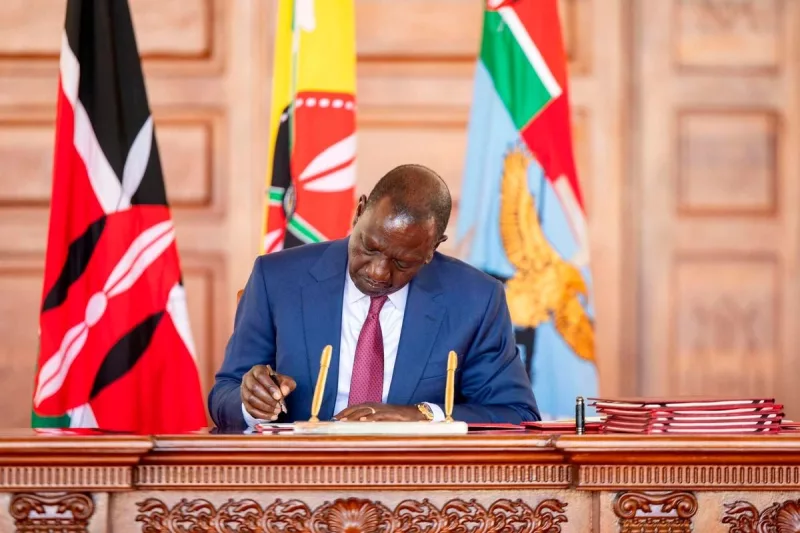
 President William Ruto signs a document at State House, Nairobi. /FILE
President William Ruto's Kenya Kwanza administration has introduced a raft of new taxes and statutory contributions, while raising rates, widening tax bases and tightening enforcement of several taxes inherited from previous administrations.
The government has termed the measures an essential "bitter pill" needed to rescue Kenya from a crushing debt crisis, achieve financial self-reliance and fund grassroots development projects.
As the September 13 fourth anniversary of the administration draws closer, the President and government officials continue to argue that Kenya is historically undertaxed relative to its Gross Domestic Product (GDP) compared to regional peers, making expansion of the tax base a technical necessity for long-term growth.
They have maintained that new laws and tighter enforcement do not squeeze ordinary citizens, but rather close loopholes for the wealthy, target cheats and ensure everyone pays a "fair share" of taxes.
The administration frames higher revenue collection as the only viable path to stop taking on expensive foreign commercial debt and structural adjustment loans that mortgage the country's future.
Intense public pushback and youth-led anti-tax protests forced the administration to make adjustments and pivot away from blanket tax hikes, but public outcry has continued nonetheless over some of the tax measures.
Some of the most visible changes are entirely new levies introduced under Ruto, while others involve taxes that existed before he took office but whose rates, thresholds or application have changed during his administration.
New levies introduced under Ruto
Affordable Housing Levy: The Affordable Housing Levy became effective in July 2023 following the enactment of the Finance Act 2023.
It imposes a mandatory 1.5 per cent deduction from a salaried employee's gross monthly pay, with a matching employer contribution to fund affordable housing units and related social infrastructure.
Contributors may benefit through access to affordable home ownership via Boma Yangu through monthly tenant-purchase payments spanning up to 30 years for studio to three-bedroom units.
The levy is one of the clearest examples of a new statutory charge introduced under the Kenya Kwanza administration. KRA began collecting it in 2023.
Social Health Authority (SHA): The Social Health Authority (SHA), introduced under the Social Health Insurance Act, 2023, became fully operational on October 1, 2024, replacing the former National Health Insurance Fund (NHIF).
Unlike a conventional tax, the 2.75 per cent payment is a statutory health insurance contribution.
It is nevertheless a significant additional deduction from employment income.
The contribution is based on gross salary and goes towards the Social Health Insurance Fund (SHIF).
The lowest possible contribution is Sh300 per month, while there is no maximum limit, meaning the amount rises with earnings.
For instance, a gross Sh15,000 salary translates to a monthly contribution of Sh412.50, while Sh150,000 gross pay translates to Sh4,125.
Digital Asset Tax — replaced by an excise duty: The government initially introduced the Digital Asset Tax (DAT) through the Finance Bill, 2023, targeting income derived from the transfer or exchange of digital assets.
The proposed 3 per cent tax attracted significant opposition before the government abandoned it and replaced it with an excise duty on fees charged by virtual asset service providers.
The change illustrates how the administration has adjusted some of its tax proposals following public and industry pressure rather than implementing the original measures unchanged.
Existing taxes whose rates or application changed under Ruto
VAT on petroleum products: Value Added Tax on petroleum products was introduced before the Ruto administration, with the 16 per cent rate taking effect in September 2018.
The Kenya Kwanza administration inherited the tax at 8 per cent rate before the Finance Act 2023 deleted the preferential 8 per cent rate and retained the standard 16 per cent rate.
Amid mounting global fuel prices that spiked local pump prices to a record high in April 2026, Parliament passed legislation reducing VAT on petroleum products from 16 per cent to 8 per cent.
The reduced rate was subsequently extended for a further three months and is currently due to remain in force until October 14, 2026.
In the absence of a further extension, the applicable rate would revert to 16 per cent.
Enhanced NSSF contributions:
Although not a tax, the National Social Security Fund (NSSF) is a mandatory pension and retirement savings scheme whose contribution requirements have been substantially increased during the Ruto administration.
Both employers and employees contribute towards NSSF based on tiered pensionable earnings.
The higher contribution rates mean increased statutory deductions from workers' pay, although the payments are intended to build members' retirement savings rather than finance general government expenditure.
Expanded PAYE
Pay As You Earn (PAYE) is another tax inherited from previous administrations rather than one introduced by Ruto.
The Kenya Kwanza administration has, however, expanded the PAYE bands and raised the top marginal rates.
Under changes implemented from July 2023, monthly employment income above Sh500,000 and up to Sh800,000 became subject to a 32.5 per cent rate, while income above Sh800,000 became subject to a 35 per cent rate.
The changes increased the tax burden on higher-income earners while maintaining personal relief arrangements for lower-income workers.
Turnover Tax
Turnover Tax is also not a new Ruto administration tax. It was first introduced in 2007 and later reintroduced in 2020 after being dropped in 2019.
However, the Kenya Kwanza administration changed the tax through the Finance Act 2023, raising the rate from 1 per cent to 3 per cent with effect from July 1, 2023, and reducing the upper turnover threshold from Sh50 million to Sh25 million.
The tax applies to resident businesses with annual gross turnover of more than Sh1 million but not exceeding Sh25 million.
This means the Kenya Kwanza administration did not create Turnover Tax but made it more costly for businesses within the affected band.
Capital Gains Tax
Capital Gains Tax (CGT) also predates the Ruto administration. It is a tax on gains arising from the transfer of property and certain other assets.
The current rate is 15 per cent of the net gain, rather than 15 per cent of the entire sale price.
The changes were made partly after businesses complained that they were being taxed even on losses.
The tax is therefore paid on the profit arising from a qualifying transfer, subject to applicable exemptions and deductions.
The Kenya Kwanza administration has retained CGT as part of its broader effort to increase revenue from property and investment transactions.
Export and Investment Promotion Levy (EIPL)
The Export and Investment Promotion Levy is a customs levy introduced before the Ruto administration and subsequently used as part of the government's industrial policy.
It is charged on specified imported goods and is intended to promote local manufacturing by making selected imports more expensive.
The measure fits within the administration's broader "Buy Kenya, Build Kenya" agenda, which seeks to shift demand towards domestically manufactured goods.
What the changes mean for taxpayers
Taken together, the measures show that Ruto's tax record is not simply a story of creating new taxes.
The administration introduced new charges such as the Affordable Housing Levy and the health insurance contribution under the new SHA framework.
At the same time, it changed the rates, thresholds or application of long-standing taxes such as PAYE, VAT and Turnover Tax.
For households, the effect has been felt through direct payroll deductions, higher taxes on some income bands and changes in the prices of goods and services.
For businesses, the impact has included higher compliance requirements, changes in turnover-tax obligations and measures designed to broaden the tax base.
The distinction is important because the tax burden under Ruto cannot be measured only by counting new taxes.
It also reflects how his administration has altered the rates and reach of taxes that Kenyans were already paying before he took office.