 The negotiations will continue, with the next session scheduled to take place in Nairobi from November 30 to December 11. /JACKTONE LAWI
 African countries have made progress towards agreeing on common rules for how multinational companies should price transactions when moving profits between their operations in different countries.
The c0ntinent’s tax advocacy experts say the move could help governments protect tax revenues by sealing pricing loopholes that have initially been exploited to facilitate illicit financial flows.
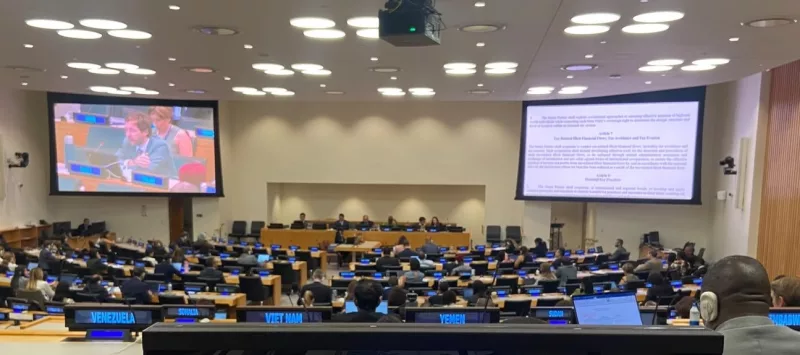
This is among the breakthroughs of the just concluded 5th session of negotiations for a UN Framework Convention on International Tax Cooperation that took place at the UN Headquarters in New York.
The discussions are aimed at addressing a long-running challenge facing African tax authorities in determining whether multinational companies are using fair prices when transferring goods, services, loans or other payments between companies within the same group.
For Kenya, the issue is significant because multinational companies operating in sectors such as banking, manufacturing, technology, telecommunications and consumer goods regularly conduct business between their local subsidiaries and parent companies or other related businesses abroad.
Under the emerging framework, countries would have clearer and more consistent ways of determining the value of such transactions when calculating how much profit should be taxed locally.
The goal is to prevent a multinational from artificially reducing the profits reported in Kenya by, for example, paying unusually high amounts to a related company in another country.
Global Alliance for Tax Justice, executive coordinator Dereje Alemayehu, said the latest negotiations showed that countries were increasingly focused on making the international tax system fairer.
He said the talks were addressing fundamental questions around how countries share the right to tax multinational companies, how wealthier individuals are taxed and how to make the global tax system more transparent.
“The session saw strong engagement on these topics showing that the debate is open and moving forward. As civil society, we are calling for continued ambition as the negotiations progress,” said Alemayehu.
What the latest breakthrough means is that a company operating in Kenya could, for instance, buy management services from its parent company abroad.
If the Kenyan subsidiary pays an inflated amount for those services, its costs rise and its taxable profit falls.
The proposed approach seeks to ensure that such transactions are priced at levels that reflect what independent businesses would reasonably pay.
The work forms part of wider efforts by African countries to strengthen their ability to collect domestic revenue and reduce tax losses linked to cross-border business.
The lack of a clear and standard pricing system has seen the continent miss out on revenues that would otherwise have been put to public good services.
According to the Tax Justice Network Africa (TJNA), Africa loses an estimated $89 billion (Sh11 trillion) to $90 billion (Sh11.64 trillion) annually to illicit financial flows (IFFs) as of 2024.
These losses are driven largely by tax evasion, commercial profit-shifting, trade misinvoicing, and harmful tax incentives, particularly within the extractive sector.
It also comes as countries negotiate a new United Nations Framework Convention on International Tax Cooperation, with the Africa Group playing a leading role in pushing for changes to the global tax system.
In the the fifth round of UN negotiations governments discussed proposals covering cross-border services as well as ways of preventing and resolving tax disputes.
The proposals would also allow countries to agree in advance on how certain transactions between related companies should be treated for tax purposes.
This would give businesses greater certainty while reducing the risk of lengthy disputes with tax authorities.
A company could, for example, approach tax authorities before carrying out a major transaction and establish how it would be treated for tax purposes.
The proposed rules are also targeting the use of low-tax countries to move profits away from the countries where businesses generate their revenues.
The broader negotiations include rules covering digital businesses such as online advertising, search engines, cloud computing and social media platforms.
For Kenya and other African countries, the digital economy presents a particular challenge because companies can earn substantial income from local consumers without having a large physical presence in the country.
The proposed global rules seek to give countries greater rights to tax income generated from services provided to their residents.
The UN negotiations were initiated by the Africa Group with support from other developing countries. Supporters say a new global tax framework could help African governments raise more revenue for public services, infrastructure and development.
The negotiations will continue, with the next session scheduled to take place in Nairobi from November 30 to December 11.