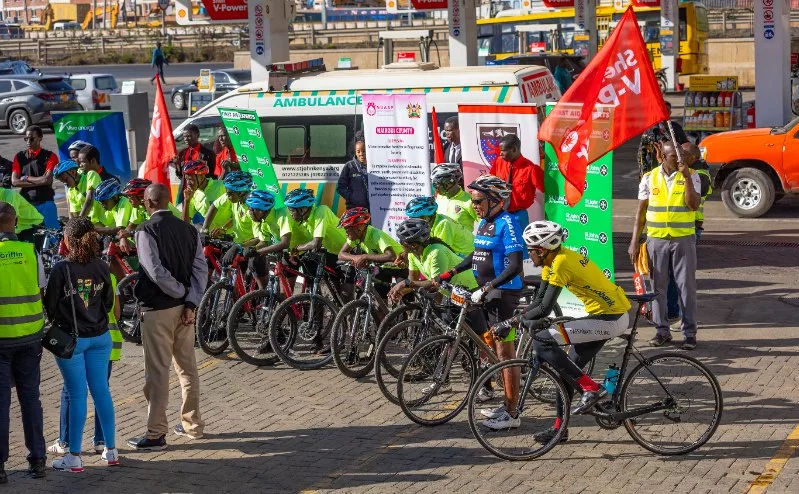
After eight days of grit, pain and sacrifice, 13 Starehe Boys’ Centre students pedalled into Nairobi on Monday, having conquered more than 600 kilometres of a gruelling 1,100-kilometre journey from Busia to Mombasa.
The distance covered so far is about half the journey they are to undertake.
The young cyclists, aged between 14 and 17, had traversed 19 counties, battling scorching sun, treacherous hills, heavy traffic and the exhaustion that comes with spending day after day on a bicycle.
For many, who had never travelled beyond their home counties, the journey has been more than a physical test. It has been a pilgrimage of purpose.
The Dr Geoffrey Griffin Memorial Charity Bikeathon 2026 is raising Sh10 million for the Starehe education fund, helping provide opportunities for students who would otherwise struggle to access quality education.
Now in its second year, the event honours the legacy of the late Geoffrey Griffin, founder of Starehe Boys’ Centre and a champion of education and opportunity.
By Tuesday, the team had raised just over Sh1 million, according to coach Ian Hisho. Safaricom, whose chief executive Peter Ndegwa is an alumnus, donated Sh1 million, while other Old Starehians contributed Sh100,000.
But Starehe director Fred Okono says the Bikeathon is about much more than raising money.
“In Starehe, we do not see ourselves just as a school. We see ourselves as a character-forming institution,” he said.
“Academics is only a small part of that. We are also very actively involved in adventure activities, leadership training, exploration.”
The bike ride, he said, fitted naturally into that philosophy. “It’s challenging, so it’s good for character formation. It’s something that’s very visible and loud, so it serves our purpose of preaching the legacy of Dr Griffin.”
About 78 per cent of Starehe students are on full scholarships, while the remaining 22 per cent pay an economic fee. The 13 riders represent both groups.
The money raised through the Bikeathon will go into the Griffin Memorial Endowment Trust, a capital fund that the school hopes to grow to Sh1.3 billion.
The Sh10 million target will be added to the endowment, with only the interest used to support students.
“Our estimate is that the interest this money earns will be enough to support 10 students here at Starehe,” Okono said.
“And the best part about it, because the capital sum is never used, it means it will support ten students in Starehe forever. It translates into a generational support of Starehe’s mission.”
Since its foundation in 1959, the school has supported slightly more than 17,870 students, with about three quarters being children who would not have received the education Starehe provides had they not joined the institution.
The Bikeathon builds on a tradition of fundraising within the Starehe community.
In 2019, the alumni association chairman walked nearly 300 kilometres from Nandi county to Nairobi, while a group of alumni climbed Mount Kenya.
Hisho, an Old Starehian and the team’s technical director and coach, has completed a ride from Mombasa in 24 hours and another from Cairo to Cape Town covering more than 10,000 kilometres.
The efforts have helped support about 40 students currently at Starehe. For the young cyclists, however, the road has been its own classroom.
Training began in January with running, press-ups and sit-ups before progressing to long practical rides every Sunday from Isinya to Bisil in Kajiado county and back.
“You can’t just wake up and ride 1,100 kilometres for goodness sake,” Hisho said.
The boys had to prepare physically and mentally for riding about 100 kilometres a day, knowing they would have to repeat the feat the following morning.
Team captain Leon Stanley, 17, a Form 3 student, said heavy traffic on the first day demanded constant concentration. Dust became another hazard, particularly when descending hills. For Stanley, the greatest lesson has been teamwork.
“You have to take care of your partner and your partner will take care of you. Out of this, I can say I have learnt to trust people.”
He has also discovered that leadership is about more than being at the front. “Leadership is not just about being in front; it is about making sure everyone gets to the destination.”
Fidel Alfred Odhiambo, 17, is making his second attempt at the Bikeathon after stepping in when some riders dropped out during training.
“The Bikeathon is not for my personal benefit. It is for the benefit of others,” he said.
The heat tested him early in the journey, leaving his skin badly affected by the sun. He even considered giving up on the first day.
But watching his teammates continue gave him the strength to push on. “No one will ever give up. So if the others aren’t giving up, then why should I give up?”
His biggest lessons have been determination and resilience. “There are moments when you feel like giving up, especially when climbing the hills, but you remember why you started and you keep going.”
For 16-year-old Grade 10 student Marklus Kazungu, the hills have been the hardest part. “The distance of climbing the hills is longer than the distance of coming down,” he said.
What keeps him moving is the encouragement of his teammates and the mission. “When we reach Mombasa, it will mean that we have achieved the goal we set for ourselves: getting everyone there safely and helping raise funds for Starehe.”
His twin brother Crispus is also part of the team. The brothers learnt to ride on a Black Mamba bicycle in Grade Three while fetching water in their village in Watamu, Malindi.
The journey has strengthened their bond. “If I see my brother is cycling and then I’m like, ‘If my brother can do it, also I can do it,’” Crispus said.
The cyclists have encountered scepticism along the route, with some people questioning whether they could actually reach Mombasa.
Others have offered encouragement, urging them to keep going. The support of Vivo Energy Kenya, trading as Shell, has also been crucial.
The company has fuelled the vehicles accompanying the cyclists, while Shell stations along the route provide refreshments and flag off the team.
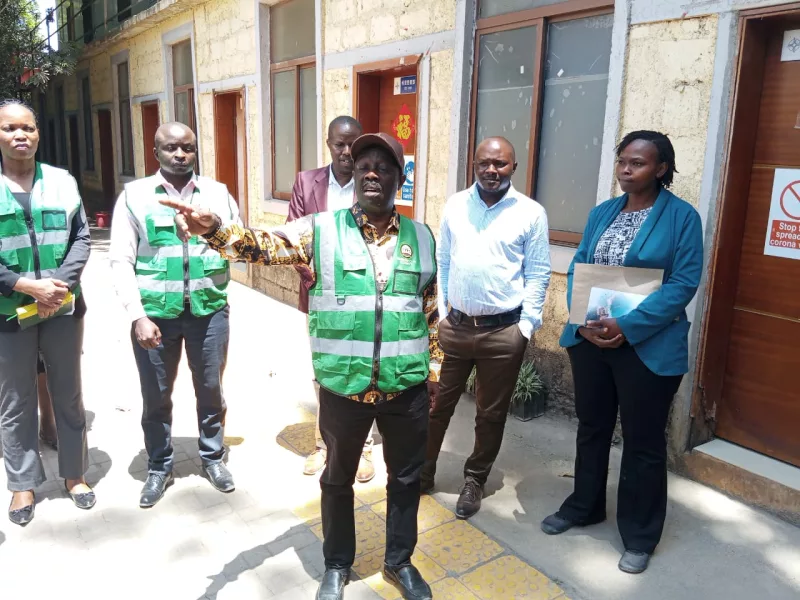
Tara Muchina, Vivo Energy’s internal communications and CSR coordinator, said the boys’ resilience had impressed the company.
“We support these boys with ease because for us, riding bikes from Busia to Nairobi and then Nairobi to Mombasa shows discipline, it shows resilience,” she said.
Emergency response teams are also accompanying the cyclists to provide safety and medical assistance.
For Okono, the ultimate reward will be the character the boys develop along the road. “We are hoping for three things,” he said.
The first is self-esteem and character formation. The second is a sense of service and self-sacrifice. “That’s critical for us in Starehe. It’s what we are about. Doing something bigger than yourself for the benefit of somebody else.”
The third is teamwork. The cyclists are not racing each other. They are travelling as one unit, with each rider playing a role in ensuring the group remains safe.
Hisho says the road has become a classroom where lessons that cannot easily be taught in books have come alive.
“Resilience, keeping to the task, focus, preparation. Understanding that life is just not a smooth road, there are ups and downs even literally on the road.”
The journey is also personal for Hisho. “I want to give back to my alma mater and help other young people benefit from the same opportunities I received here,” he said.
“You are because someone was, and I believe it is important to give back and create that opportunity for someone else.”
The riders departed Shell Imara Daima on Wednesday for the final leg to Mombasa, passing through Emali, Mtito Andei, Voi and Samburu.
They are expected to arrive on Sunday, August 16. For the 13 young men, however, the finish line is only part of the journey.
They are pedalling not simply to reach Mombasa, but to help ensure that another generation of Starehe students gets the opportunity to follow a different road — one paved with education, character and opportunity.
Instant analysis
The Starehe Bikeathon is more than a fundraising campaign; it is a powerful demonstration of how education can build character, resilience and a sense of service. The 1,100-kilometre challenge puts students through physical hardship while teaching lessons that cannot easily be learnt in a classroom. Its deeper value lies in creating a sustainable education fund, with the Sh10 million target intended to generate long-term support for disadvantaged students through the Griffin Memorial Endowment Trust. The boys’ journey also reflects Starehe’s enduring culture of giving back. Their determination, teamwork and sacrifice offer a compelling reminder that opportunity becomes more meaningful when it is extended to others.
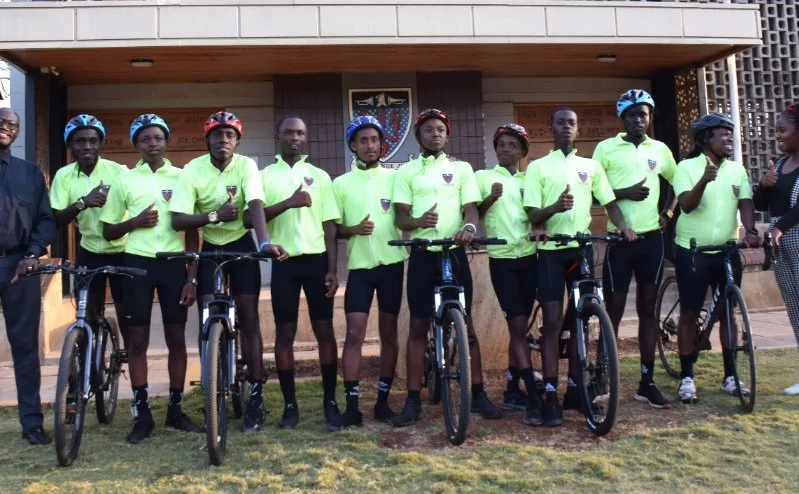 Director Fred Okono and Vivo’s Tara Muchina with the team at the Starehe Boys Centre, when they marked the bikerthon’s halfway point /HANDOUT