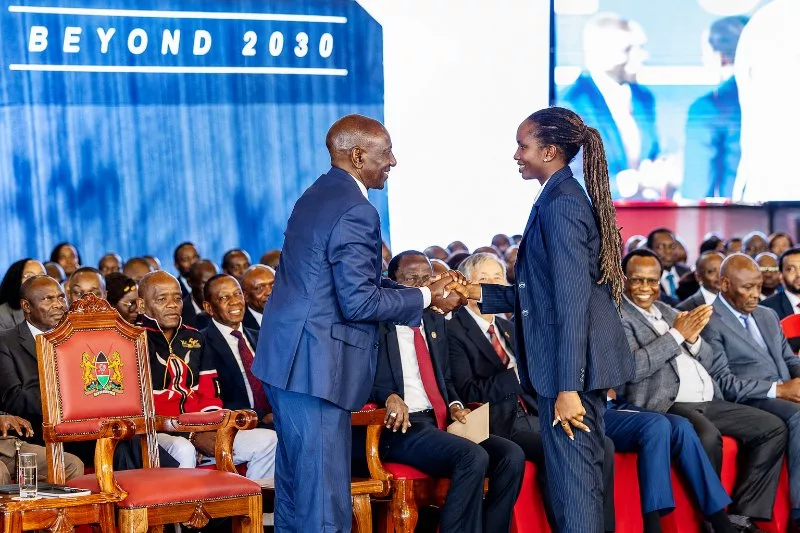
 President William Ruto congratulates MKU graduate Mogesi Maroa after delivering her speech during the National Conversation: Kenya Beyond 2030 at KICC, Nairobi. [Photo John Muchucha]
Speaking during the launch of the National Conversation: Kenya Beyond 2030 at the Kenyatta International Convention Centre (KICC), law graduate Mogesi Maroa said Kenya’s next development chapter should prioritise opportunities that enable young people to actively participate in the country’s economic transformation.
Maroa urged the national conversation to move beyond political discourse and focus on development priorities that directly improve the lives and prospects of Kenyans, particularly the country’s youthful population.
Reflecting on her upbringing in Kuria, Migori County, she said she had witnessed how investment in infrastructure, education and digital connectivity could transform communities and create new opportunities.
“The generation before us fought with their lives so that we could have the democracy we are enjoying today. Democracy, we have discussed all my life up to where I am. Please, let us discuss development. We have invested in one for far too long; it is time to invest in the other.”
She said young people should not be viewed merely as beneficiaries of government programmes but as partners, innovators, entrepreneurs and decision-makers capable of shaping Kenya’s future.
Maroa called for increased investment in education, technology, skills development, employment and entrepreneurship to equip young people to compete in a rapidly changing global economy.
Her remarks come as Kenya begins developing a long-term framework to guide the country’s development beyond Vision 2030.
Launched in 2008, Vision 2030 sought to transform Kenya into a newly industrialising, middle-income country with a high quality of life for its citizens.
While significant progress has been recorded in several areas, some targets remain unmet, creating the need for a new long-term development framework.
President William Ruto, in his address at the national conversation, emphasised the importance of developing a collective national vision that extends beyond short-term electoral cycles.
He called for long-term planning capable of guiding successive medium-term development plans and sustaining Kenya’s transformation over several decades.
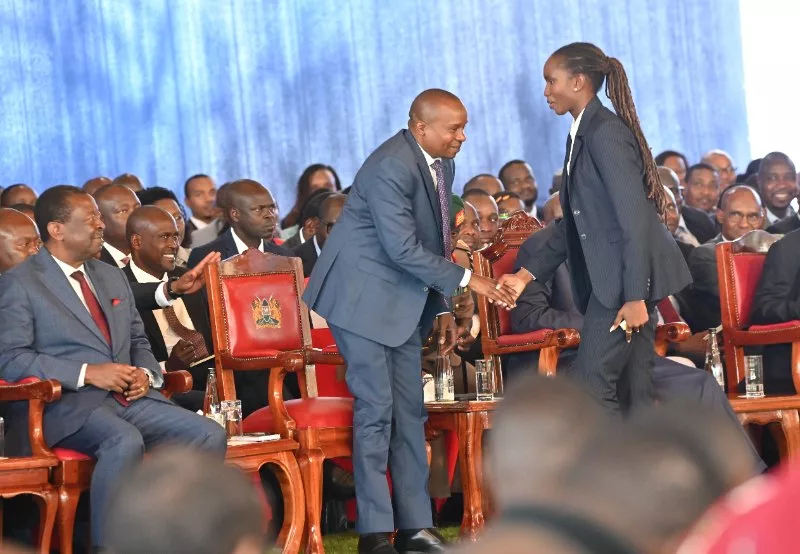 Deputy President Kithure Kindiki congratulates Mount Kenya University (MKU) graduate Mogesi Maroa, as Prime Cabinet Secretary Musalia Mudavadi and other senior delegates look on, after she delivered her speech during the National Conversation: Kenya Beyond 2030 at the Kenyatta International Convention Centre (KICC), Nairobi. [Photo John Muchucha]
The President also placed citizens at the heart of the country’s development, highlighting the role of young people, farmers, entrepreneurs and civil society alongside government in driving economic growth.
He further pointed to inequality, corruption and accountability as challenges that must be addressed as Kenya develops its post-2030 agenda.
Technology-driven systems, including electronic government procurement and anti-fraud measures, were highlighted as tools that can strengthen transparency and accountability.
Ruto also underscored Africa’s growing strategic importance, citing its youthful population, agricultural potential and renewable energy resources. He said Kenya must position itself to take advantage of the opportunities emerging from the continent’s changing role in the global economy.
Maroa’s message was echoed by ICT expert Prof. Bitange Ndemo, who called for greater investment in infrastructure and skills to prepare Kenya for an increasingly artificial intelligence-driven economy.
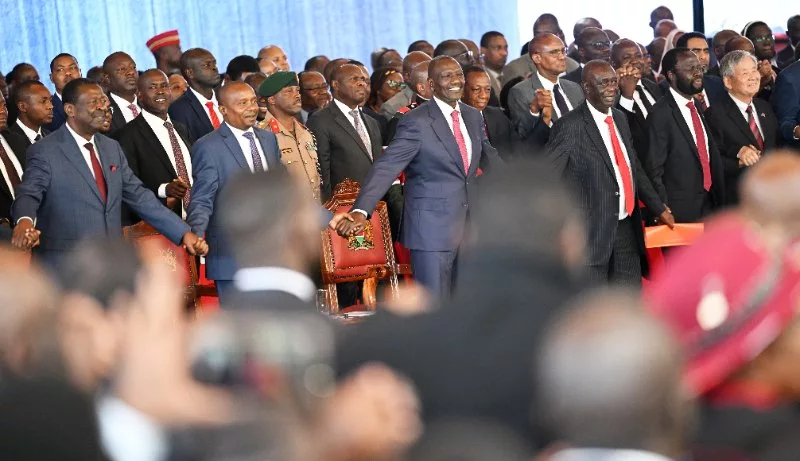 President William Ruto, Deputy President Kithure Kindiki and Prime Cabinet Secretary Musalia Mudavadi, alongside senior government officials and other delegates, during the National Conversation: Kenya Beyond 2030 at the Kenyatta International Convention Centre (KICC), Nairobi. [Photo: John Muchucha]
The discussions highlighted the need to align Kenya’s post-2030 development agenda with the aspirations of its large and increasingly connected youth population.
For Maroa, empowering young people with the right skills, resources and platforms will be critical to ensuring that the next development blueprint translates into tangible opportunities.
As Kenya shapes its priorities beyond Vision 2030, the call for a youth-centred development agenda is emerging as a key element of the country’s next phase of economic and social transformation.
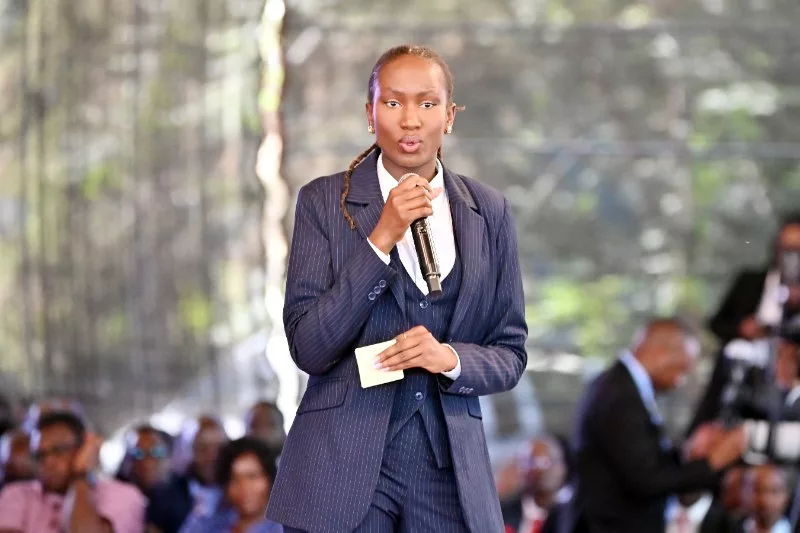 Mount Kenya University (MKU) graduate Mogesi Maroa delivers her speech as senior government officials and other delegates look on during the National Conversation: Kenya Beyond 2030 at the Kenyatta International Convention Centre (KICC), Nairobi. [Photo John Muchucha]
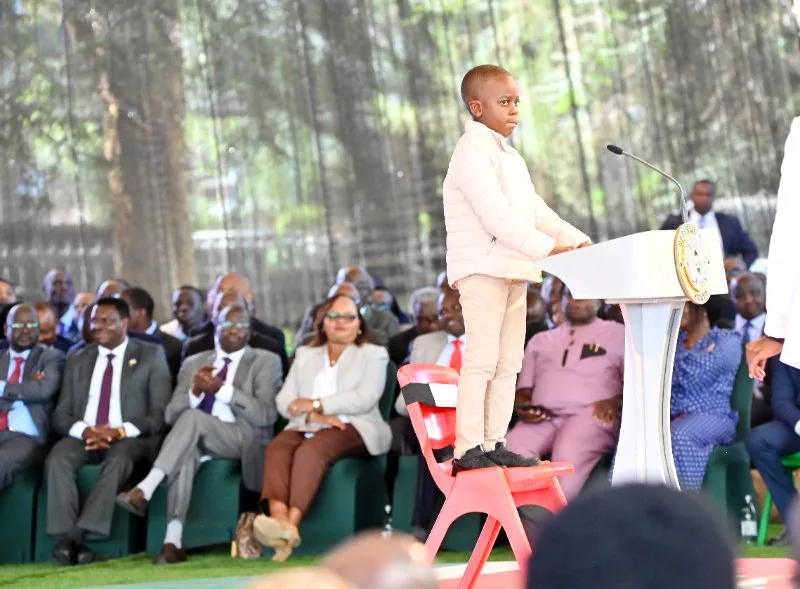 A seven-year-old Adrian Gweth confidently takes the podium to share his dream of serving Kenya’s people and helping lead the nation to greater heights beyond Vision 2030, in the presence of the President of Kenya. [Photo John Muchucha]
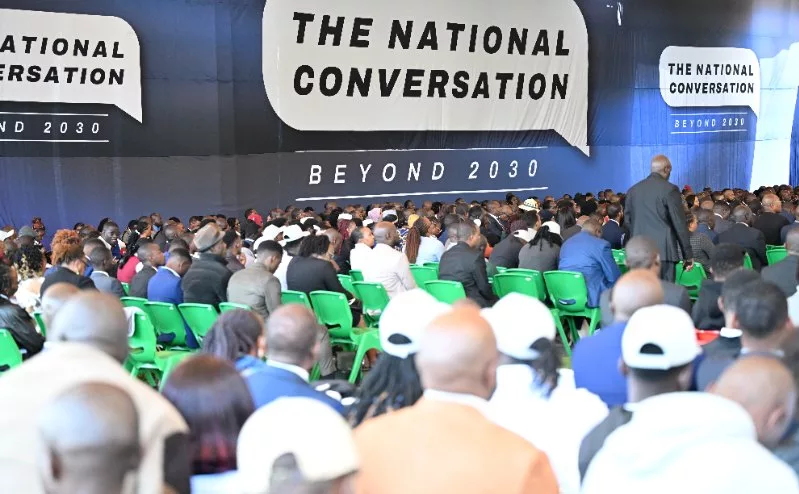 National Conversation: Kenya Beyond 2030 at the Kenyatta International Convention Centre (KICC), Nairobi. [Photo John Muchucha]