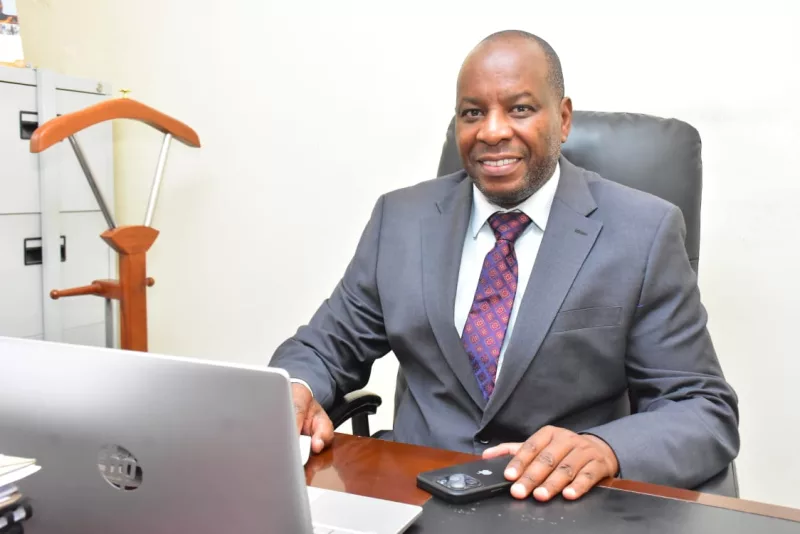
 KMRC chief executive and managing director Johnstone Oltetia /HANDOUT
Kenya’s affordable housing debate is shifting beyond the construction of more homes to finding financing models that can enable more households to buy them.
This will be a key focus at the fifth Kenya Affordable Housing Conference, where financial institutions, policymakers, developers and investors will examine how blended finance, development finance institutions and mortgage liquidity facilities can expand access to homeownership.
The conference, organised by the Kenya Mortgage Refinance Company (KMRC), will be held from August 20 to 21 at Lake Naivasha Resort in Nakuru County under the theme, “Scaling the Base: Unlocking Inclusive and Sustainable Housing Solutions.”
KMRC chief executive and managing director Johnstone Oltetia said the housing challenge was not only about the shortage of homes but also the inability of many Kenyans to secure affordable financing.
“This year's theme speaks to both the scale of the challenge and the promise before us. We need to close the gaps on both supply and demand while ensuring that housing solutions are inclusive, resilient and built to last,” Oltetia said.
Delegates will explore innovative funding structures that can lower the cost of housing finance and bring more borrowers into the formal mortgage market.
Particular attention will be paid to blended finance, where public or development capital is combined with private funding to reduce risks and attract more investment into affordable housing.
Development finance institutions are also expected to examine how they can provide catalytic capital, credit enhancement and other forms of support to unlock private-sector financing for housing projects.
Mortgage liquidity facilities such as KMRC will be another area of focus, as participants consider how longer-term funding for lenders can help expand mortgage lending and make home loans more accessible.
The discussions will pay particular attention to groups that have traditionally struggled to qualify for conventional mortgages, including informal workers, micro-entrepreneurs, SACCO members and households with irregular incomes.
Experts from Kenya, South Africa, Tanzania and India will share experiences on housing finance systems and models that could help extend credit to low- and middle-income households.
The conference will also examine how land administration, title regularisation and improved land governance can make it easier for developers and lenders to finance housing projects.
Sustainability will form another part of the discussions, with delegates looking at climate-resilient housing, green buildings and resource-efficient construction while considering how to keep such homes affordable.
Technology is expected to feature prominently, including modern construction methods and the use of artificial intelligence to reduce costs, improve efficiency and shorten project delivery timelines.
Data on residential property prices, affordability, demand and investment trends will also be discussed as stakeholders seek to better align housing interventions with market realities.
The conference will bring together government officials, financial institutions, SACCOs, pension funds, developers, investors, housing agencies and international experts.
For the first time, homeowners will also have a stronger voice, with real-life experiences expected to highlight the financial and practical challenges households face on the path to ownership.
The event will close with the inaugural Kenya Affordable Housing Awards, which will recognise mortgage lenders for expanding access to homeownership, improving customer experience and introducing innovative and sustainable housing finance solutions.
The conference comes as Kenya seeks to address its housing deficit by strengthening not only the supply of homes but also the financial systems needed to make them affordable to a wider section of the population.