There is a line by Shakespeare that says, "Neither a borrower nor a lender be" from the play Hamlet, spoken by the character Polonius in Act 1, Scene 3.
Polonius, the chief counsellor to King Claudius and the father of Laertes and Ophelia in the play, is known for being pompous, meddlesome and long-winded. Spoiler alert: The poor devil is accidentally killed by Prince Hamlet while spying from behind a curtain.
Anyway, this man advises his hot-headed son Laertes, who serves as a fiery foil to Prince Hamlet, rushing into action and demanding immediate revenge when tragedy strikes his family as he leaves for France.
The full quote, just for the record, is: “Neither a borrower nor a lender be; / For loan oft loses both itself and friend / And borrowing dulls the edge of husbandry.”
With this thought at the top of my mind, I find myself thinking, somewhat uncharitably, of how some people find it difficult or at least awkward to lend others money even when they may be flush with cash. The same people can, however, be remarkably generous when confronted by a person they know with a large hospital bill or funeral expenses.
It's funny how we, myself included, are so willing to part with cash in such situations where we know we won’t get it back. But then perhaps some hope that they will be rewarded for this generosity in the afterlife or by some sort of karmic return of the hand.
I got to thinking about Polonius’ advice when, for various reasons, including ‘makosa imefanyika mahali’, I recently found myself facing ‘temporary financial embarrassment’. As a result, I was forced to consider borrowing cash from a friend to tide me over until better times.
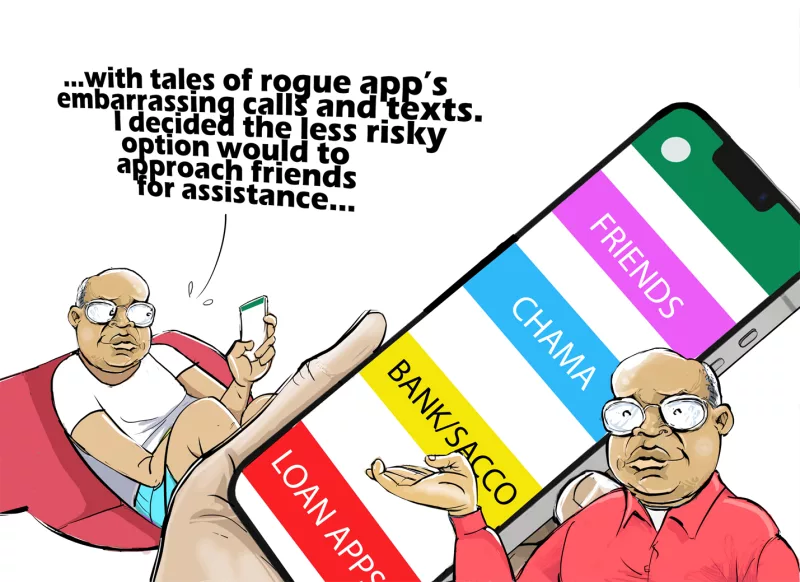
Before sending my SOS to the friend, I briefly considered the multitude of lending apps that the algorithms keep throwing at me, as if somehow the people behind them know the parlous state of my finances. But deep down in my heart, I know that’s a slippery slope, especially for a freelancer who has no consistent income.
I have heard too many stories of people facing severe distress after using digital credit platforms, dealing with aggressive debt-shaming, hidden charges and endless cycles of debt to cover basic needs like food and medical emergencies.
There are tales of rogue apps that routinely harvest phone contact lists upon installation. When a borrower falls behind by even a few days, collectors bombard family members, close friends and employers with embarrassing calls and texts.
With this in mind, I decided the less risky option would be to approach friends for assistance.
In the current Kenyan economy, I am aware that I am not alone in being broke. In fact, if anything, I have enormous privilege to have friends who are so generous. Nevertheless, it is still daunting and awkward to appeal to friends for financial aid.
I am aware that Kenyans are incredibly generous when it comes to raising money for funerals and illness through a blend of traditional community spirit, mobile money technology and formal micro-insurance. The main methods include WhatsApp fundraising groups, specialised digital platforms like M-Changa, chamas and family contributions.
I know that many neighbourhood, church or workplace associations maintain a regular internal kitty to disburse immediate emergency aid for members. Of course, being a freelancer and not religious, these doors are not available for me to knock on.
There are also temporary WhatsApp groups created by friends, family and co-workers to coordinate emergency committees, share hospital or funeral budgets and collect donations. Contributions are sent directly via M-pesa phone numbers or dedicated Paybill/Till numbers shared in messages.
There are also digital tools like M-Changa, which allow organisers to collect funds transparently and share links across wider social media networks. And of course, there is the historic cultural practice of harambee or ‘pulling together’, where community members physically or digitally meet and contribute cash towards a shared burden.
When it comes to death, of course, there is an increasing number of solutions for urban and rural households to pay small monthly premiums into commercial or micro-insurance packages to cover mortuary bills, coffins and transport.
Thankfully, I am not dead yet, so let me see how the borrowing goes.