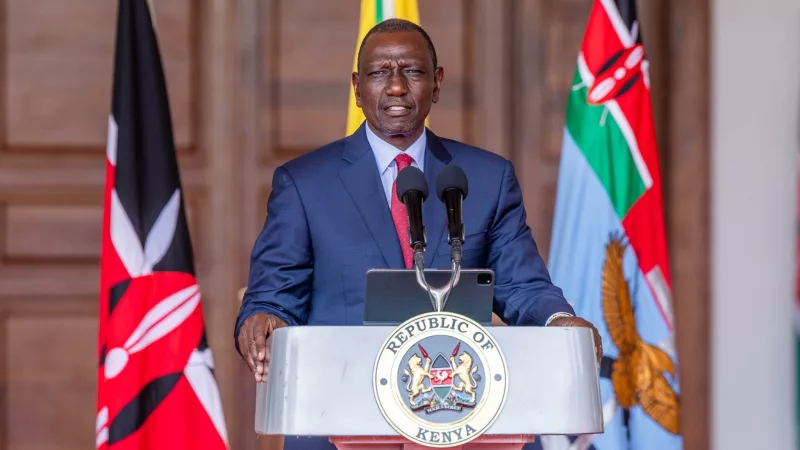
 President William Ruto/ FILE
When President William Ruto took office in September 2022, Kenya's economy was recovering from the Covid-19 pandemic but growing unevenly, while households were already struggling with rising costs, a long drought and declining incomes.
The economy grew by 4.8 per cent in 2022, down from 7.6 per cent in 2021, according to the Kenya National Bureau of Statistics' 2023 Economic Survey.
The survey attributed the slowdown to, among other factors, the effects of the Covid-19 pandemic and drought, which affected agricultural production.
It was against that backdrop that Ruto's administration began its economic programme, promising to protect the economy from shocks, restore stability and deliver what the President had described during the 2022 campaign as a transformation that would benefit Kenyans at the bottom of the economic pyramid.
Four years later, several of the key economic indicators have changed.
The shilling, which came under intense pressure during the first half of Ruto's term, has stabilised at around Sh129 to the dollar, while foreign exchange reserves have risen substantially.
The Central Bank Rate has fallen to 8.75 per cent after a period of tight monetary policy. Inflation, which had reached much higher levels during the cost-of-living crisis, has moderated, although food and transport costs continue to push the overall rate higher in 2026.
Foreign investment has also improved, while the economy has continued to grow.
The labour market, however, remains dominated by informal employment. In 2025, Kenya created 822,100 jobs, according to the 2026 Economic Survey, but 87.2 per cent were in the informal economy.
The latest poverty data available from KNBS still puts the overall poverty headcount at 39.8 per cent, based on 2022 data.
GDP growth: 4.8 per cent in 2022, about five per cent by 2026
The 2023 Economic Survey, which provides the official figures for 2022, recorded real GDP growth of 4.8 per cent.
The report noted that the services sector remained an important source of growth, while agriculture contracted for a second consecutive year because of drought.
The International Monetary Fund, reviewing Kenya's economy in 2023, similarly reported that real GDP growth stood at 4.8 per cent in 2022 and said the drought had worsened food and economic insecurity among vulnerable households.
The IMF also noted that higher living costs and a tighter policy environment had constrained consumption and investment.
The labour market was also expanding, although overwhelmingly outside formal employment. The 2023 Economic Survey recorded 19.1 million people in employment in the modern and informal sectors in 2022, up from 18.3 million in 2021.
The economy generated 816,600 new jobs during the year.
Then Treasury Cabinet Secretary Njuguna Ndung'u said at the launch of the survey:
"I note that a total of 816.6 thousand new jobs were generated despite the slowdown in the economy in 2022."
The survey showed that informal employment remained the dominant source of work. Of the 19.1 million people recorded in the modern and informal sectors, 16 million were working in micro, small and medium enterprises, according to figures cited by Ndung'u at the survey's launch.
GDP growth subsequently rose to 5.7 per cent in 2023 before slowing to 4.7 per cent in 2024 and 4.6 per cent in 2025, according to KNBS.
KNBS said the 2025 expansion was supported by positive growth across all sectors. Agriculture, forestry and fishing, which accounts for more than one-fifth of the economy, expanded by 3.1 per cent.
Construction rebounded strongly, while accommodation and food services grew by 15.6 per cent, public administration by 8.3 per cent, financial and insurance activities by 6.5 per cent, and information and communication by 4.8 per cent.
The latest quarterly figures show that GDP grew by 5.3 per cent in the first quarter of 2026.
The World Bank's latest assessment of Kenya also projects growth of about 4.7 per cent in 2026.
In his special national address, Ruto said his administration had spent the first part of its term dealing with the economic shocks it inherited.
"Four years ago, our priority as a nation was not to imagine Kenya's next chapter. It was to survive global economic turbulence, restore stability, rebuild confidence and place our economy back on a firm foundation," he said.
The President said the reforms had now created room for Kenya to think beyond crisis management.
"Because we have restored stability, rebuilt investor confidence and laid a firm foundation for our economy, now is the perfect opportunity for Kenya to begin shaping the next phase of our national development," he said.
Exchange rate: From above Sh160 to about Sh129
The shilling came under intense pressure during the first part of Ruto's term, eventually trading above Sh160 to the dollar.
Deputy President Kithure Kindiki, defending the government's record during an economic retreat, put the change in stark terms.
"All the indicators are showing to a stable economy, a strong currency. For the last two and a half years, the Kenyan currency has been stable. We found it at 162, 165 to the dollar. It has been stuck at 129 for two and a half years, showing economic stability," Kindiki said.
CBK data shows that the currency has remained stable in 2026. In the week ending July 16, the shilling traded at Sh129.34 to the dollar, compared with Sh129.22 the previous week, according to the Central Bank's weekly bulletin.
The change has been accompanied by an increase in foreign exchange reserves.
Kindiki said reserves had increased from $5.7 billion in 2022 to $15.1 billion.
The latest CBK figures available before the President's four-year assessment showed reserves at $14.169 billion as of July 16, equivalent to six months of import cover.
CBK's weekly bulletin said the reserves met the statutory requirement to maintain at least four months of import cover.
In his national address, Ruto said Kenya had "rebuilt our foreign exchange reserves to more than $15 billion, equivalent to 6.5 months of import cover".
Inflation: Lower than the 2022 crisis levels, but costs remain high
Inflation is another area where the economic picture has changed.
Kindiki said the government had reduced inflation from 9.6 per cent when it took office to below six per cent.
The latest official figures show that inflation stood at 6.4 per cent in June 2026, down from 6.7 per cent in May, according to KNBS.
CBK said the increase in inflation during the first half of the year had been driven largely by higher energy prices and disruptions to global supply chains linked to the conflict in the Middle East.
The CBK bulletin showed that the June decline was a moderation rather than a return to the much lower rates recorded earlier.
The distinction between the inflation rate and the actual price level is also reflected in the latest poverty data.
KNBS's Kenya Poverty Report 2022 found that 39.8 per cent of Kenyans were living below the overall poverty line, equivalent to more than 20 million people.
Food poverty stood at 31.7 per cent, affecting more than 16 million people.
The same report found that average monthly food and non-food expenditure per adult equivalent had risen to Sh8,030 in 2022 from Sh7,393 in 2021, while food accounted for 59.1 per cent of total consumption.
Interest rates: CBR falls to 8.75 per cent
Monetary policy tightened as inflation and exchange-rate pressures intensified, prompting CBK to raise the Central Bank Rate.
By 2024, it had reached levels above today's position.
The Monetary Policy Committee reduced the rate as inflation moderated and the exchange rate stabilised.
In February 2026, CBK cut the CBR by 25 basis points to 8.75 per cent and maintained it at 8.75 per cent in June, saying the stance remained appropriate.
Kindiki cited the decline as evidence of stabilisation, while the President said borrowing costs had declined.
However, bank lending rates remain higher.
Investment: Improvement from 2022
Ruto has placed investor confidence at the centre of his economic argument.
In his special address, he said Kenya attracted a record $3.2 billion in foreign direct investment in the previous year, more than double the amount recorded in 2022.
"Investor confidence has returned," he said, citing the 2025 IMD World Competitiveness Ranking, which placed Kenya as Africa's most competitive economy.
The official investment data shows that the improvement was gradual.
KNBS's foreign investment data showed the stock of foreign direct investment rising between 2022 and 2023, while the government has since reported much higher inflows.
Jobs: More employment, but informal work dominates
Employment rose from 19.1 million in 2022 to 20 million in 2023, 20.8 million in 2024 and 21.6 million in 2025.
New jobs reached 816,600 in 2022, 848,200 in 2023, 782,300 in 2024 and 822,100 in 2025.
Informal employment, however, remained dominant.
In 2023, 720,900 jobs, or 85 per cent, were informal.
In 2024, 703,700, or 90 per cent, were informal.
In 2025, 87.2 per cent were informal.
By year-end, informal employment stood at 18.1 million, against 3.3 million wage employees.
Household conditions remain a key part of the picture
The government's economic scorecard increasingly revolves around the argument that stabilising the State's finances was necessary before living standards could improve.
Ruto inherited a country facing substantial debt-service obligations, while his government has pursued increased revenue collection and expenditure controls.
The administration has argued that these measures were necessary to avoid a deeper fiscal crisis and restore investor confidence.
But higher taxes and statutory deductions have also reduced the amount of money available to some households.
The latest national poverty baseline remains the 2022 KNBS figure of 39.8 per cent.
The employment data also shows that the labour market remains dominated by informal work.
What comes next?
Ruto is now trying to move the conversation beyond the economic emergency that defined the early years of his administration.
In his address on the country's future development path, he argued that Kenya needs to think beyond Vision 2030 and prepare a new long-term framework, Vision 2060.
He identified technology, artificial intelligence and climate change among the forces that have changed the environment in which Kenya must plan.
"We are having this conversation now because, number one, Vision 2030 will come to an end. Number two, the world has changed, with technology, AI and climate change reshaping our reality," Ruto said during the launch of the national conversation on Vision 2060.
He also said the new framework should not be tied to one administration.
Ruto said Vision 2060 should "provide a long-term national roadmap that goes beyond individual administrations and political cycles".
Treasury Cabinet Secretary John Mbadi reinforced that point, saying the proposed vision should not be treated as a personal project of the President.
"Ruto has not developed a vision. Tomorrow we are starting conversation on how to develop vision for this country," Mbadi said before the launch.
"The vision is not for Ruto; it is 2060. Ruto can only be in power up to 2032, not beyond," he said.
"Because we have restored stability, rebuilt investor confidence, and laid a firm foundation for our economy, now is the perfect opportunity for Kenya to begin shaping the next phase of our national development."