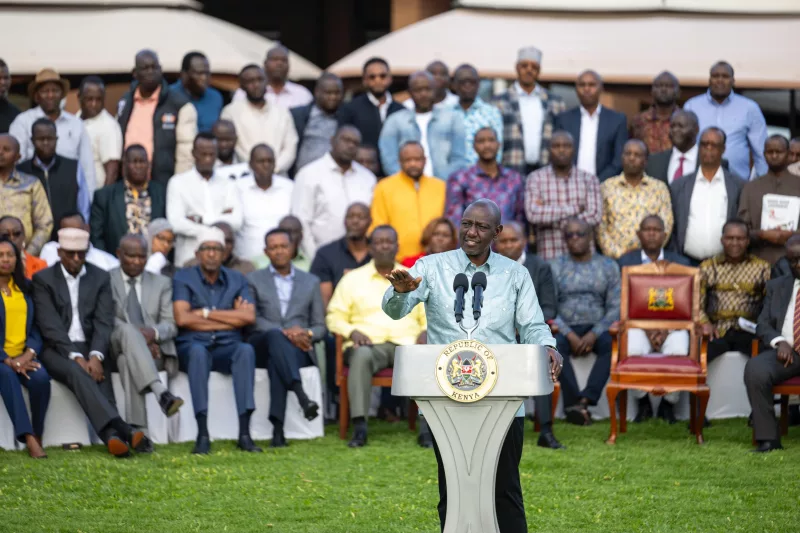
 President William Ruto addresses the press at the ODM UDA Retreat in Naivasha, August 10, 2026.
There is growing unease in President William Ruto’s camp as
ODM moves to stake major claims in its looming 2027 pre-election deal with the
ruling party.
The disquiet is more pronounced among Ruto’s Mt Kenya foot soldiers, amid fears that the Orange Party’s power matrix will disturb the established power dynamics.
The concerns spilt into the open during the Broad-Based retreat in Naivasha, with the drama playing out in Ruto’s presence.
ODM is demanding a 50/50 sharing of government with UDA, apart from being unconditionally handed the running mate slot.
Kisii Governor Simba Arati reportedly made the calls, allegedly triggering a walkout by some Mt Kenya MPs during the retreat.
Gatundu South MP Gabriel Kagombe said it was difficult for leaders who had supported Ruto from the beginning to accept a proposal that appeared to diminish the position of Deputy President Kithure Kindiki.
“Imagine the deputy president seated there and the governor for Kisii would ask that the deputy president no longer serves, and that ‘wakati wa kufanya kazi imeisha, ni wakati wa kutafuta kura’,” Kagombe said.
One lawmaker described the intervention as ‘a little distasteful’.
The incident highlights the dilemma Ruto faces: drop Kindiki as his second in command and face more rebellion from Mt Kenya, or retain him and face uncertainty in ODM zones.
The demands by ODM were reportedly rejected as inappropriate for the forum and should instead be taken to the coalition-building committee being constituted by the two parties.
Tana River Senator Danson Mungatana denied assertions that there was a walkout.
It is understood that there are fears the renewed pressure could leave some of the President’s original supporters fighting for space.
The coalition-building committee is expected to negotiate the structure of the ODM-UDA alliance, including its name, identity, slogan and sharing of political positions.
On Monday, Ruto said Kenya Kwanza and ODM had agreed to move beyond their cooperation in government and establish a formal political coalition.
“After consultations within our respective parties and formations, the Kenya Kwanza and the ODM have today formally resolved to develop a joint manifesto for the next election and constitute a coalition to contest the 2027 general election together,” Ruto said.
He said the partnership, which began with the formation of the Broad-Based Government, would now acquire a “clear political framework” ahead of the 2027 polls.
“What began as cooperation in government will now become a common political platform upon which we shall seek the mandate of the Kenyan people in August next year,” he said.
But events at the meeting of leaders in Naivasha showed that agreeing to work together may be easier than agreeing on how the spoils of the alliance will be shared.
Kagombe warned that Kenya Kwanza politicians could not be expected to remain in a coalition where they felt excluded from decision-making.
“We must be represented at the table. We cannot be giving our support and we are not at the table,” he said.
“The bare minimum is that we get what we want and if we don’t, then we call it quits. This is politics. And in politics, it is about interest and how we represent our people.”
He said Mt Kenya leaders could explore other political options if their interests were ignored.
“If people are making coalitions, nothing stops us as Mt Kenya from seeking a place elsewhere. It has been the politics since time immemorial,” Kagombe said.
The warning introduces a new complication for Ruto, who has been seeking to consolidate a broad-based political alliance capable of carrying him into a second term.
ODM is understood to be seeking a stronger presence in government and a meaningful role in determining the political architecture of the coalition.
The party is also expected to push for a larger share of elective and government positions as the two sides negotiate their joint platform.
The negotiations could unsettle other Kenya Kwanza partners, particularly Ford Kenya, which holds the influential position of Speaker of the National Assembly through party leader Moses Wetang’ula.
ODM has previously sought the position, meaning the coalition negotiations could reopen the question of who controls some of the most powerful offices in Parliament.
ODM could also seek additional Cabinet representation and other senior positions as part of the negotiations.
Mombasa Governor Abdulswamad Nassir, who is ODM deputy party leader, confirmed that the party would take its interests to the negotiating table, although he said the specifics had not been agreed.
He said Monday’s meeting was primarily about taking stock of the government’s performance and agreeing on areas to prioritise in the 2027 election campaign.
“The meeting was to set action plans. It was to take stock on how we have fared on the common issues we sought to pursue in the 2022 elections,” Nassir said.
“Our manifesto, which encompassed Baba’s vision, had issues to do with agriculture, health and education.”
He said both parties would now develop their respective proposals for the 2027 campaign before they are harmonised by the joint teams.
“The party leader of ODM and UDA will come up with a team to do the negotiations. We intend to pursue our interests there. The negotiations will define the coalition structure,” Nassir said.
The two parties have also agreed not to dissolve or merge ODM and UDA as they enter the coalition, allowing each to retain its identity and political structures.
“This arrangement is expected to make the negotiations more complicated because both parties will have to balance the interests of their own supporters with the demands of the new coalition,” Prof Olang Sana, a Maseno University don, said.
The joint negotiating team will have five members from each political formation, with the executive directors of ODM and UDA serving as ex-officio members.
ODM nominated Isaac Wanuge, Mariam Abdulai, Leonida Kerubo Omosa, engineer Carey Orege and Professor Bernard Mok.
Kenya Kwanza nominated Emmanuel Nzai, Dr Daniel Mwai, Bramwell Simiyu, Mohammed Hassan and Dr Cecilia Ngetich.
The team will be expected to agree on the coalition’s name, brand identity and slogan.
This is in addition to the separate team working on the framework for developing a joint manifesto.
The size of Monday’s gathering underlined the political weight of the new alliance.
More than 250 MPs, 24 governors, 48 senators and 24 deputy governors attended the meeting, according to participants.
The leaders were also expected to receive a common narrative on the government’s performance to be used in the 2027 campaign.
“We agreed that people subscribe to one language in explaining the government’s scorecard,” a participant said.
But even as Ruto seeks to present the partnership as a broad national coalition, the early signs point to a difficult balancing act.
For UDA and its original allies, the fear is that ODM’s entry into the political equation could result in the redistribution of positions and influence at a time when the ruling coalition is already preparing for a highly competitive election.
The President will now have to keep ODM satisfied without alienating the UDA grassroots and other parties that helped him win the 2022 election.
For ODM, the negotiations offer an opportunity to convert its influence in the Broad-Based Government into a formal political arrangement ahead of 2027.
INSTANT ANALYSIS
For Ruto’s original allies, the immediate question is how much political space will remain for them once the new partnership is fully negotiated. That question could determine whether the Ruto-ODM pact becomes the foundation of a formidable 2027 coalition or the beginning of a fresh struggle for power within the President’s camp.