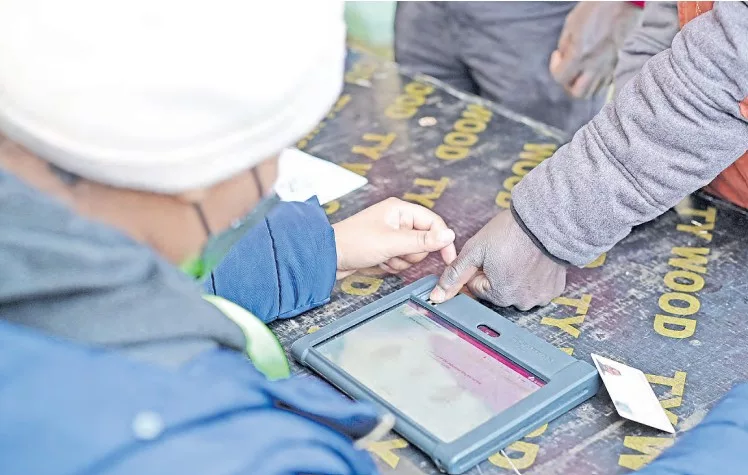
 Kiems kit being used at a polling station.
The Independent Electoral and Boundaries Commission has begun procurement of new election technology and highly secure ballot papers for next year’s general election.
This comes as the commission moves to seal loopholes that have raised questions over the integrity of elections in the country.
Two tenders issued by the commission yesterday give a peek into IEBC’s elaborate plan to ensure a credible vote.
They reveal how the IEBC is seeking to install a foolproof biometric voter registration and identification system, with ballot papers carrying multiple anti-counterfeit features.
The plan targets the entire voting chain, from the moment one registers as a voter to identification at the polling station, casting of the ballot, transmission of results and preservation of election records.
IEBC is seeking to procure ballot papers designed to make counterfeiting, copying and substitution much harder.
For the 2027 polls, the commission says it could require up to 180 million ballot papers for the six elective positions.
It estimates that the number of polling stations could rise from 46,229 in 2022 to about 55,000, while registered voters could reach 28.4 million.
There will be seven ballot-paper types, including a possible referendum ballot.
The presidential ballot will have a white background; National Assembly ballots will be green; MCA ballots brown; Senate ballots yellow; county woman representative ballots purple; gubernatorial ballots sky blue; and referendum ballots grey.
Candidates’ passport-size photographs and referendum symbols must measure at least 20mm by 20mm.
Among the security features on the ballot papers is a watermark embedded during manufacture, an IEBC logo visible only under ultraviolet light and anti-copy features.
The paper is to be designed to reveal the word ‘Copy’ across a reproduced ballot when photocopied or scanned.
They will also carry guilloche patterns, which are complex lines designed to resist reproduction.
The papers would also be fitted with micro-text, embossed and unique QR codes containing variable data.
The papers will additionally use tapered serial numbers printed with multi-coloured ink and will be perforated.
The dimensions will vary according to the number of candidates.
Presidential and gubernatorial papers will range from A4 for two to six candidates to larger formats for bigger fields.
Senate, National Assembly, woman representative and MCA ballots will similarly expand as the number of candidates increases.
Each ballot booklet will contain the number of papers corresponding to the registered voters at that polling station.
The packaging itself will provide another layer of control.
Booklets, result declaration forms and ballot posters for the same elective position will be packaged together for each polling station, with each package carrying a distribution list.
The booklet cover must show the manufacturer, elective position, number of ballot papers, first and last serial numbers, IEBC logo, year of issue and batch number.
The commission is also procuring tactile folders for voters with visual disabilities.
The folders will come in seven types, with colours corresponding to the different elective positions, and will be sized to match the respective ballot papers.
TECHNOLOGY
The Integrated Elections Management System (IEMS) tender requires a biometric matching system capable of handling at least 30 million records.
IEBC says the system should have capabilities “for identification and de-duplication of the registered voters”.
The tender says the system must show how data will move from registration centres to central servers for the generation of the voters’ register.
This is intended to make it harder for a person to register more than once and to identify duplicate records before the final register is produced.
The system will also use fingerprints and facial images. The tender requires new fingerprint imaging components to comply with FBI image quality specifications.
The commission also wants the system to support internationally recognised standards for facial photographs.
The aim, the tender document says, is to optimise their use in automated facial recognition and voter identification.
The hardware specifications provide for a fingerprint optical sensor, a camera of at least 13 megapixels, barcode and Machine Readable Zone reading.
It would also feature contact and contactless smart-card readers, Near Field Communication, iris capture and geofencing.
The devices are also required to support 3G, 4G and 5G networks, dual SIM cards, Wi-Fi, Bluetooth and eSIM technology.
The commission says it may require up to 60,000 new devices, depending on the number of registered voters and polling stations.
ONE PERSON, ONE VOTER RECORD
The proposed system will also allow the commission to detect attempts at double registration.
The tender specifically requires the voter registration application to warn users when electoral requirements are breached, including attempts at double registration, which ‘must be rejected’.
Where a passport is used for registration, the system must automatically check its validity date from the document’s Machine Readable Zone.
The commission is also seeking to integrate online pre-registration with the Integrated Population Registration System (IPRS).
The proposed Online Voter Pre-Registration System will retrieve biographical information from IPRS.
The system is to allow citizens to begin the registration process online before biometric capture is completed at a registration centre.
At the central level, registration data will first go to a staging server, where encryption and digital certificates will be checked.
Each registration kit will have a unique digital certificate to authenticate records sent to the central system.
Registration data can be transmitted securely both online and offline, while the system will maintain records of rejected enrolments and voter transfers.
The system will also have the capacity to prevent registration, transfer or updating of voter records after the deadline in an affected electoral area.
IEBC is seeking to ensure that, once a statutory deadline has passed, officials will not simply be able to make last-minute additions or changes to the register through the system.
The same safeguards will apply on polling day.
Each Kiems kit will be linked to the register for a particular polling station through a QR code.
The kit will contain biometric information for voters in its designated area and will be restricted to the relevant polling station.
It will display a voter’s biographical information and voting status and will stop identifying voters once the polling period has closed.
The system will generate audit trails showing voter identification, turnout and the opening and closing of polling stations.
The commission further wants verifiable, read-only logs of voting-day activities and unique digital certificates for each deployed kit.
RESULTS TRAIL
IEBC is also seeking to close gaps between what happens at the polling station and what reaches tallying centres.
The results transmission module will allow polling officials to scan signed results forms and transmit them to a central server for storage and publication on an online portal.
The system will generate digital signatures for results and embed them on scanned forms.
Where a network connection is unavailable, the system will store the results and transmit them once connectivity is restored.
The scanned official forms will be made publicly accessible through a web portal, creating a digital trail that can be checked against physical forms at tallying centres.
The system is also required to use strong authentication, encryption, VPN and Transport Layer Security for communications involving sensitive personal information.
IEBC’s tender documents therefore envisage an election in which voter registration, identification, ballots and results each leave a verifiable trail.
INSTANT ANALYSIS
The IEBC’s planned election technology and enhanced ballot security signal a major effort to strengthen Kenya’s 2027 electoral process. Biometric verification, anti-counterfeit ballots, encrypted results transmission and comprehensive audit trails could significantly reduce fraud, duplication and manipulation risks. However, public confidence will depend on transparent procurement, system testing, cybersecurity, independent oversight and effective implementation across all polling stations.