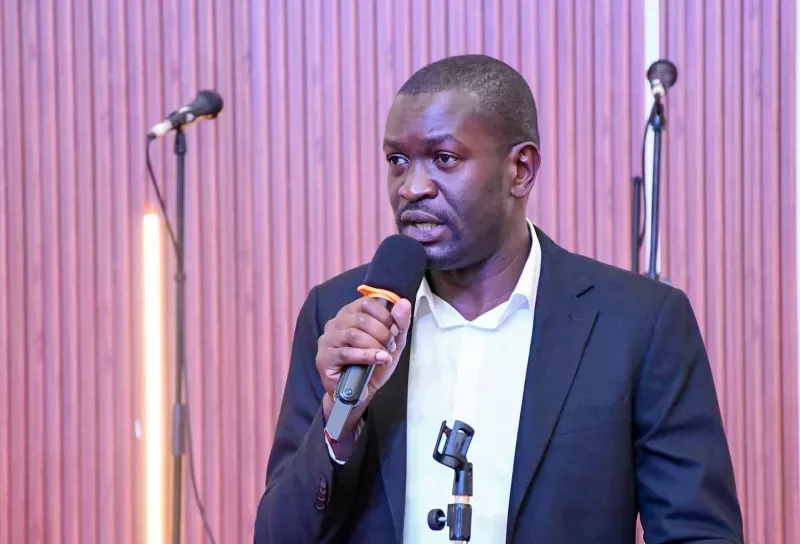
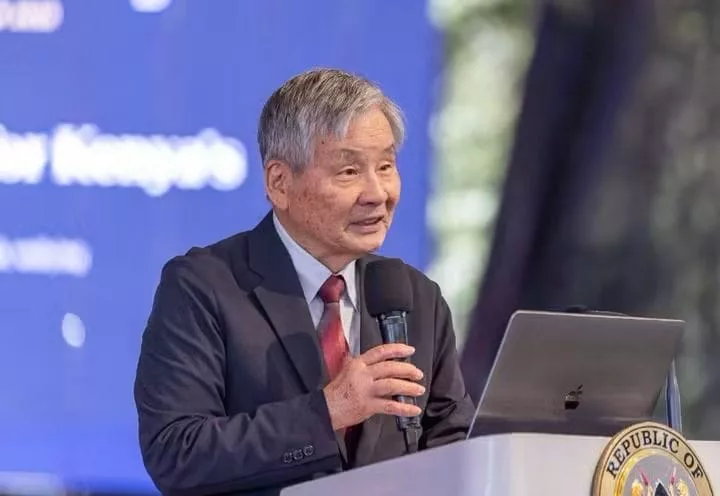
 Duke University Professor Hiroyuki Hino speaks during the launch of the national conversation on Beyond Vision 2030 at KICC on August 12, 2026/PCS
Kenya’s ambition to transform into a first-world economy comparable to Singapore is achievable, although it will require decades of sustained growth, discipline and investment in human capital, Duke University Professor Hiroyuki Hino has said.
Hino acknowledged the enormous economic gap between Kenya and Singapore but challenged Kenyans not to abandon an ambitious development target simply because it appears difficult.
“I am told many Kenyans are sceptical, believing Singapore is too high a target. I agree reaching its level of development in 30 to 40 years will be difficult,” Hino said.
“Singapore’s income per person exceeded $80,000 last year, compared to just over $2,000 in Kenya. Huge difference,” he added.
Hino, who is among experts contributing to the formulation of Kenya’s proposed Vision 2060, however, said the country possessed an important asset that could power rapid economic transformation: its people.
“But Kenyans possess personal attributes that can power extraordinary growth,” he said.
Hino also urged the government to deal decisively with corruption, noting it damages the economy while weakening the social fabric.
He said curing the vice would be transformative for Kenya.
“Kenyans often say the government tolerates corruption and public officials are rarely prosecuted. I agree that where there is sufficient evidence, those responsible must be brought before courts, but citizens also have an important role to play. When they learn of such cases, they can expose them through social media,” he said.
Hino further called for the need to address inequality in the country and that it should be a central element of the national consultation.
His remarks came as President William Ruto launched the national conversation on Kenya’s long-term development beyond Vision 2030, which is approaching the end of its implementation period.
Ruto has argued that Kenya needs a new development framework because the global environment has changed significantly since Vision 2030 was formulated, with technology, artificial intelligence and climate change reshaping economies.
The President has also said Vision 2030 was developed before the 2010 Constitution, which established a stronger framework for public participation and long-term national planning.
Ruto has urged Kenyans to use the Vision 2060 process to agree on the kind of country they want to build over the next generation, with the ambition of transforming Kenya into a prosperous, high-income, industrialised and globally competitive economy.
Hino’s assessment adds an economic perspective to the government’s push for a Singapore-style transformation, while acknowledging the scale of the challenge.
Singapore’s progress has often been associated with investments in human capital, skills, infrastructure, efficient institutions, technology and an environment conducive to investment and enterprise.
Hino said Kenya’s human capital could similarly become a major engine of growth if properly harnessed.
The debate comes as the government seeks to move the country beyond the targets of Vision 2030 and develop a longer-term framework stretching to 2060.
Treasury Cabinet Secretary John Mbadi has insisted that the proposed vision should not be regarded as President Ruto’s personal blueprint, saying it will be shaped through public participation and implemented by successive administrations.
He said the process was intended to give Kenyans an opportunity to contribute ideas on where the country should be headed.
“The vision is not for Ruto; it is 2060. Ruto can only be in power up to 2032, not beyond,” Mbadi said.
The Vision 2060 consultations are expected to involve Kenyans, political leaders, experts, institutions, the private sector and other stakeholders across the 47 counties.
Hino’s message comes down to a simple proposition: the gap with Singapore is vast, but Kenya’s development ambitions should be measured not only by where the country stands today, but by what it can achieve through sustained transformation over the next three to four decades.