August 12, 2026, is set to be a busy day for skywatchers, with three major astronomical events taking place within about 24 hours.
A six-planet alignment will appear before sunrise, a total solar eclipse will cross parts of the Northern Hemisphere later in the day, and the Perseid meteor shower will reach its peak after dark.
Total Solar Eclipse — Where It Will Be Visible
The main event is the total solar eclipse, which occurs when the Moon passes between Earth and the Sun and completely blocks the Sun for observers in the path of totality.
Read Also
The eclipse will begin around 15:34 GMT, with the Moon’s shadow travelling across parts of the Arctic before moving towards Greenland, Iceland, northern Russia and Spain. Parts of Portugal will also experience totality.
Spain is expected to be one of the major viewing destinations, with the eclipse occurring late in the afternoon and into the evening. Because the Sun will be low on the horizon, the event could create a striking sunset or “golden-hour” eclipse.
A partial eclipse will be visible across much wider areas, including much of Europe, north-western Africa, Canada and parts of the United States.
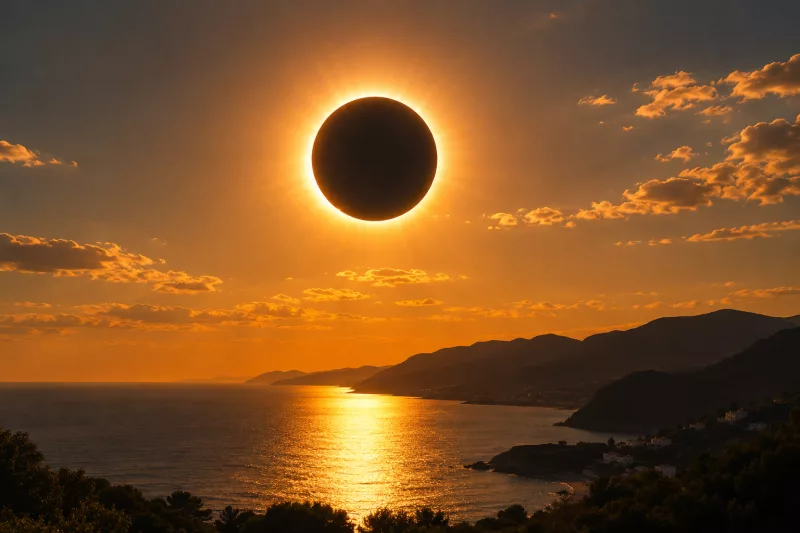
The maximum totality will last about 2 minutes and 18 seconds.
The eclipse will not be visible from Nairobi or most of Kenya, as the country is outside the eclipse’s visibility zone.
Anyone watching the eclipse from a location where it is visible should use approved solar viewing glasses rather than looking directly at the Sun.
Six-Planet Alignment — Where to See It
Before sunrise, skywatchers in favourable parts of the Northern Hemisphere will have an opportunity to see six planets appear together across the early-morning sky.
The planets are Mercury, Mars, Jupiter, Saturn, Uranus and Neptune.
The alignment does not mean the planets have physically formed a straight line. They only appear grouped from Earth’s perspective because their orbits around the Sun are broadly aligned.
The event will be best positioned for observers across parts of Europe, North America and other Northern Hemisphere locations.
Mercury, Mars, Jupiter and Saturn are the easier planets to identify, while Uranus and Neptune are much fainter and may require binoculars or a telescope.
Visibility will depend on the observer’s location, local weather and whether the planets are above the horizon at the right time.
Perseid Meteor Shower — Where to See It
After sunset, attention will shift to the Perseid meteor shower, which reaches its annual peak around August 12 and 13.
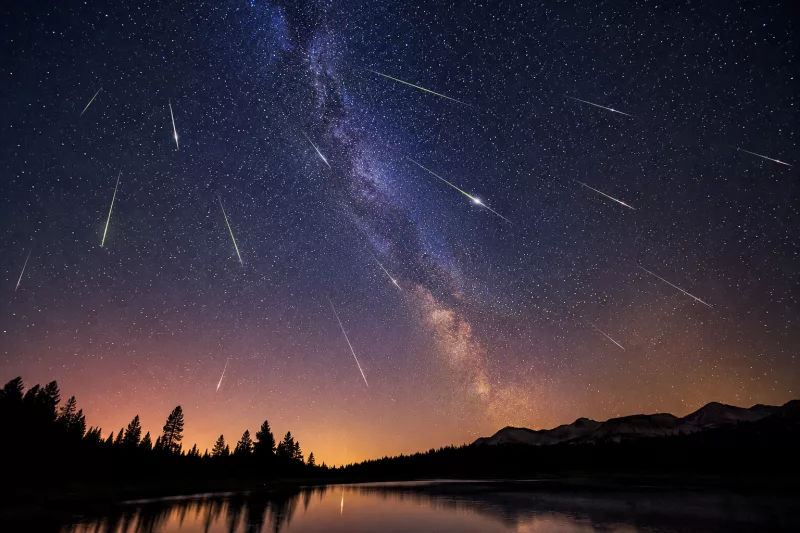
The Perseids occur as Earth passes through dust and debris left behind by Comet Swift-Tuttle. As the particles enter Earth’s atmosphere, they heat up and create bright streaks across the sky.
Under ideal conditions, the shower can produce up to about 100 meteors per hour.
This year’s peak has an additional advantage: it occurs around the New Moon, meaning there will be very little moonlight to interfere with observations.
The Perseids are best seen across the Northern Hemisphere, including Europe, North America and Asia. They can also be observed from Kenya and other parts of East Africa, although the display is generally stronger for observers farther north.
For people in Nairobi, the Perseids will be the main astronomical event to watch. A dark location away from city lights and clear skies will provide the best chance of seeing meteors.
For Kenyan skywatchers, the meteor shower is the most accessible of the three major events.
A Busy 24 Hours in the Sky
The three events will not be visible from every location. The eclipse is concentrated along a specific path, the planetary alignment favours Northern Hemisphere observers, while the Perseids offer a much wider viewing opportunity.
For skywatchers in Kenya, the Perseid meteor shower will be the highlight, while those in Spain, Iceland, Greenland and other parts of the eclipse path will have the opportunity to witness the day’s most dramatic event.