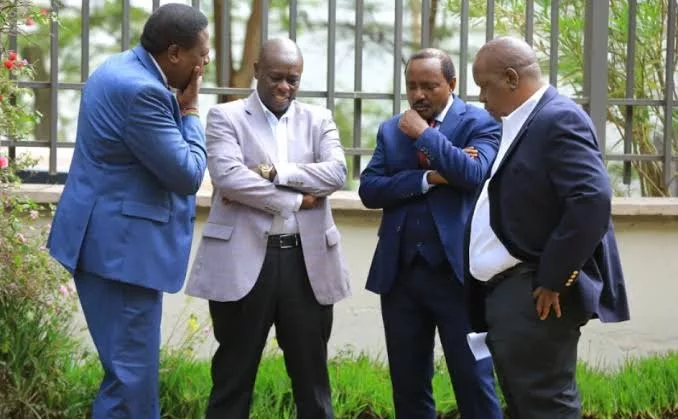
 United Opposition leaders Eugene Wamalwa, Rigathi Gachagua, Kalonzo Musyoka and Fred Matiang'i/HANDOUT
The battle over who will fly the opposition presidential flag is emerging as the coalition's biggest test ahead of next year's general election.
A bitter row has already rocked the emerging alliance, threatening to break it even before it formalises and settles on a candidate to face President William Ruto.
“As long as there is fragmentation in the opposition, their chances of taking on President Ruto will be impossible,” political analyst Calvin Muga said.
The united opposition team is made up of former Deputy President and DCP leader Rigathi Gachagua, Jubilee deputy party leader Fred Matiang'i, Wiper leader Kalonzo Musyoka and DAP-Kenya leader Eugene Wamalwa.
Others are PLP leader Martha Karua, Democratic Party leader Justin Muturi and Nairobi Senator Edwin Sifuna of the Linda Mwananchi movement. All are eying the presidency.
They all agree on the need to rally behind one candidate but have publicly disagreed on when to name the flag bearer, how to choose the candidate and who should lead the coalition heading into the high-stakes elections.
The disputes have exposed deep mistrust, with accusations of arrogance, bullying and hidden political agenda spilling into the open.
Each camp is also pulling strings to their end, while some principals are warning that they will not support certain leaders if they emerge as the coalition's presidential candidate.
Last week, Party of National Unity leader Peter Munya declared he would not support Gachagua if he is picked as the joint opposition candidate. He described the former deputy president as a bully.
"I'm hoping Gachagua is not a presidential candidate because I would not support that kind of person to run the country," Munya said.
He argued that Gachagua's leadership style mirrors the current regime that the opposition wants to remove from power.
"Those dictatorial tendencies are the same ones we are saying we don't want in the current government," he said.
Gachagua and his allies have dismissed the criticism and accused the other principals of being lazy. They insist the opposition candidate should be chosen based on political strength.
According to Gachagua, the coalition must first consolidate its support. Only then should it discuss the presidential ticket.
"How do you choose a candidate before you consolidate? We also need to look at the level of consolidation. What are your numbers?" Gachagua asked.
The principals have also disagreed over when to unveil the candidate.
Kalonzo, Karua, Muturi and Wamalwa want the coalition to announce its candidate early.
They argue that an early decision would give clarity, unite supporters and avoid last-minute confusion.
Muturi has warned that delaying the decision could trigger a repeat of the events of 2002, when Kanu struggled to contain internal divisions.
"Waiting till the tail end could be disastrous. There might be no time to control the damage from the fallout," Muturi said.
"I hope I will convince my colleagues. I do not believe naming a candidate early will make Ruto target that person. He should focus on him."
However, Gachagua has vehemently opposed the early naming of the opposition candidate.
He argues that naming a candidate too early would expose the person to political attacks, intimidation and state pressure.
Instead, he wants the principals to leverage the moment to consolidate their regional support before settling on one candidate.
"We are not in a hurry. I want to tell Kenyans that we have time," he said.
Gachagua has repeatedly cited the 2002 election when Mwai Kibaki was unveiled barely two months before polling day.
"In 2002, Mwai Kibaki was named on October 14 when the election was in December. We have a whole year. There is no hurry. We can even name a candidate as late as May 15, 2027."
Last week, Kitui Senator Enoch Wambua, a close ally of Kalonzo, claimed the coalition would unveil its candidate within two weeks.
"From the discussions we have had, and I believe I have the authority to say this, Kalonzo Musyoka will be given the united opposition flag in the next two weeks," Wambua said.
Earlier, Kalonzo had suggested the matter should be settled before December.
"I personally think we should agree on our flag bearer within the first quarter. Kenyans want certainty," he said.
Wamalwa said the coalition should choose its candidate about six months before the general election.
"We will only choose a candidate Kenyans want. The person must have no corruption cases, no blood on his hands, no questionable character and a proven track record," Wamalwa said.
Beyond the timing debate, suspicion has become another fault line.
Some opposition leaders accuse their colleagues of secretly working with the state. Others believe some principals are pursuing personal interests instead of opposition unity.
Gachagua's allies have openly questioned Matiang'i's commitment to the coalition. They claim he is being used to weaken the former deputy president.
"They want to go to Ruto. That is where they are headed. If you touch Gachagua, we will deal with you," Kiambu Senator Karungo Thangwa said in remarks widely seen as directed at Matiang'i.
The claims come amid reports that Ruto's allies have quietly reached out to Matiang'i. They are said to be trying to persuade him to join the broad-based government.
Kajiado North MP Onesmus Ngogoyo has also accused Matiang'i of aggressively pushing his presidential bid.
"Matiang'i thinks he must be president. We do not have any agreement to make him president," Ngogoyo said.
Matiang'i's camp has hit back with Kitutu Chache South MP Antony Kibagendi accusing Gachagua of undermining opposition unity through arrogance and intimidation.
"I would like to tell Gachagua that you are the biggest impediment to opposition unity. Stop arrogance. Stop belittling other opposition leaders. You are bullying your colleagues," Kibagendi said.
Kisii Senator Richard Onyonka also told a meeting Matiang'i attended that Gachagua's approach was making other coalition partners uncomfortable.
"We want to tell you, Gachagua, that you are making us uncomfortable with you," Onyonka said.
"You are telling us how you have numbers and no one should go to Mt Kenya because you have taken it to be your fiefdom, and you believe that many of us who don't have four million votes cannot be president of Kenya. We want to tell you this time, it is also our turn."
INSTANT ANALYSIS
The fight over the opposition's presidential ticket has exposed deep divisions that could weaken its bid to unseat President William Ruto. Disagreements over timing, selection criteria and leadership have fuelled mistrust, public spats and competing power centres. While leaders insist unity remains intact, the growing rivalry risks overshadowing the coalition's anti-Ruto agenda. How the opposition manages competing ambitions will determine whether it emerges united or heads into 2027 fractured and vulnerable.