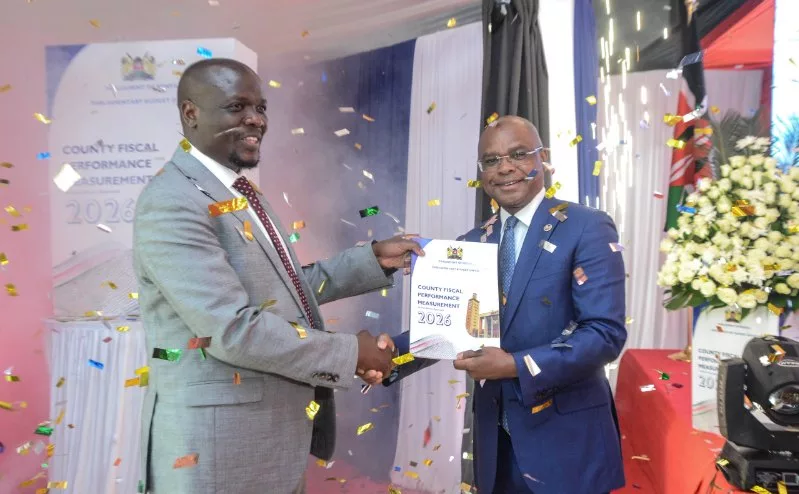
 Speaker of the Senate Amason Kingi and director Parliamentary Budget Office Martin Masinde display a booklet of a county fiscal performance measurement index during the official launch at Main Parliament on August 6, 2026 /DOUGLAS OKIDDY
A new Senate ranking of counties based on actual fiscal performance rather than public perception has upended the long-held narrative about the country’s best-performing governors.
The inaugural County Fiscal Performance Measurement Index, released on Thursday, shows several governors who have consistently ranked poorly in public opinion surveys outperformed colleagues who have traditionally dominated popularity polls.
The report, which assessed county performance during the 2023–24 and 2024–25 financial years, measures how devolved units managed public finances using objective indicators rather than public approval ratings.
For the 2024–25 financial year, Embu county under Governor Cecily Mbarire, Narok led by Governor Patrick Ntutu, Wajir under Governor Ahmed Abdullahi, Kitui headed by Governor Julius Malombe and Kilifi under Governor Gideon Mung'aro emerged as the top-performing counties.
In the previous financial year, Turkana, under Governor Jeremiah Lomorukai, topped the rankings, followed by Narok, Kitui, Wajir and Kwale, led by Governor Fatuma Achani.
Senate Speaker Amason Kingi launched the first-ever CFPMI, describing it as a landmark tool for objectively evaluating county governments.
"Since the advent of devolution, one of our greatest limitations has been the absence of a scientific and objective framework for measuring how counties perform against established public finance management indicators," Kingi said.
Majority leader Aaron Cheruiyot, Minority leader Stewart Madzayo, several senators and Senate Clerk Jeremiah Nyegenye attended the launch at Parliament Buildings.
Cheruiyot said the index would provide an evidence-based assessment of county performance.
"This is good progress for us as an institution. As we provide a fair assessment of what your county has done, we do so from a point of information," he said.
The report was prepared by the Parliamentary Budget Office, Parliament's fiscal think tank, which evaluated all 47 county governments using seven key indicators.
These include budget implementation, development expenditure, own-source revenue, county wage and benefits, pending obligations, county assembly expenditure ceilings and audit outcomes.
The assessment relied on data from the Office of the Auditor General and the Kenya National Bureau of Statistics for the 2023–24 and 2024–25 financial years.
"The tool uses min-max normalisation and weighting techniques in the computation of the composite score, grading counties into five tiers, namely A, B, C, D and E. Findings show systemic weaknesses in county performance," the report states.
The Senate ranking sharply contrasts with annual, semi-annual and quarterly opinion polls by research firms that measure governors based on residents' perceptions.
In the latest Infotrak survey released on Tuesday, Murang'a Governor Irungu Kang'ata emerged as the country's top-performing governor with an approval rating of 80 per cent.
He was followed by Trans Nzoia Governor George Natembeya at 76 per cent, Kiambu Governor Kimani Wamatangi at 71 per cent, Homa Bay Governor Gladys Wanga at 66 per cent and Makueni Governor Mutula Kilonzo Jnr at 66 per cent.
However, the Senate's fiscal index paints a different picture.
Murang'a ranked 33rd in the 2024–25 financial year and 28th in the previous financial year.
Trans Nzoia was placed 11th in both financial years, while Kiambu ranked 23rd in 2024–25 after placing 38th the previous year.
Homa Bay dropped from 17th in 2023–24 to 28th in 2024–25, while Makueni improved significantly from 29th to eighth.
The report identifies Wajir, Narok, Tana River, Kilifi and Kitui as the only counties that consistently finished in the top 10 in both financial years, highlighting sustained fiscal discipline.
At the other end of the rankings, Kisumu, led by Governor Anyang' Nyong'o, was the poorest performer in 2024–25, placing 47th.
Other counties in the bottom 10 were Kakamega under Governor Fernandes Barasa, Busia led by Governor Paul Otuoma, Bomet under Governor Hillary Barchok and Nairobi headed by Governor Johnson Sakaja.
Others were Baringo under Governor Benjamin Cheboi, Lamu led by Governor Issa Timamy, Kajiado under Governor Joseph Lenku, Bungoma under Governor Kenneth Lusaka and Meru, now under Governor Isaac Mutuma.
In the 2023–24 financial year, Nairobi ranked last, followed by Kisumu, Mombasa under Governor Abdulswamad Nassir, Machakos led by Governor Wavinya Ndeti and Nyamira under Governor Amos Nyaribo.
Others were Kajiado, Nyandarua under Governor Kiarie Badilisha, Laikipia under Governor Joshua Irungu, Kisii led by Governor Simba Arati and Kiambu.
Kisumu, Nairobi, Kisii and Kajiado featured in the bottom 10 in both financial years.
On budget implementation, also known as absorption, Turkana emerged as the best-performing county in 2024–25, followed by Kitui, West Pokot, Trans Nzoia and Nyeri.
The poorest performers in budget absorption were Kajiado, Nakuru, Kwale, Nyandarua and Kisumu.
In managing county wage bills, Embu ranked first, followed by Nakuru, Narok, Kilifi and Tana River.
The weakest performers in wage bill management were Kajiado, Nyeri, Nairobi, Baringo, Bomet, Homa Bay and Kisii.
The report also identifies pending bills as one of the biggest threats to county finances.
"Pending bills remain a critical challenge in county public finance management, reflecting gaps in budget execution, revenue collection and expenditure planning," the report states.
It notes that counties had accumulated pending obligations amounting to Sh226.61 billion as of June 30, 2024, posing significant fiscal risks and undermining service delivery.
Although the amount declined slightly, counties still owed Sh217.68 billion as of June 30, 2025.
On development expenditure, Kwale emerged as the top-performing county, followed by Mandera, Embu, Uasin Gishu, Kericho and Siaya.
The poorest performers in development spending were Taita Taveta, Nyamira, Nairobi, Elgeyo Marakwet, Kisumu, Vihiga and Nandi.
The report notes that many counties continue to fall below the legal threshold for development spending.
According to Section 107(2)(b) of the Public Finance Management Act, county governments are required to allocate at least 30 per cent of their total budgets to development expenditure.
"However, the data reveals that many counties are falling short of this threshold, with only a few surpassing the 30 per cent mark," the report states.
On own-source revenue, Tana River emerged as the best-performing county, followed by Kirinyaga, Wajir, Samburu, Tharaka Nithi and Elgeyo Marakwet.
"OSR performance is measured by comparing actual revenue collections against annual targets, with a ratio of 100 per cent or above indicating optimal performance," the report states.
The weakest performers in own-source revenue collection were Kisumu, Kakamega, Homa Bay, Baringo, Lamu and Busia.
Lamu topped the rankings on the settlement of pending bills, followed by Elgeyo Marakwet, West Pokot, Nyeri, Baringo, Samburu and Kirinyaga.
The poorest performers in clearing pending bills were Nairobi, Kilifi, Kiambu, Nakuru, Narok, Kisumu and Nyandarua.
On audit performance, Embu, Homa Bay, Kajiado, Kitui, Kwale, Machakos and Makueni emerged as the best-performing counties.
However, the report found that 37 counties shared the lowest audit performance rating, underscoring widespread weaknesses in financial management and accountability across devolved units.
The Senate ranking of the counties is likely to trigger murmurs among governors who have long-running battles with lawmakers.