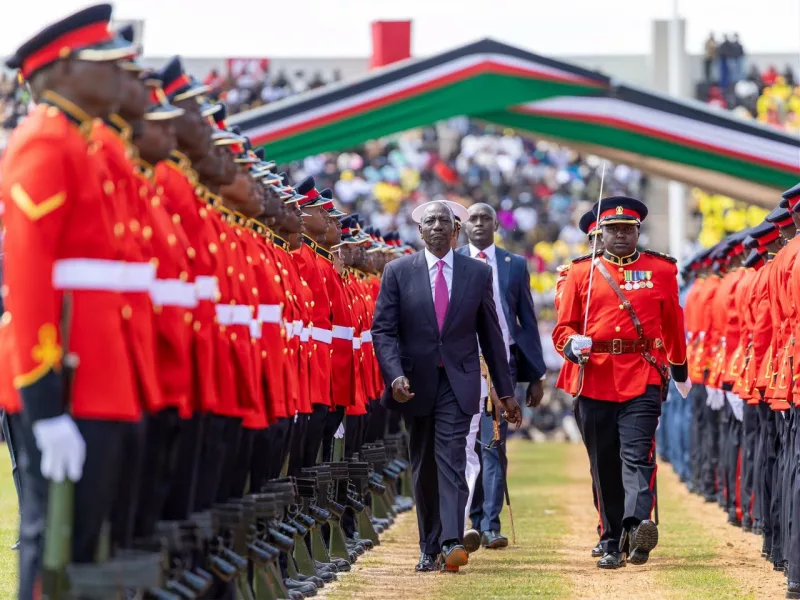
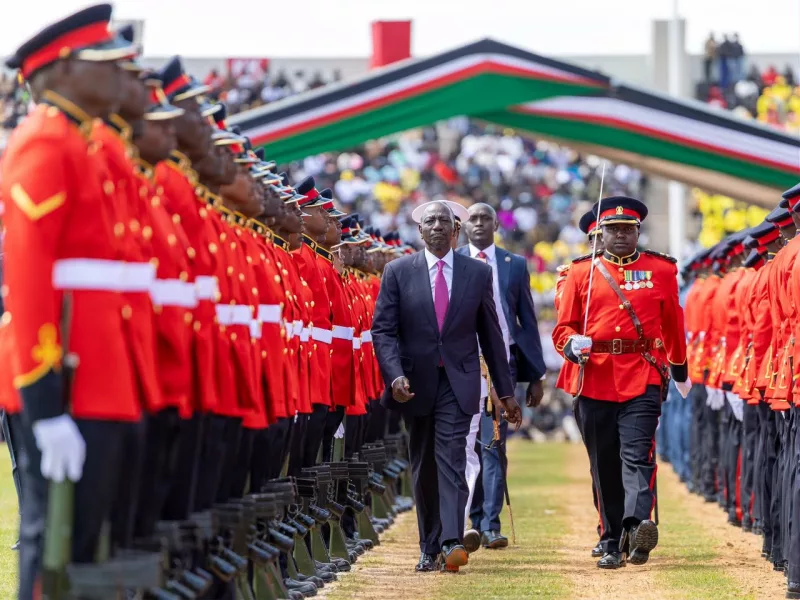
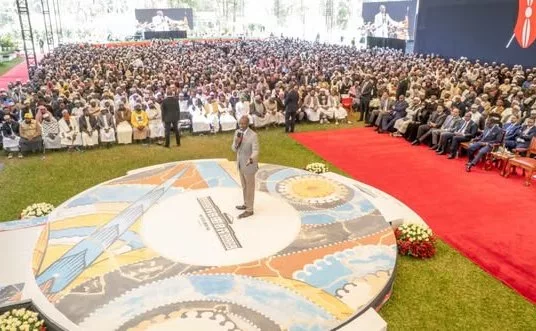
 President William Ruto, during a meeting with Muslim leaders at State House in Nairobi on Wednesday, August 5, 2026/ HANDOUT
President William Ruto has embarked on a fresh political strategy to expand and strengthen his grassroots political machinery ahead of the high-stakes general election next year.
The President has escalated meetings with influential groups key to popularising his administration's agenda at the village level and bolstering his re-election bid.
This week alone, Ruto has hosted thousands of religious leaders, village elders and other influential groups at State House, Nairobi, urging them to champion his development agenda across the country.
"Are you ready? Will you help me spread this word to the people in the villages?" Ruto asked village elders as supporters responded with chants of "Tutam” on Tuesday.
On Thursday, the President is expected to host more than 5,000 private security guards at State House, where he is set to unveil reforms aimed at improving the welfare of the officers.
There are more than 1.2 million private security guards, making the sector a significant voting bloc.
The meeting follows Wednesday's engagement with more than 9,000 Muslim leaders, Tuesday's meeting with over 10,000 village elders and Monday's gathering with more than 5,000 Friends Church (Quakers) faithful.
In recent months, Ruto has also held similar meetings with chiefs, National Government Administration Officers, youth and women's groups, church leaders and other grassroots actors.
The meetings underscore a deliberate strategy to build political networks through opinion leaders who wield influence in villages, churches, mosques and local communities.
An invitation issued by the Private Security Regulatory Authority (PSRA) directed private security firms, industry associations and the Kenya National Private Security Workers Union to send guards to Thursday's meeting.
"The purpose of this letter is to formally invite Private Security Officers (Security Guards) from your security firm, association, or union to attend a meeting scheduled to take place at State House, Nairobi," reads the letter signed by PSRA Chief Executive Officer Philip Leakey Okello.
During Wednesday's meeting, Ruto used the platform to court the Muslim community, highlighting what he described as his administration's efforts to end decades of discrimination against Muslims, particularly those from the Northeastern region.
He cited the abolition of discriminatory vetting in the issuance of national identity cards and passports, the opening of passport offices in Garissa and Mombasa, and increased investment in historically marginalised regions.
"I signed a proclamation removing discriminatory vetting. Every Kenyan must be treated equally. Today, all our children are treated the same," Ruto said.
"I want to assure the Muslim community that they are at the centre of all the projects and programmes we are undertaking. What we have done, we can even do more."
The President announced a Sh70 million donation towards the purchase of land for the development of madrassas.
Prime Cabinet Secretary Musalia Mudavadi urged Muslim leaders to rally behind Ruto's re-election, saying the President deserved a decisive victory that would not end up in court.
"Next year, I urge you to come out in large numbers and vote for President Ruto. Let us have a victory without petitions. Petitions are divisive, expensive and delay development," Mudavadi said.
Health Cabinet Secretary Aden Duale declared that the Muslim community would support Ruto, citing what he termed the President's commitment to inclusivity, equitable development and equal access to government services.
"When the time comes, we shall stand with you. With everything you have done — inclusivity in government, equity in sharing the national cake and development — we will vote for you," Duale said.
Ruto dismissed the opposition's growing popularity, arguing that political slogans alone would not deliver victory in 2027.
Without naming anyone directly, Ruto appeared to target Linda Mwananchi movement leader Edwin Sifuna and DCP leader Rigathi Gachagua, whose "Kasongo Must Go" campaign has gained traction across the country.
"Some people think they will play cards with us using 'Kasongo Must Go' and win. It is not going to work that way," Ruto said.
"You must tell Kenyans how you will deal with the cost of living and how you will transform our economy. That is the difficult task."
He accused his rivals of thriving on political rhetoric instead of offering practical solutions to Kenya's economic challenges.
In another apparent jab at the opposition, Ruto mocked criticism of the Affordable Housing Programme, saying critics had reduced the debate to whether a chicken could climb to the seventh floor.
"I have asked those competing with me, what is your plan, vision and agenda? The biggest problem they have with housing is how a hen will climb to the seventh floor. If that is the alternative we have, then we have a problem," he said.
Ruto maintained that his administration's flagship programmes, including affordable housing, the Social Health Authority and infrastructure projects, would ultimately earn public support.
He also defended his proposed National Development Charter, Vision 2060, saying Kenya must shift its focus from endless politics to long-term economic transformation.
"I want us to start a conversation on the development and economic transformation of Kenya. Some people don't want us to talk about that. They want us to talk about politics," he said.
"Without a plan, we are doing guesswork. Kenya cannot change through empty rhetoric and noise."
The outreach forms part of Ruto's sustained offensive to consolidate influential voting blocs as he prepares for the 2027 election.
At Tuesday's meeting with village elders, the President announced a Sh3,000 monthly stipend, smartphones, health insurance and leadership training for more than 106,000 elders who have now been incorporated into the National Government Administration system.
"We start from here (Sh3,000) and when we cross the next election, we will push it even higher," Ruto told the cheering crowd.
"This is not a reward for patriotism. It is recognition of the service you have rendered to your communities."
He challenged the elders to champion Vision 2060, saying the national conversation must reach every village and household.
"This conversation cannot be for the government alone. It must reach every county, every ward, every village and every household," he said.
Mudavadi openly asked the elders to help secure Ruto a landslide victory in 2027.
"I ask elders to help President Ruto win the next election by a landslide because his development record speaks for itself," he said.
ODM leader Oburu Oginga backed the programme, describing it as the first serious effort by any administration to recognise the role of village elders.
"This is the only administration that has appreciated the work of village elders. Previous governments never implemented such a programme," Oburu said.
He dismissed criticism that the initiative would increase public spending, arguing the resources were directly benefiting ordinary Kenyans.
Oburu also reaffirmed that ODM would not field a presidential candidate in 2027 and would instead support Ruto's re-election.
INSTANT ANALYSIS
Ruto's aggressive outreach reflects a calculated effort to build a formidable grassroots political machine ahead of the 2027 election. By targeting influential groups such as village elders, Muslim leaders, clergy and private security guards, he is creating networks capable of shaping public opinion at the local level. Coupled with welfare incentives and development messaging, the strategy seeks to counter a resurgent opposition led by Rigathi Gachagua and Edwin Sifuna by shifting the campaign from protest politics to service delivery and economic transformation.