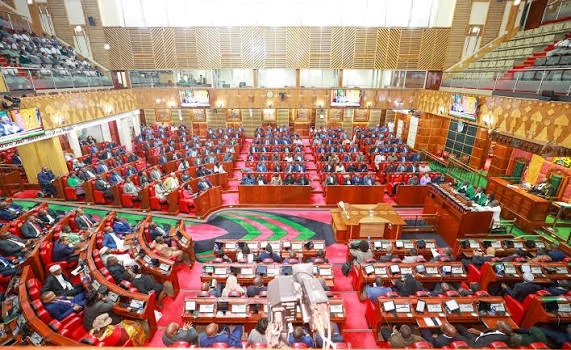
 MPs in session at Parliament Buildings
The National Assembly was forced to cut short its Wednesday morning sitting after lawmakers failed to raise the minimum number required to transact business, disrupting debate on several Bills and motions lined up for consideration.
Presiding Speaker David Ochieng’ (Ugenya MP) adjourned the sitting after the quorum bell rang for the required period but the House still failed to attain the mandatory 50 members.
The Speaker expressed disappointment at the development, noting that Parliament had only one year remaining before the next general election and still had a heavy legislative agenda.
“It is unfortunate that we have to adjourn yet Wednesday morning is members’ business. We have only one year to election and we have a lot of business lined up,” Ochieng’ said.
The adjournment came at a time when MPs were scheduled to debate a number of Bills and motions touching on key sectors, including transport, employment, education, agriculture and healthcare.
Among the legislative items affected was the Foreign Service (Amendment) Bill, 2026, sponsored by Charles Ngusya, which was scheduled for First Reading.
The House was also expected to resume debate on the National Transport and Safety Authority (Amendment) Bill, 2023, sponsored by Didmus Barasa, which had been carried forward from the previous sitting.
Other Bills on the order paper included the Kenya Roads (Amendment) Bill, 2024, sponsored by Naisula Lesuuda, which was scheduled for consideration at the Committee of the Whole House stage.
The Micro and Small Enterprises (Amendment) Bill, 2025, and the Employment (Amendment) Bill, 2023, both sponsored by Barasa, were also lined up for Second Reading.
The failed sitting also delayed debate on a series of motions seeking policy changes in various sectors.
One of the motions, sponsored by Rahab Mukami, sought the introduction of mandatory guidance and counselling programmes in all primary and secondary schools.
Mukami wants the Ministry of Education to establish a structured and time-tabled counselling programme, develop a national framework for recruiting and accrediting professional school counsellors, and integrate mental health education, child protection awareness and life skills training into the curriculum.
Another motion by Gertrude Mbeyu proposed a policy framework to allow structured engagement of National Youth Service (NYS) graduates as supplementary security officers in government institutions.
Mbeyu argued that with about 18,000 youth graduating from NYS annually, the government should create opportunities for them by prioritising their engagement in public institutions while maintaining space for private security firms.
The proposed framework would provide guidelines on recruitment, deployment, remuneration, training and career progression for NYS graduates engaged in security roles.
Gathoni Wamuchomba’s motion on reducing electricity costs for export-oriented agriculture was also affected by the quorum failure.
The legislator wants the government to formulate a power subsidy policy targeting producers, cooperatives, processors and exporters dealing in key agricultural commodities such as coffee, tea, avocados, cut flowers, macadamia nuts and cashew nuts.
She argued that high electricity costs were hurting Kenya’s competitiveness in international markets by increasing expenses associated with irrigation, cold storage, processing and value addition.
The motion comes amid efforts to expand agricultural exports following new market opportunities, including duty-free access to the Chinese market for selected Kenyan products.
Education reforms were also set to take centre stage through a motion by Clive Gisairo seeking changes in senior school admissions, capitation and infrastructure management.
Gisairo raised concerns over overcrowding in Category One and Two schools following the introduction of senior school admissions under the Competency-Based Curriculum.
He proposed a review of the capitation model to reflect actual school capacity and guidelines limiting the number of streams in different categories of schools.
The motion also called for accelerated infrastructure upgrades in Category Three and Four schools to reduce pressure on high-demand institutions.
The House was further scheduled to debate a motion by George Murugara seeking a policy framework on recruitment and remuneration of Community Health Promoters.
Murugara said the health workers remained central to primary healthcare delivery but continued to operate under inadequate facilitation and low pay.
The quorum failure highlights growing concerns over attendance as Parliament enters the final year before next year’s general election.