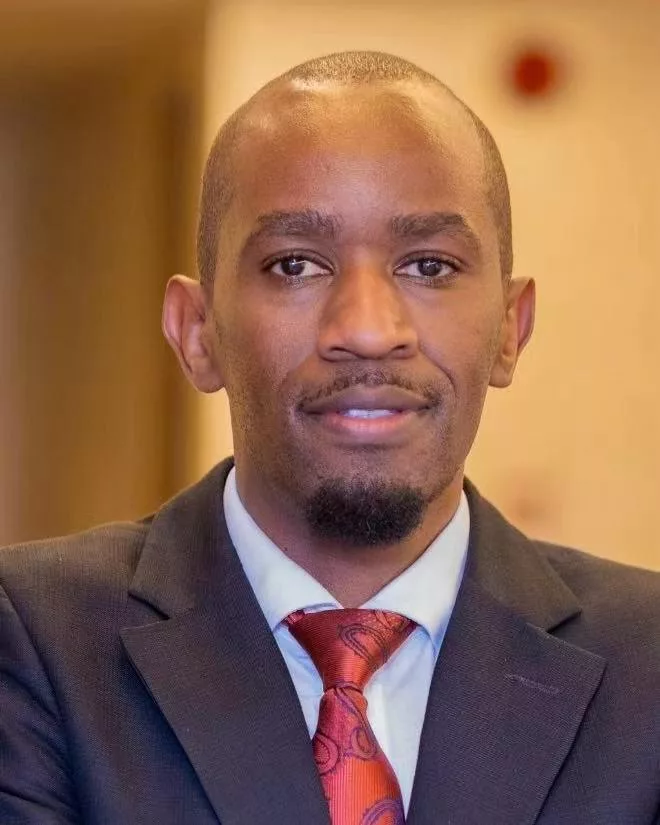
 Dr Dennis Munene, Executive Director of the China-Africa Centre at the Africa Policy Institute.
On August 12, President William Ruto will lead Kenyans in a futuristic national conversation to support the country’s long-term transformation agenda beyond Vision 2030. This conversation comes four years before the conclusion of the Vision 2030 development blueprint.
While some view the conversation as Ruto’s 2027 re-election manifesto launch, forward-looking Kenyan’s see it as a timely roadmap defining our country's future development beyond next year's general election. This futuristic national conversation is not just limited to Kenya.
It is a movement that will also prompt the global community to assess its 2030 United Nations Agenda for Sustainable Development (SDGs), with most countries, including Kenya, off target.
However, countries such as China have managed to attain critical targets of the 2030 UN SDGs, such as poverty alleviation, through its bold centennial goals guided by its strategic Five-Year Plan for national economic and social development.
While Kenya's political, economic, and social agendas may differ from those of China, valuable lessons can be drawn from China’s national economic and social development that helped the country move from a GDP per capita of approximately US$200 in 1980, lower than Kenya’s US$450, to become the second largest economy in the world with a GDP per capita of more than US$14,000.
Having attained its first centenary goal of building a moderately prosperous society in 2021, the country is on a bold trajectory of achieving its second centenary goal of creating a great modern socialist country by 2049.
These lessons are not about replicating China’s model but about adopting a strategic futuristic plan that promotes sustainable and inclusive development.
First, China's development success has largely been anchored on consistency in long-term national planning. Since 1953, the country has implemented successive Five-Year Plans that translate long-term national aspirations into measurable goals.
Each plan aligns the government priorities towards common objectives. Unlike many developing countries such as Kenya, whose development plans often change after every election cycle, China’s planning system has ensured continuity regardless of leadership transitions.
A post-Vision 2030 framework needs to be anchored in a legislative mechanism within our constitution to safeguard its continuity, knowing our political parties tend to have a ‘high short-term mortality rate’.
Second, China’s futuristic and long-term national goals have been anchored in a strong political party, the Communist Party of China, whose goals and those of the country are one.
Other minor and non-oppositional political parties, such as the Revolutionary Committee of the Chinese Kuomintang, fully support the Five-Year national economic and social development plans under the CPC. Thus, in a multi-party system like Kenya, the ruling party and the opposition parties need to come together and chart a post-Vision 2030 agenda, each committed to implementing the agenda if any is elected to form the next government.
Third, long-term national goals are of importance. China's first centenary goal aimed at building a moderately prosperous society by 2021, coinciding with the centenary of the CPC. This goal mobilised national resources around key strategic issues such as poverty reduction, among others.
In the next few days, Kenya will embark on the path to chart a new Kenya. This Vision can be targeted to coincide with the African Union Agenda 2063 to tap into the continent's rising narrative, moving it from local political mischief that may dilute the bigger agenda for Kenya.
Fourth, China’s scientific planning with extensive public consultation has enabled the Five-Year Plans to be a success. The CPC Central Committee formulates and adopts the recommendations of the specific Five-Year Plan.
A leading group and drafting team are established to refine strategic visions. The drafting team conducts over 40 field trips to diverse regions and convenes more than 50 thematic symposiums.
Research institutions produce nearly 200 supporting reports. An online initiative titled “seeking ideas and strategies for the draft outline” is conducted, with a total of nearly 70,000 high-quality suggestions collected in the campaign.
Specialised National People’s Congress (NPC) working committees carry out targeted research and produce more than 20 special research reports. After that, the State Council holds multiple symposiums to hear ideas from all groups, and the NPC votes to pass the plan, which is now at its 15th Five-Year Plan. This process is what Kenya needs to implement.
The notion of a few experts and scholars sitting in a boardroom and designing an agenda beyond Vision 2030 is dead on arrival. An all-society approach is needed. Universities, research institutions, think tanks, private sectors, civil societies, youth and marginalised groups, and county governments should play a more prominent role in informing areas of priorities.
This will help the country undertake a sequential development approach and ensure we have comprehensive data on areas of focus, such as strategic industries, including manufacturing, high technology, renewable energy, biotechnology, and artificial intelligence, needed to move Kenya to become an industrialised, modern, and upper-income country beyond Vision 2030.
Last but not least, China undertakes extensive regular monitoring and an independent evaluation process on its Five-Year Plan. Since the launch of Vision 2030 on June 10, 2008, by former President Mwai Kibaki, no comprehensive national review of the blueprint has been undertaken until now.
Subsequent administrations have been implementing the blueprint through successive five-year frameworks like the Second and Third Medium-Term Plans (MTP II and MTP III). Even so, the younger generation has been void of its implementation.
Thus, as Kenya begins the national conversation on its development trajectory beyond Vision 2030, as a country we now have a rare opportunity to design a more resilient, inclusive, and forward-looking development blueprint, not an afterthought to silence the One-Term and Two-Term political campaign slogans.
Dr Dennis Munene is the Executive Director of the China-Africa Centre at the Africa Policy Institute.