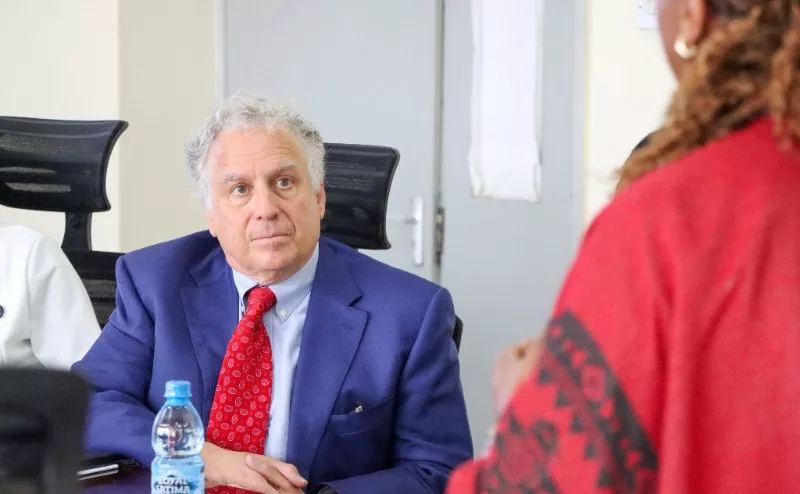
 IAVI President and CEO Dr Mark Feinberg
For more than 40 years, Dr Mark Feinberg has chased one of medicine's toughest goals: a vaccine against HIV. As president and CEO of the International Aids Vaccine Initiative (IAVI), a global non-profit that develops vaccines for diseases that hit poor countries hardest, he has spent his career pushing that dream closer to reality.
QUESTION: During your visit you met with the Minister of Health, the Kenya BioVax Institute Ltd and also visited other institutions. What is your overall assessment of Kenya's scientific capacity today, and where do you see the biggest opportunities for growth?
FEINBERG: IAVI has been working with Kenyan partners for essentially two decades. We've had very productive engagements with a range of stakeholders. We've always viewed the Kenyan scientific community and the Kenyan government as key partners, and we're very pleased to have seen just how much great talent in the scientific arena has emerged in Kenya in the fight against HIV and other infectious diseases.
How do you decide which diseases or vaccine candidates deserve IAVI’s investment, especially when resources are limited?
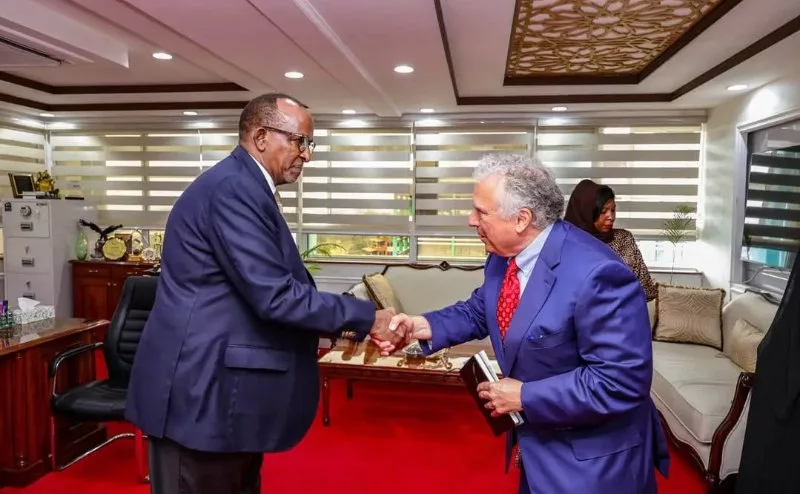 IAVI President and CEO Dr Mark Feinberg with CS Aden
 You have been pursuing an HIV vaccine for a long time. Looking at where the science stands today, how optimistic are you that we'll have something that actually works soon?
I've been working in HIV since 1984, so more than 40 years. I've been asked that question a lot over the years, and I've given different answers at different times. But the answer I'll give you today is different from what I've been able to give in many instances in the past, and that is: I'm more optimistic about the potential for an HIV vaccine now than I've ever been before.
The scientific efforts that have gone into HIV vaccine research have been extraordinarily informative. We don't have a vaccine yet, not because there's been a lack of effort or innovation, but because HIV is such a difficult virus to develop a vaccine against.
It's highly variable, and once someone is infected with the virus, they're infected for life; their immune system is unable to clear it. That's different from the diseases for which vaccine development has been successful in other instances. So to make an HIV vaccine, we basically have to do something that's never been done before.
While there have been frustrations and disappointments along the way, we now have a very clear vision for what it's going to take to make an efficacious HIV vaccine. The approach we're taking is focused on inducing so-called broadly neutralising antibodies in people who receive the vaccine. Those antibodies are able to bind to the HIV virus and prevent it from establishing infection. We now have a very good idea of which regions of the virus are most vulnerable to those broadly neutralising antibodies, and increasingly good ideas about how to elicit specific immune responses against those vulnerable regions.
The data we've generated so far in early-phase clinical trials is very encouraging. It lets us think we're on the right track. These studies are done in partnership with a range of stakeholders across Africa and across the world, but many of them are located at KAVI-ICR and Kemri, especially at the Kilifi site.
The data they're generating is really impressive. I can't tell you exactly how long it's going to take, but for the first time, I see a clear path we can follow to get to an HIV vaccine. It's not going to happen soon enough — I want it to be available tomorrow. Is it going to take three years, five years, ten years? I don't know.
Africa is a net consumer of vaccines. We import about 99 per cent of human vaccines used locally. But now there are a lot of clinical trials happening in Kenya, Rwanda, Uganda, and many other African countries. Do you believe the continent is finally becoming a genuine developer and manufacturer of vaccines, or how long do we still have to go?
I think Kenya has a lot of the skills to contribute to product development. But there are additional capabilities that go beyond what academic groups are typically familiar with — additional skills in, say, pharmaceutical product development. IAVI is very supportive of providing whatever expertise we have, so that investigators and developers in Kenya gain those skills and insights.
We fully support the aspirations for greater regional manufacturing on the continent. We're working with partners in Senegal, at the Institut Pasteur de Dakar, to transfer some of our vaccine candidates so they could be produced on the African continent, and we're very interested in exploring partnerships with Kenyan scientists and the Kenya BioVax Institute, so that whatever skills and insights we have could be made available to Kenyan product developers and manufacturers, to help them achieve their aspirations of regional manufacturing on the continent. It's going to take some time, and again, focused and sustained investment, to achieve that goal. But I'm optimistic that it will be achieved.
END