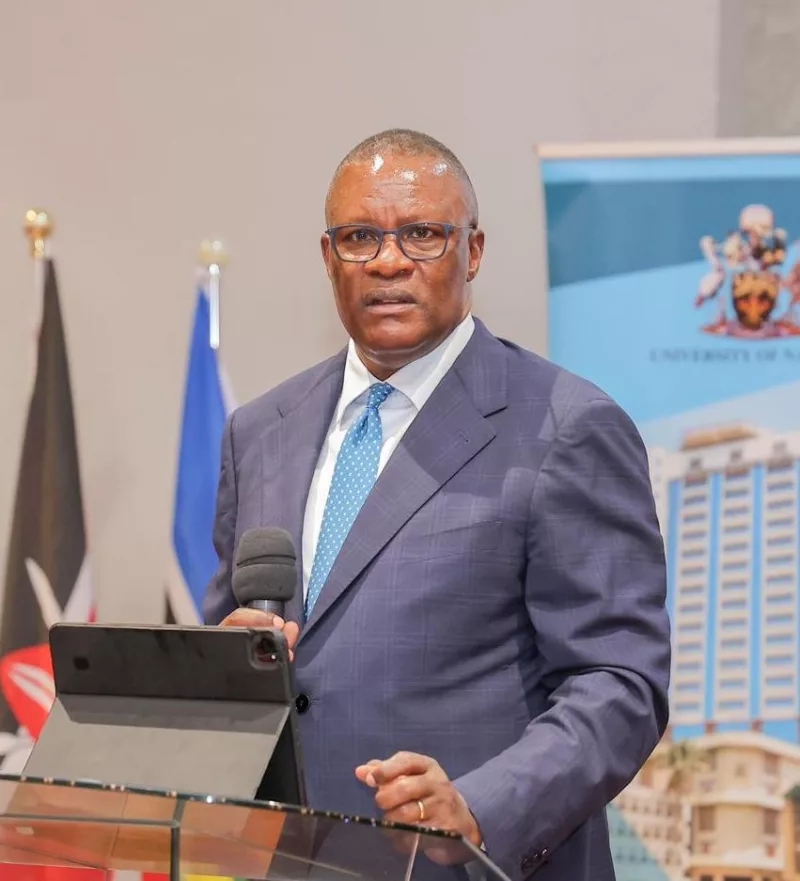
 Presidential aspirant Eliud Owalo has called for retention of live streaming of election results./ Faith Matete
 Presidential aspirant Eliud Owalo has called for the retention of live streaming of election results, saying the practice is crucial to strengthening transparency, public trust and the integrity of Kenya's electoral process.
Owalo said Kenyans should be allowed to follow the announcement of election results in real time, arguing that openness would help reduce suspicion, curb misinformation and promote confidence in electoral institutions.
He said live streaming gives citizens, candidates, political parties, election observers, the media and other stakeholders an opportunity to monitor a critical stage of the electoral process as results are announced at polling stations.
"Kenya's democracy belongs to all of us. It should be built on the confidence citizens have in the fairness, openness and credibility of our elections," Owalo said.
He said any proposed changes to electoral laws should be assessed based on whether they strengthen public confidence or create doubt about the credibility of elections.
Owalo maintained that live streaming should not be viewed as a threat to the electoral process but as an important tool for enhancing accountability when supported by proper safeguards.
He said electronic transmission of results, public access to election forms, physical tallying, independent observation, media coverage and live streaming should complement one another in protecting the integrity of elections.
"Our electoral history has taught us that when citizens feel excluded from information, suspicion grows. When suspicion grows, misinformation spreads, political tensions rise, and confidence in institutions is weakened," he said.
Owalo said Kenya should focus on improving the management of live streaming rather than reducing transparency in the electoral process.
He called for stronger verification procedures, enhanced cybersecurity, protection of transmission infrastructure, credible audits and proper preservation of election records.
The presidential aspirant said transparency should be treated as a democratic responsibility, not a burden, adding that the integrity of official election results can be protected while allowing the public to observe the process in real time.
"We can protect the integrity of official results while still allowing Kenyans to observe the process in real time. These goals are not in conflict. They are both essential to a credible election," he said.
Owalo urged policymakers to avoid measures that could create unnecessary doubt among voters and instead invest in technology and safeguards that would improve confidence in the management of elections.
He said Kenya should retain live streaming as part of a broader election transparency framework ahead of the 2027 General Election.
"Our duty should be to protect the vote, strengthen verification and ensure that every Kenyan can have confidence in both the process and the final result," Owalo said.
The Independent Electoral and Boundaries Commission (IEBC) has since dismissed reports that it plans to ban live-streaming of election processes and results during the 2027 General Election, assuring Kenyans that the media will remain a key partner in promoting transparency and accountability.
IEBC Chairperson Erastus Ethekon said the commission had neither made a decision nor proposed to Parliament any measure aimed at stopping the media from live-streaming election proceedings.
"I would like to assure the people of Kenya that there is nothing like that whatsoever," Ethekon said.
He said the commission would be the last institution to introduce measures that undermine the media's role in scrutinising electoral processes, insisting that transparency remained a central principle of the IEBC's work.
"This commission stands for transparency and accountability, and we will be the last people to make any decision or any proposals to stifle the freedom of the media to check what we are doing, including live-streaming of the election processes," he said.
Ethekon challenged those behind the reports to explain the source of the information, describing the claims as misinformation and propaganda.
"Whoever manufactured that story, we need to know where they found those stories from. As IEBC, we want to state here categorically that we have not made any such decision. Neither have we made any proposals to Parliament to try and stop live-streaming," he said.
The chairman said the commission had instead been working closely with media organisations to strengthen collaboration ahead of the 2027 polls.