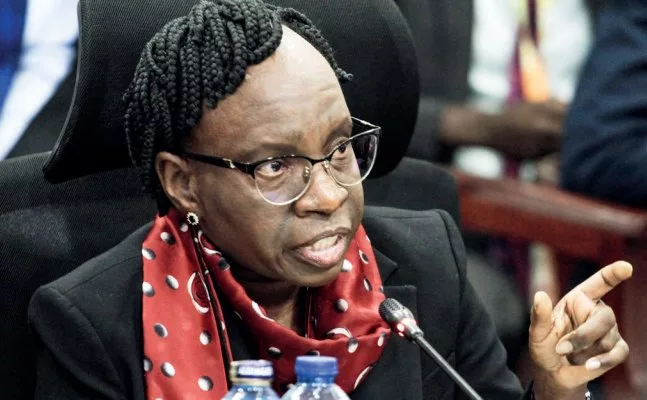
 Auditor General Nancy Gathungu /ENOS TECHE
Kikuyu and Luo employees make up the largest ethnic groups at the Office of the Auditor General, even as the institution expands representation to 35 of Kenya’s 46 ethnic communities.
The latest diversity report by Auditor General Nancy Gathungu shows that Kikuyu account for 24.33 per cent of the workforce, followed by Luo at 21.79 per cent.
Kalenjin and Kamba each account for 8.48 per cent and 8.63 per cent respectively, while Luhya make up 8.63 per cent and Kisii 8.24 per cent.
Other communities represented include Meru at 4.58 per cent, Mijikenda at 2.10 per cent, Somali at 2.97 per cent, Maasai at 1.51 per cent, Taita at 1.32 per cent, Embu at 1.66 per cent, Borana at 0.59 per cent and Pokomo at 0.73 per cent.
The report also lists representation from smaller and minority communities, including Arab, Nubi, Taveta, Swahili, Rendille, Asian, Ilchamus/Njemps, Dorobo, Sakuye, Orma, Bajuni, Ogiek, Mbeere and Burji.
Gathungu presented the report to the Senate Standing Committee on National Cohesion, Equal Opportunity and Regional Integration on Tuesday, saying the office had made measurable progress in promoting diversity and inclusion.
The number of ethnic communities represented in the office has increased from 24 in 2023 to 34 in 2025 and 35 this year.
Gathungu said the office was committed to ensuring that recruitment was based on merit while taking into account the need for wider representation of Kenya’s communities.
“The Office of the Auditor General has undertaken deliberate and measurable progress in advancing diversity, equity and inclusion within our workforce,” she said in the report.
The ethnic diversity figures come alongside a near-balanced gender composition.
Men account for 56 per cent of the workforce while women make up 44 per cent, placing the office within the constitutional requirement that no more than two-thirds of members of an appointive public body should be of the same gender.
The office has also recorded a significant increase in the proportion of young employees.
Workers aged between 18 and 35 now account for 36.4 per cent of staff, up from 29.4 per cent in 2025.
More than 60 per cent of employees are below the age of 40, providing a pool of younger officers who can be groomed for future leadership and critical roles.
The office has also increased the number of employees with disabilities.
Their representation has risen from 34 staff, or 2.07 per cent, in 2023 to 38 employees, or 2.09 per cent, in 2025 and 61 employees, representing 2.97 per cent, in 2026.
Recruitment over the past three years also points to efforts to widen representation.
The office recruited 569 permanent and pensionable employees during the period, with 323 men and 246 women.
Of those recruited, 388, or 68 per cent, were aged between 18 and 35.
Some 24 persons with disabilities were recruited, accounting for 4.2 per cent of the new employees.
Gathungu said the office would continue to close the remaining gaps through equitable recruitment, promotion, mentorship and leadership training.
However, the report shows that gender imbalance persists at senior management level, where men account for 76.47 per cent and women 23.53 per cent.
Two persons with disabilities currently serve in senior leadership positions.
Gathungu said the office would continue to pursue inclusion while applying the same standards of accountability to its own workforce that it applies when auditing other public institutions.