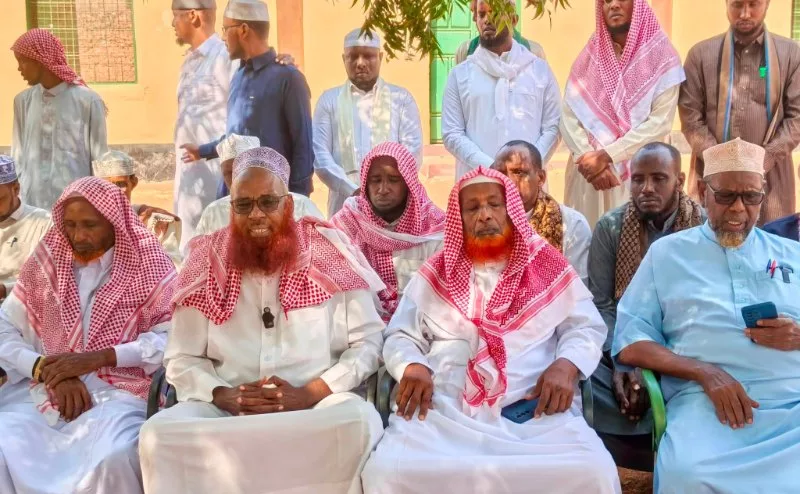
 Religious leaders from Wajir after attending
a meeting on combating human trafficking and illegal migration at Madarstul Al
Fatah Islamiya in Wajir town /STEPHEN ASTARIKO
Religious leaders from Wajir after attending
a meeting on combating human trafficking and illegal migration at Madarstul Al
Fatah Islamiya in Wajir town /STEPHEN ASTARIKO
Religious leaders in Wajir have raised concerns over rising cases of human trafficking, illegal migration and drug abuse.
They warned the growing vices are destroying the lives of young people and threatening the social fabric of communities across the county.
The leaders convened a meeting in Wajir town to discuss ways of tackling the problem and identifying lasting solutions.
The forum, organised by the Supreme Council of Kenya Muslims (Supkem), brought together imams and Islamic scholars from across the county under the leadership of the organisation's Northeastern regional coordinator, Adam Yunis.
He said human trafficking has become increasingly prevalent in Northeastern because of its proximity to international borders and established migration routes. He said the problem has been worsened by rising drug abuse among young people.
Yunis warned that traffickers and criminal networks are exploiting vulnerable young people by luring them with promises of lucrative jobs and better opportunities abroad, only for many to end up in forced labour, exploitation or other forms of abuse.
He said reversing the trend will require sustained collaboration between families, religious institutions, community elders, government agencies and political leaders.
"Protecting our young people is a shared responsibility that cannot be left to one institution alone," Yunis said.
Sheikh Abdullahi Amiri urged parents to be more vigilant and take greater responsibility for monitoring their children's movements, saying many families were unknowingly exposing their children to criminal syndicates.
"We are appealing to parents to be vigilant and aware of where their children are. There is a worrying problem not only in Wajir county but across the entire Northeastern," he said.
"There are people treating our children as commodities, and we are all aware of the growing menace of human trafficking."
Amiri likened traffickers to "marauding and lurking hyenas", saying they prey on vulnerable families and innocent young people.
He challenged political leaders to make the fight against human trafficking a priority before the problem escalates further.
"We call upon our local leaders to take this matter seriously and expand their efforts to protect the community from traffickers. This problem requires urgent intervention before it gets out of hand," Amiri said.
The clerics also urged security agencies to intensify operations against trafficking networks and individuals facilitating illegal migration, arguing the authorities have sufficient intelligence to dismantle the criminal rings.
"Government agencies know what is happening within our towns and communities. They understand the movements taking place and must now act decisively to deal with traffickers and safeguard innocent citizens," Sheikh Amiri said.
The religious leaders appealed to those involved in cross-border trafficking to abandon the illegal trade, saying it continues to rob families of their children while exposing victims to suffering and exploitation.
"The perpetrators of this crime must stop these activities and fear God. We equally urge members of the public to join hands in fighting human trafficking because protecting our children is a collective responsibility," he added.
Supkem official Sheikh Hassan Ahmed said parents have a critical role in protecting children from criminal exploitation, lamenting that many have neglected their responsibilities.
"Parents have failed to take full responsibility for their children. Many young people remain outside their homes until very late at night. This is not the conduct expected of responsible parents," he said.
Ahmed urged families to discourage children from loitering in the streets at night, saying this leaves them vulnerable to traffickers, drug dealers and other criminal elements.
"As parents, you are responsible for your children. Keep them away from the streets during the late hours because that is where many harmful influences begin," he said.
Ahmed also criticised political leaders for remaining largely silent on the growing problem, saying human trafficking deserves greater public attention and stronger policy interventions.
"No leaders are speaking consistently about this problem despite the pain it is causing families. It is time for everyone entrusted with leadership to speak out and act," he said.
Ahmed further faulted security agencies for what he termed inadequate enforcement against traffickers and facilitators of illegal migration.
"Security agencies understand the challenges our community is facing. They must fully discharge their mandate and ensure those involved in these criminal activities are brought to justice," he said.
In recent years, Wajir and neighbouring counties have witnessed growing concern over human trafficking and drug abuse, with community leaders warning that the two problems are becoming increasingly intertwined.
Cases of young people disappearing after being promised jobs abroad, coupled with rising narcotics abuse among idle young people, have prompted repeated calls for stronger public awareness, enhanced border surveillance and tougher enforcement against criminal networks operating in the region.
Instant analysis
The intervention by Wajir's religious leaders highlights the growing role of faith-based institutions in confronting social problems that extend beyond the reach of law enforcement. Human trafficking, illegal migration and drug abuse are increasingly interconnected, driven by poverty, unemployment and the lure of opportunities abroad. While calls for tougher policing are important, enforcement alone is unlikely to solve the problem. Community awareness, stronger parental involvement, youth empowerment and cross-border cooperation are equally critical. The clerics' warning also puts pressure on political leaders and security agencies to treat trafficking not merely as a criminal issue, but as a humanitarian and development challenge requiring sustained action.
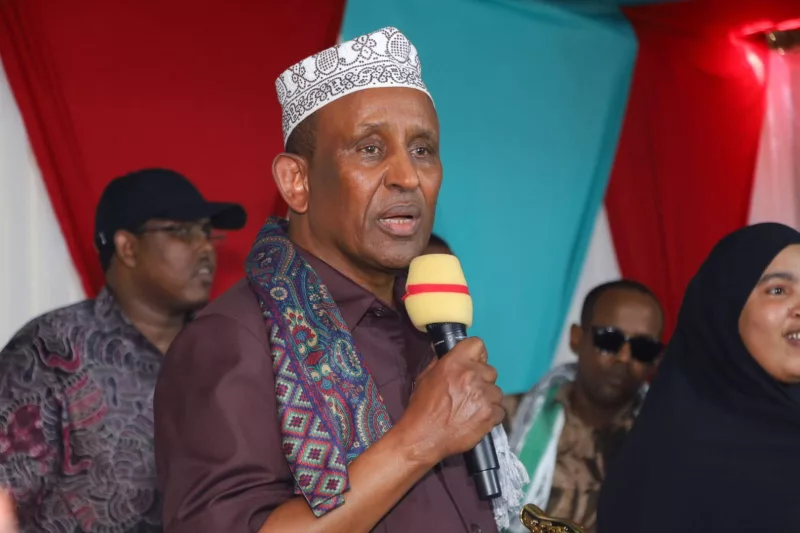
 Sheikh Abdullahi Amiri speaks to the press in Wajir
town /STEPHEN ASTARIKO
Sheikh Abdullahi Amiri speaks to the press in Wajir
town /STEPHEN ASTARIKO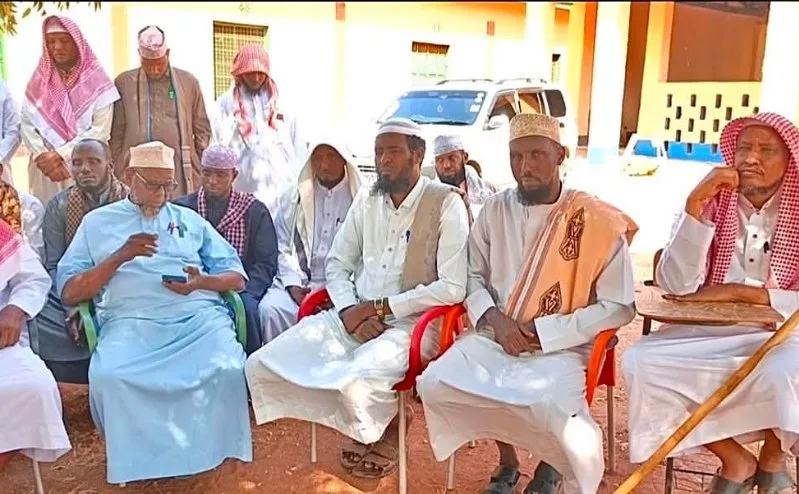 Religious leaders from Wajir after attending
a meeting on combating human trafficking and illegal migration at Madarstul Al
Fatah Islamiya in Wajir town /STEPHEN ASTARIKO
Religious leaders from Wajir after attending
a meeting on combating human trafficking and illegal migration at Madarstul Al
Fatah Islamiya in Wajir town /STEPHEN ASTARIKO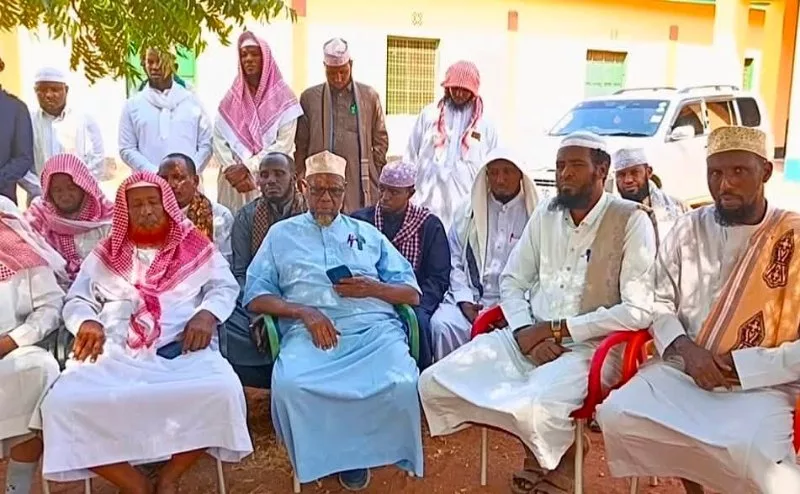 Supkem Northeastern regional coordinator Adam Yunis[2ndR]
s with fellow religious leaders after the meeting./STEPHEN
ASTARIKO
Supkem Northeastern regional coordinator Adam Yunis[2ndR]
s with fellow religious leaders after the meeting./STEPHEN
ASTARIKO