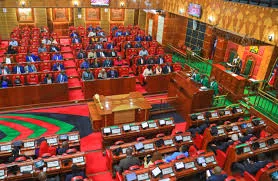
MPs elected in the 2027 general election could easily face
citizen’s wrath with the electoral commission proposing sweeping changes to the
country’s recall law.
The proposed Election Laws (Amendment) Bill, 2026 has
lowered the threshold for initiating petitions recalling Senators, Women Reps
and Members of the National Assembly.
The amendments proposed by Independent Electoral and
Boundaries Commission (IEBC) removes
legal hurdles that frustrated past recall attempts.
At the height of the 2024 anti-Finance Bill protests, angry
Kenyans sought to recall several MPs but were frustrated by the absence of a
clear legal framework and a cumbersome recall process.
Nairobi Woman Representative Esther Passaris was also
targeted following her proposed anti-demos law.
ODM threatened to initiate recall against its six MPs that
voted in support of the Finance Bill of 2024.
They included Elisha Odhiambo (Gem), Gideon Ochanda (Bondo),
Caroli Omondi (Suba South), Emmanuel Wangwe (Navakholo), Memusi Kanchory
(Kajiado Central), and Bernard Shinali (Ikolomani).
One of the biggest changes being dropped in the new law is
that a sitting MP could only be recalled by voters only after a High Court judgment
confirming violation of Chapter Six of the constitution or is convicted of
graft.
In the proposed changes, a voter may begin the recall
process on grounds of incompetence.
Other grounds are gross violation of the constitution or any
other law, gross misconduct or conviction an offence punishable by imprisonment
for at least six months.
Ironically, it’s MPs who will either approve or reject the
amendments. MPs have previously shot down public interest legislation for their
own self-preservation.
“A recall under subsection… shall only be initiated within a
period of 24 months after the election of the Member of Parliament and not
later than 12 of Parliament and months immediately preceding the next general election,”
part of the proposed amendments reads in part.
“A recall petition shall not be filed against a Member of
Parliament more than once during the term of that member in Parliament.”
In the proposed changes, IEBC says the petition to recall an
MP should be backed by at least 30 per cent of registered voters.
“The list of names referred to in subsection (2)(b) shall
contain the names, address, national identity card number or passport number
and signature of the voters supporting the petition,” the suggested amendments
states.
The current law says such a petition should have the backing
of at least 15 per cent of the voters in more than half of the wards in the
county or the constituency.
The current law also barred unsuccessful MP contestants from
initiating recall proceedings.
It is also required that a recall election generate more
than 50 per cent turnout in the affected constituency.
But that has been changed in the bill which IEBC has
published for public participation before sending it to Parliament.
It simplifies the petition process saying it’ll be initiated
by any registered voter in the constituency.
It lowers the threshold for the vote to 30 per cent and with
the process, including the election, to be conducted within five months.
Petitioners would thus only need signatures from at least 30
per cent of registered voters in the affected constituency or county.
The changes come barely three years after the country witnessed
an unprecedented campaign to recall MPs.
Citizens launched online campaigns to mobilise signatures
against several MPs, especially those who supported the controversial Finance
Bill, 2024.
Several MPs became targets of grassroots and online recall
campaigns because they voted in favour of the Finance Bill.
Some also publicly apologised to constituents after intense
backlash.
The efforts were, however, marred by legal obstacles.
IEBC said the constitutional right of recall lacked an
operational legal framework following court decisions.
This was tested recently in court where Justice Roselyne
Aburili held that she couldn’t compel IEBC to process petitions seeking recall
of MPs.
Justice Aburili said the petitions were premature because
Parliament was yet to complete the legislation guiding the process.
“The petitioners as well as the court should let Parliament
legislate and wait for the outcome,” she said in the matter.
The petition was filed after IEBC declined to initiate the
process of recalling Tharaka Nithi Senator Mwenda Gataya.
A 2017 case by Katiba Institute invalidated several sections
of the Elections Act governing recall of MPs.
Article 104 of the constitution gives voters the right to
recall a Member of Parliament before the expiry of the term.
At the height of the calls, IEBC cited court decisions that
affected the existing law, and the wave of petitions subsided.
Observers also cited the requirement for a prior High Court
determination as one of the biggest barriers.
The new bill seeks to change that.
If enacted, voters would initiate the process directly,
subject to the statutory grounds and the signature threshold.
The proposal is also likely to influence how MPs conduct
themselves after the 2027 general election.
Recall campaigns could follow over unpopular decisions,
broken campaign promises or conduct that voters consider unacceptable.
The reforms, however, are likely to generate debate.
If enacted, the law would send a clear message to those
seeking election in 2027.
Winning an election would no longer guarantee five
uninterrupted years in office.
An MP who loses the confidence of constituents could face an
organised campaign to remove them long before returning to the ballot.