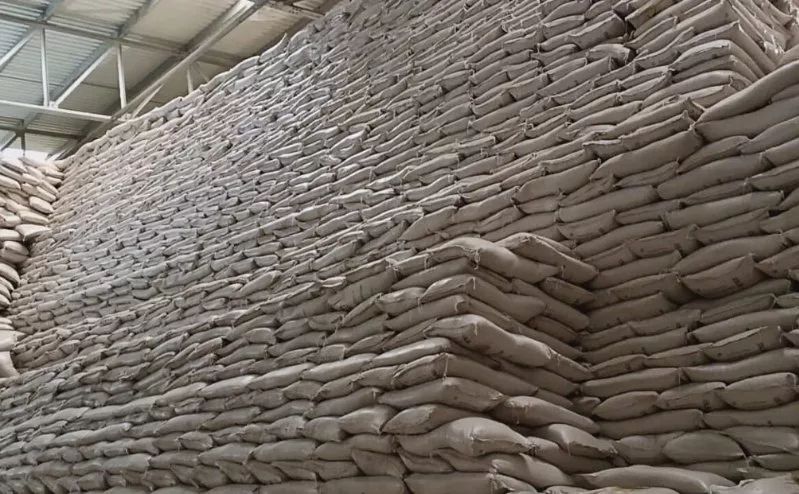
Sugar in one of the Busia sugar stores /HANDOUT
Sugar millers in Western Kenya are struggling with rising stocks of unsold sugar amid an influx of smuggled and imported sugar into the country.
The cheaper sugar is taking a toll on local millers through declining sales, leaving factories with large quantities of unsold stock.
The surge in cheaper sugar, which industry players believe is entering the country through porous border points alongside increased imports, has significantly slowed sales of locally produced sugar.
As a result, millers are struggling to generate enough revenue to pay farmers for delivered cane, settle suppliers' bills and remit employees' salaries.
A spot check by the Star found large quantities of unsold sugar stored in godowns at several sugar factories in the region.
As of July 28, 2026, Nzoia Sugar had accumulated 269,750 bags of sugar awaiting sale. Kabras Sugar had 146,091 50kg bags of sugar and 40,500 bales in stock, while Naitiri Sugar had 269,000 50kg bags of sugar and 10,857 bales. Olepito Sugar was holding 47,000 50kg bags of sugar.
The growing stockpiles have raised concerns that some factories may be forced to suspend milling operations if the situation persists.
Cane farmers say such a move would have serious consequences, leaving those with mature cane unable to harvest it and denying them an income.
The growing anxiety has prompted sugarcane farmers to threaten demonstrations, accusing the government of failing to protect the local sugar industry from what they describe as unfair competition.
George Olaktar, a farmer from Busia County, questioned why the government and sugar sector regulators had remained silent as local millers struggled with cheap imported sugar.
"The future of our sugar factories is bleak. These factories are suffering because they are not making sales from the sugar they are producing, yet they still have to pay farmers and employees," Olaktar said.
He warned that continued importation of cheap sugar would drive down domestic sugar prices, ultimately reducing cane prices and hurting farmers.
The concerns come amid claims that raw sugar worth Sh3 billion was cleared for importation into the country.
"The impact of allowing Sh3 billion worth of raw sugar into the country will be severe for local millers and farmers. Do you really mean well for Kenya's sugar industry?" Olaktar posed.
Another farmer, Shaban Wandera, urged the national government to move swiftly to address the crisis or risk nationwide demonstrations by cane growers.
"In the interest of protecting our local millers, we shall soon organise a major demonstration against the influx of sugar from outside Kenya. Perhaps then our concerns will finally be heard," he said.
Flora Kagera warned that many farmers could abandon sugarcane farming if urgent action is not taken.
"We have suffered for many years and often feel neglected by the government. It has the capacity to stop illegal sugar imports but has allowed cheap sugar to flood the market," she said.
Millers say the crisis has already begun disrupting operations.
Busia Sugar head of operations Abdul Abu said locally produced sugar was becoming increasingly difficult to sell because imported sugar was retailing at much lower prices.
"Our production costs remain high, yet our sugar is not moving. The government must seal all loopholes through which this sugar is entering the country," he said.
Olepito Sugar general manager Wazir Gathenge said the factory had exhausted its storage capacity and had been forced to secure additional warehouse space.
"It has not been easy for months now. We continue milling, but we are simply storing sugar and hoping the market improves," he said.
Gathenge warned that if sales do not improve, the factory may have no option but to suspend milling.
According to industry players, much of the sugar from Uganda is allegedly being smuggled into Kenya through the Busia and Malaba border points using lorries, motorcycles, bicycles and public service vehicles before finding its way into markets across Western Kenya, Kisumu and Siaya counties.
Busia County Police Commander Robinson Lang'at said security agencies had intensified efforts to curb the illegal trade.
"I have instructed officers to crack down on all illegally imported sugar entering the country through our border points," he said.
Industry players also attribute the crisis to Kenya's decision earlier this year to lift the long-standing sugar import safeguards under the Common Market for Eastern and Southern Africa (COMESA).
The move allowed duty-free sugar imports from member states. Industry players argue that the policy has accelerated the influx of cheaper sugar, leaving local millers with excess stock and declining sales.
Naitiri Sugar communications manager Edwin Musonye said the factory's cash flow had been severely affected by sluggish sales.
"For years, Naitiri Sugar has paid farmers every week. However, because sugar sales have remained extremely low over the past three months, we are now unable to maintain that payment schedule," he said.
Kabras Sugar deputy process manager Billy Talaam said the decline in sales began about three months ago and warned that storage facilities were nearing capacity.
At Nzoia Sugar, deputy process manager Boniface Ouma echoed similar concerns, saying the factory's warehouses were almost full even as farmers continued waiting for their mature cane to be harvested.
"Our sugar godowns are nearly full. Farmers have mature cane ready for harvesting, but without sales, the factory is unable to sustain normal operations. The situation is becoming increasingly difficult," he said.