

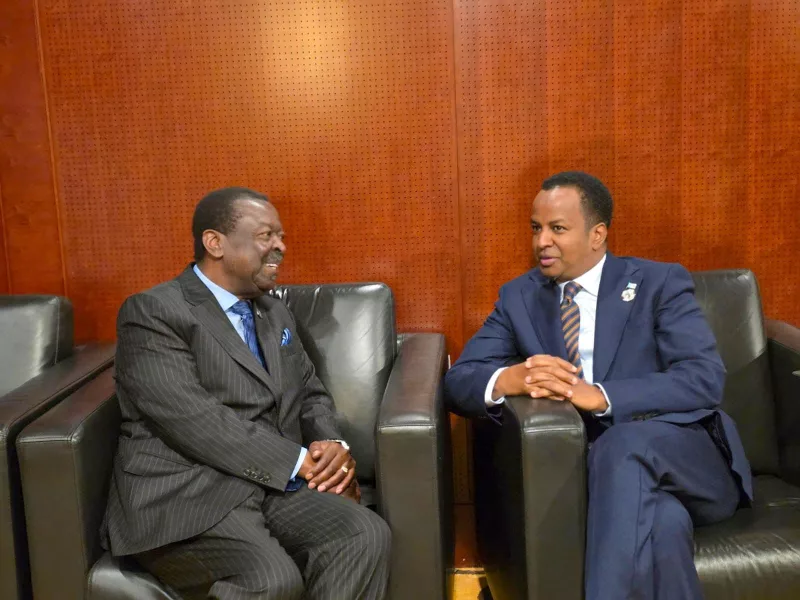
 PCS and Foreign Affairs CS Musalia Mudavadi holds talks with Somalia’s counterpart Abdisalam Ali on the sidelines of the 49th AU Executive Council Session in Addis Ababa on July 28, 2026
Diplomatic relations between Kenya and Somalia are under renewed strain following the recent denial of entry into Kenya of Somalia government officials.
The latest tensions were triggered after Somalia's State Minister at the Presidency, Abshir Bukhaari, was reportedly denied entry into Kenya at Jomo Kenyatta International Airport on Monday and returned to Mogadishu.
The case follows a similar incident in late June involving Somalia’s Second Deputy Prime Minister Jibril Haji, who was also denied entry into Kenya.
The denial of entry follows reports that Nairobi has intensified investigations into fraudulently acquired Kenyan passports allegedly held by Somali state officials and politically connected individuals.
Haji reportedly presented a valid Somali diplomatic passport and Kenyan entry visa upon arrival. However, immigration officers at JKIA flagged him after suspecting he was also in possession of a Kenyan passport believed to have been improperly acquired.
The two incidents prompted Somalia to summon Kenya's Ambassador in Mogadishu, Kubai Iringo, for consultations.
The matter further escalated after Mogadishu recalled Ambassador Jabril Abdulle for consultations over the issue.
Attempts by the Star to get comments from the respective envoys were futile, as they did not respond to calls and messages.
The matter also featured prominently during a bilateral meeting between Prime Cabinet Secretary and Foreign Affairs CS Musalia Mudavadi and Somalia's Foreign Minister Abdisalam Ali on the sidelines of the 49th African Union Executive Council meeting in Addis Ababa.
According to a media dispatch after the discussions, the two ministers agreed to strengthen cooperation on immigration management, consular affairs and cross-border mobility. However, neither government publicly linked the talks directly to the reported airport incidents.
Diplomatic sources in Nairobi say the investigations have widened beyond the recent airport cases to include senior Somali government officials, politically connected individuals and businesspeople suspected of fraudulently acquiring Kenyan travel documents.
The sources further indicate that travel restrictions and asset freezes are among the measures reportedly under consideration as investigations continue.
Horn of Africa analyst and researcher Abdi Rashid said he had learnt from Kenyan contacts that between 40 and 50 per cent of senior and mid-level Somali officials serving in government in Mogadishu may own a Kenyan passport or ID, "fraudulently acquired".
"The Kenyan Immigration, Intelligence and Security Services are all now working in coordination to quietly cancel these IDs and passports," Abdi said.
The heightened scrutiny is also said to be taking place against the backdrop of Somalia's unresolved political crisis.
Diplomats say concerns have been growing within the international community over Mogadishu's failure to reach an inclusive political agreement on the country's electoral process, with some governments tightening scrutiny of individuals considered politically exposed.
While it is not well established whether the two processes are linked, the same is playing out between Mogadishu and Brussels.
According to Africa Intelligence, the conditions for granting visas to Somali nationals in EU countries have been tightened.
"This decision, justified by Mogadishu's lack of cooperation, also follows the fallout from a secret agreement with Stockholm, the revelations of which are rocking the Swedish political establishment in the run-up to the elections," the publication said on Wednesday.
On June 25, the EU Council announced it was moving to temporarily restrict visa provision for Somali nationals.
"This decision follows an assessment by the commission, which concludes that cooperation by Somalia on readmitting its nationals staying irregularly in the EU is insufficient," it said in a statement.
"As a result, it will no longer be possible for member states to issue multiple-entry visas to Somali nationals; waive requirements regarding the evidence visa applicants from Somalia must submit; or waive the visa fee for holders of diplomatic and service passports."
Furthermore, the standard processing period for visa applications was extended by a month, from 15 to 45 days.
The latest developments mark yet another disruption in Kenya-Somalia diplomatic ties.
Relations deteriorated sharply in 2020 when Somalia severed diplomatic ties with Kenya, accusing Nairobi of interfering in its internal affairs.
Kenya rejected the allegations, but both countries withdrew ambassadors before relations were restored in 2021.
The two states also clashed over the maritime boundary dispute in the Indian Ocean, which was determined by the International Court of Justice in 2021 in Somalia's favour.
Kenya rejected the ruling, arguing the court lacked jurisdiction.
Questions surrounding citizenship documentation have surfaced before, with Kenyan authorities accused of granting citizenship documents to foreigners, particularly individuals from the Rapid Support Forces in Sudan.
Instant analysis
The dispute risks reopening a sensitive chapter in Kenya-Somalia relations at a time when both countries face shared security and economic challenges. If the reported investigations into fraudulently acquired Kenyan documents continue, immigration and identity management could become a new diplomatic flashpoint. While Nairobi appears determined to tighten enforcement, both governments will be under pressure to prevent the issue from escalating into a broader political rift that could undermine cooperation on security, trade, migration and regional stability in the Horn of Africa.







