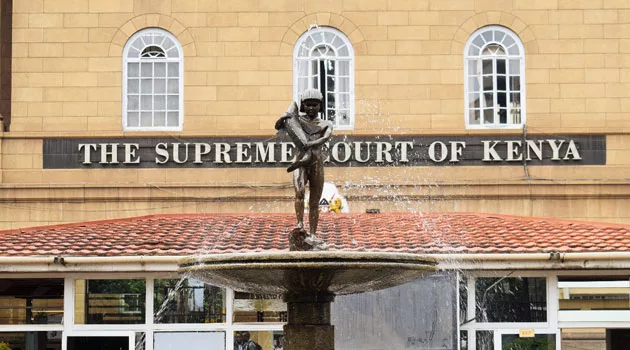
 The Supreme Court /FILE
The State cannot escape responsibility for abuses allegedly committed by police officers during the 2007-08 post-election violence by relying on the fact that the Independent Policing Oversight Authority (IPOA) was created in 2011, the Supreme Court has been told.
The case relates to an appeal in which several petitioners who were victims of the 2007-08 post-election violence are challenging the failure to provide them with compensation and other remedies for alleged human rights violations.
When the case came for hearing before a bench led by Chief Justice Martha Koome, Lawyer Willis Otieno, representing victims of the 2007-08 post-election violence, argued that the later establishment of IPOA should not be used to deny victims an effective remedy for violations committed during the violence.
He challenged the Court of Appeal’s decision to exempt IPOA from responsibility on the basis that it did not exist when the alleged violations occurred.
Otieno argued that the circumstances surrounding the creation of IPOA were directly connected to the failures and abuses associated with the post-election violence and that its mandate could therefore not be narrowly interpreted to exclude the victims.
“It’s because of the conflict that IPOA is created. That becomes its umbilical cord,” Otieno told the court.
He argued that while IPOA may not have existed during the 2007-08 violence, the authority was established precisely to provide independent oversight and accountability in relation to policing.
He further accused the State of failing to investigate the alleged involvement of police officers in violations committed during the period.
“They have not bothered to investigate and establish the role of police officers complicit on infractions of 2007-08,” he said.
Otieno said the failure to investigate and prosecute those responsible amounted to a continuing violation of the victims’ rights, particularly survivors of gender-based violence.
He urged the Supreme Court to ensure that sexual violence survivors are not left out of reparations available to other victims.
“When you look at how the State has treated GBV victims, they have been ignored by the Kenyan State,” he submitted.
He said the survivors were not asking for preferential treatment but recognition of the violations they suffered and effective remedies for the harm inflicted upon them.
However, the Attorney General opposed the appeal, urging the Supreme Court to uphold the decision of the superior courts and dismiss the petition.
Lawyer Dan Weche, appearing for the Attorney General and other respondents, argued that the petitioners were seeking to use the 2010 Constitution to address events that occurred before it came into force.
“The superior court decision was not in error. Petitioners have not made out any case for Supreme Court to interfere,” Weche submitted.
He argued that the Constitution promulgated in 2010 could not be used to establish rights violations arising from conduct that occurred in 2007-08.
“We contend petition should be dismissed with costs. Constitution isn’t retrospective. It took effect upon promulgation in 2010,” he said.
According to the respondents, allowing the petition would unfairly prejudice their rights by imposing constitutional obligations that did not exist when the alleged violations occurred.
“Rights can’t be claimed or violations alleged under constitution not yet in force when rights violations occurred,” Weche argued.
The State also challenged what they termed as the petitioners’ failure to meet the required burden of proof, arguing that their claim was essentially one for damages arising from an alleged failure by the State to exercise due diligence.
Weche said such a claim was subject to proof on a balance of probabilities, a threshold the petitioners had failed to meet.
The State also maintained that a legal framework for dealing with gender-based violence existed at the time, pointing to provisions of the Penal Code.
The Director of Public Prosecutions, through lawyer, similarly urged the Supreme Court to dismiss the petition.
Counsel argued that the petitioners had not reported their specific cases to authorities and therefore could not fault the State for failing to investigate them.
The DPP consequently urged the Supreme Court to reject the appeal.
The court reserved judgment on the matter, indicating that it would consider the entire record and deliver judgment on notice.