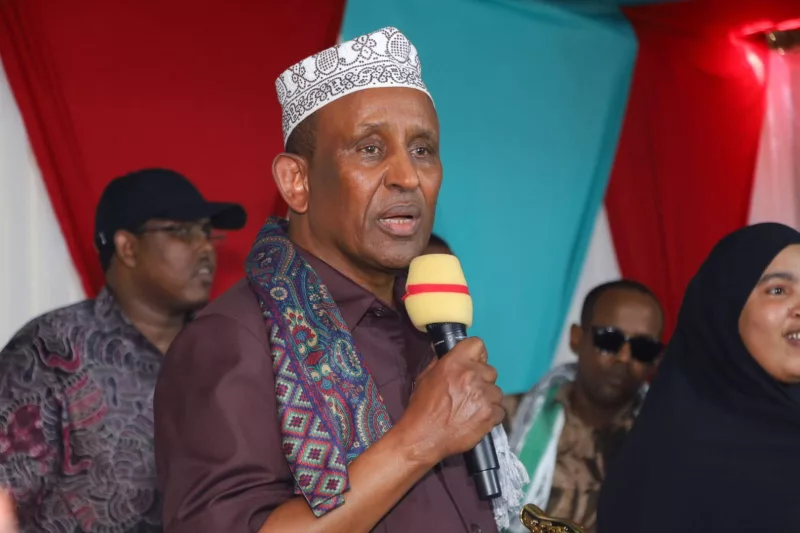
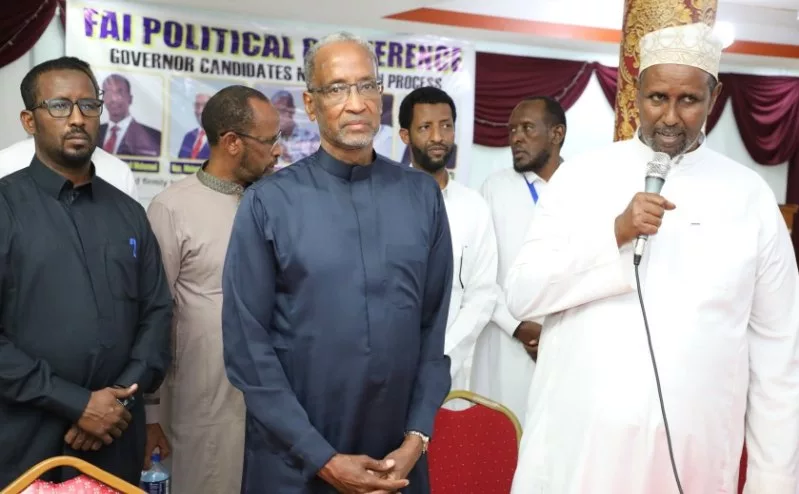
 Mohamed Osman, the chairman of the committee making the
announcement. Looking on is Dr Hassan./STEPHEN ASTARIKO
Mohamed Osman, the chairman of the committee making the
announcement. Looking on is Dr Hassan./STEPHEN ASTARIKOBarely hours after the influential Fai sub-clan of the Degodia community endorsed businessman Hassan Mohamed Adan as its sole candidate for the Wajir governor race in 2027, cracks began to emerge.
It raises fears that history could once again repeat itself.
The endorsement, announced on Saturday night after months of consultations, was intended to unify the largest voting bloc within the Degodia community behind a single candidate.
Instead, it has exposed simmering divisions reminiscent of the events that preceded the 2022 General Election, divisions that many political observers argue ultimately cost the community the governor's seat.
The Fai sub-clan, which is numerically the largest within the Degodia community and dominates Tarbaj and Wajir East constituencies, has traditionally relied on elders to build consensus around a single gubernatorial candidate.
The strategy is designed to consolidate votes and avoid splitting the clan's considerable electoral strength.
That process was revived last year when elders constituted a committee to identify and endorse a consensus candidate for the 2027 race. The move was informed by the bitter lessons of 2022.
During that election cycle, the community initially settled on Hassan Wehliye, then a Deputy Director at the Ethics and Anti-Corruption Commission (EACC), before he later withdrew from the race.
The elders subsequently rallied behind Dr Hassan Mohamed Adan. However, the decision failed to win unanimous support.
Among those who rejected the endorsement were Ugas Sheikh Mohamed, the current chairperson of the Capital Markets Authority; former governor Mohamed Abdi and Mohamed Elmi, the non-executive chairperson of the National Livestock Development and Promotion Service.
Rather than rallying behind a single flag bearer, multiple candidates from the same community entered the race, splitting the Fai vote and weakening what had traditionally been regarded as the county's strongest political voting bloc.
The fragmentation handed incumbent Governor Ahmed Abdullahi, who hails from the Matan sub-clan of the larger Degodia community and draws his political support largely from Wajir West constituency, a crucial advantage that enabled him to clinch victory.
Political observers now fear the same script may be unfolding. On Saturday, the Council of Elders and delegates converged at the Wajir County Guest House, bringing to an end months of consultations and speculation over who would carry the community's political hopes into the 2027 contest.
The elders eventually settled on Hassan, popularly known as Fuje. Speaking shortly after the announcement, the businessman welcomed the endorsement, describing it as a historic moment for the community.
"I humbly accept the White Smoke from the Fai Nation retreat as the sole governor candidate for Fai in the 2027 election, following a long, genuine process that culminated in this historic endorsement," Hassan said.
He thanked the elders, delegates and committee members who oversaw the process.
"I extend my heartfelt appreciation to the committee, the Council of Elders, delegates and the entire team who oversaw this credible and successful process with wisdom, unity and dedication. Your confidence in my leadership is both a great honour and a profound responsibility," he added.
Hassan described the endorsement as a powerful demonstration of unity and collective purpose.
"This endorsement is a powerful signal of unity, trust and our shared vision for a stronger, more inclusive and prosperous Wajir. It marks the beginning of a new chapter built on service, integrity and collective purpose."
But even before the celebrations had settled, signs of discontent surfaced.
Ugas Sheikh Mohamed, one of the leading aspirants who had hoped to secure the elders' backing, publicly distanced himself from the process, arguing that it had abandoned its original objective of building consensus.
In a lengthy statement posted on his social media platforms, Ugas announced his withdrawal from the exercise.
"I have officially withdrawn my name from the Fai consensus-building process that was intended to deliver a single governor candidate for the larger Fai community. Consequently, I have also requested that my name be removed from the ballot and that I take no further part in the voting process," he said.
He claimed the process had fundamentally changed midway. "I made this decision after the three-day consultative meeting took a significant and unexpected shift from the consensus-building framework that we had all agreed upon from the outset to a voting process that was never part of our original understanding,” he said.
“The process had been progressing well until the very principle that the community overwhelmingly desired, building consensus, was abandoned."
Ugas further criticised what he termed growing polarisation among delegates entrusted with fostering unity.
"It is deeply regrettable that we now appear to be retracing the very path that led to our division during the 2022 electoral period. As someone who has invested considerable time, effort and commitment to ensuring the success of this initiative, I am profoundly disappointed by how the process has concluded,” Ugas said.
“My withdrawal is a decision guided by principle and by my unwavering belief that lasting unity cannot be achieved through a process that departs from the foundation upon which it was established."
His remarks have reignited debate over whether the endorsement process has united or further divided the community.
Ironically, Ugas stepped down in favour of former Governor Mohamed Abdi in 2017 despite initially receiving the elders' endorsement, a sacrifice widely credited with helping secure Abdi's victory.
Political analyst Mohamed Hussein believes the unfolding events bear striking similarities to those witnessed ahead of the last election.
"The Fai sub-clan possesses the single largest voting bloc in Wajir. When united, they are virtually unbeatable. But when internal divisions dilute that strength, as happened in the last election, everyone loses," Hussein said.
He warned unless the aggrieved aspirants close ranks, the community risks repeating its past mistakes.
"It is unfortunate that they appear to be drifting towards the same path we witnessed in 2022, where fragmentation within the community split the vote. It was a tactical misstep that ultimately cost them a seat they could easily have won."
Hussein said while the endorsement might have handed Hassan an early political advantage, the real challenge lies not in defeating rival clans but in healing divisions within his own political backyard.
The other aspirants are yet to publicly respond to the elders' decision.
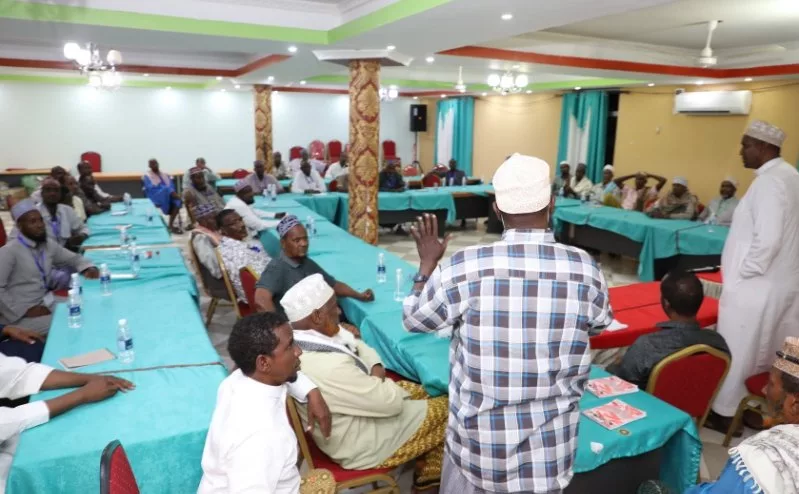 The Council of Elders and delegates converged at the
Wajir County Guest House./STEPHEN ASTARIKO
The Council of Elders and delegates converged at the
Wajir County Guest House./STEPHEN ASTARIKO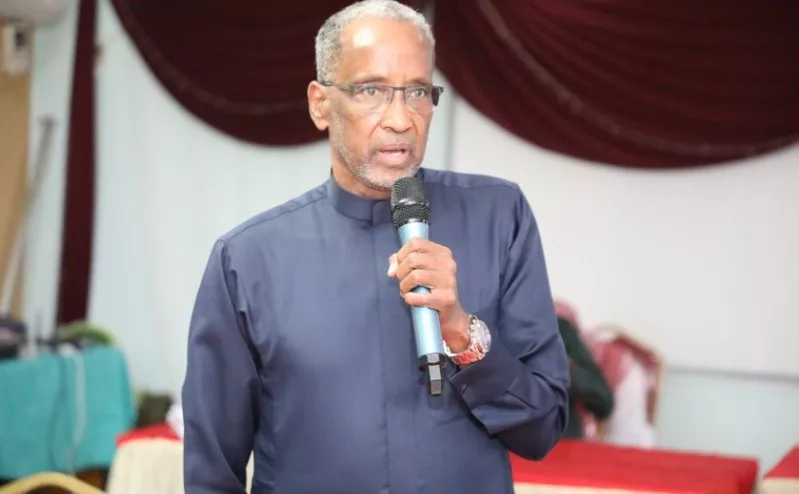 Nairobi South Hospital owner Dr Hassan Mohamed Adan speaking
after being eodrsed by his fai sub clan of the larger Degodia community as its
sole candidate for the Wajir gubernatorial race in 2027./STEPHEN ASTARIKO
Nairobi South Hospital owner Dr Hassan Mohamed Adan speaking
after being eodrsed by his fai sub clan of the larger Degodia community as its
sole candidate for the Wajir gubernatorial race in 2027./STEPHEN ASTARIKO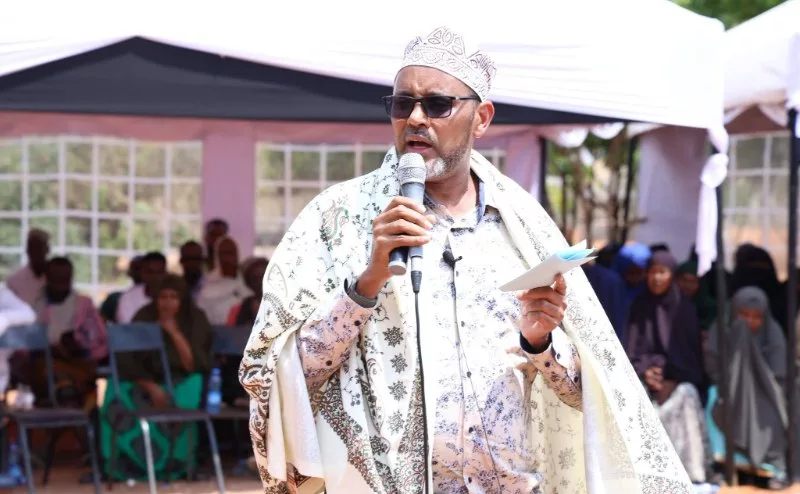 Ugas Sheikh Mohamed, one of the leading aspirants who had
hoped to secure the elders' backing, speaking at a recent function in Tarbaj town./STEPHEN
ASTARIKO
Ugas Sheikh Mohamed, one of the leading aspirants who had
hoped to secure the elders' backing, speaking at a recent function in Tarbaj town./STEPHEN
ASTARIKO