

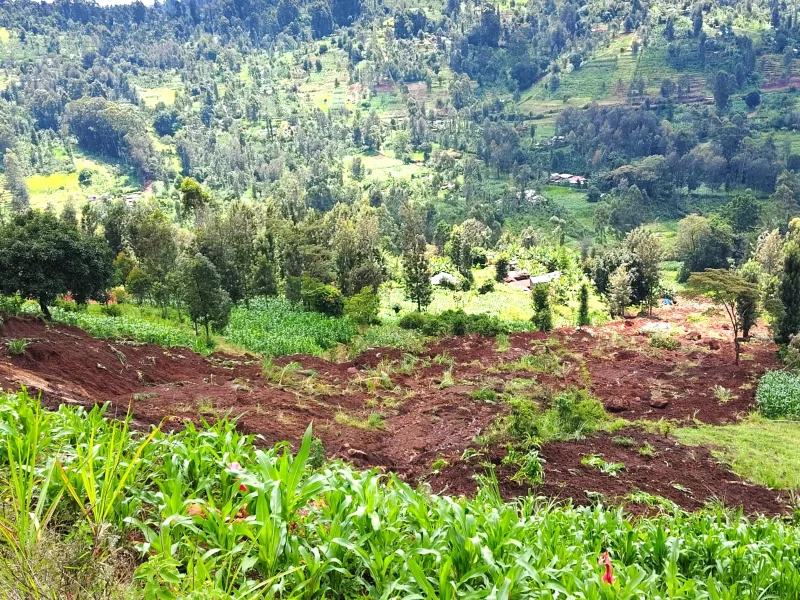
 A farm after heavy rains/ ALICE WAITHERA
Farmers with maize ready for harvest should begin removing it from their fields while the weather remains dry.
The weatherman says it may begin to drizzle next month, with most parts of Kenya, especially the eastern region, expected to receive more rain in August and September than they usually do during the two months.
Read Also
The El Niño rains are expected to follow from October.
"Wetter-than-normal conditions are expected over the eastern Horn, including Somalia, south-eastern and parts of western Ethiopia, and eastern to coastal Kenya," the Igad Climate Prediction and Applications Centre (ICPAC) said in its latest forecast.
The centre said western Kenya and the Coast are the only parts of the country likely to remain drier than normal in August and September.
"Drier-than-usual conditions are expected over most parts of the region, including Ethiopia, Djibouti, Eritrea, Sudan, South Sudan, Uganda, and western and coastal Kenya," it said in its two-month forecast.
For farmers, the changing weather means this is a good time to harvest mature maize before the rains become more frequent.
Mature maize left in the field during prolonged rains can rot, sprout or become contaminated with aflatoxin, reducing both its quality and value.
However, temperatures are expected to remain above normal throughout the forecast period.
"Warmer-than-usual conditions are expected over most parts of the region, with the highest probabilities over eastern South Sudan and western to central Ethiopia," ICPAC said.
The forecast also suggests that farmers in eastern Kenya may need to begin preparing their land for planting short-season crops as rainfall increases towards October.
The Kenya Meteorological Department did not immediately respond to the Star but is expected to issue a more detailed forecast.
Scientists are also monitoring the development of an El Niño in the Pacific Ocean. El Niño occurs when ocean waters in the central and eastern Pacific become warmer than normal. Although it develops far from Africa, it alters weather patterns around the world.
In Kenya, El Niño often brings heavier-than-normal rainfall between October and December. In the past, these rains have caused flooding, landslides and damage to roads, bridges and crops.
Last month, the United Nations Food and Agriculture Organisation (FAO) and the World Food Programme (WFP) appealed for $202 million (about Sh22.6 billion) to help countries prepare for the expected effects of El Niño before the heavy rains begin.
Kenya is among 22 countries identified as being at high risk from the coming weather pattern.
Other African countries on the list are Ethiopia, Somalia, South Sudan, Sudan, Uganda, Zimbabwe, Mozambique, Malawi, Madagascar, Nigeria and Cameroon. Outside Africa, the appeal covers Afghanistan, Pakistan, the Philippines, Timor-Leste, Colombia, El Salvador, Guatemala, Haiti, Honduras and Venezuela.
The UN agencies warned that many of the affected countries are already struggling with hunger caused by conflict, economic hardship, displacement and repeated climate shocks.
They said another extreme weather event could worsen the situation for millions of people.
FAO and WFP currently have enough funding to support about 1.2 million people expected to be affected by El Niño.
They are seeking additional resources to extend assistance to another 7.6 million people, with the goal of reaching nearly 8.8 million people in total.
The planned support includes cash transfers to vulnerable families, the distribution of drought-tolerant and flood-resistant seeds, livestock protection, water harvesting projects, flood control measures, and weather and farming advisory services.
The agencies said taking action before disasters occur is cheaper and more effective than responding after lives and livelihoods have already been lost.
"Experience consistently shows that early action is more effective and less costly than responding after a crisis has escalated," FAO Deputy director general Beth Bechdol said.
WFP Acting executive director Carl Skau added; "With El Niño on the horizon, we have a narrow window to act so families are not forced into impossible choices later. We now have the tools to anticipate these events; what matters is how we act with that knowledge. Early action keeps food on the table and protects those at most risk."







