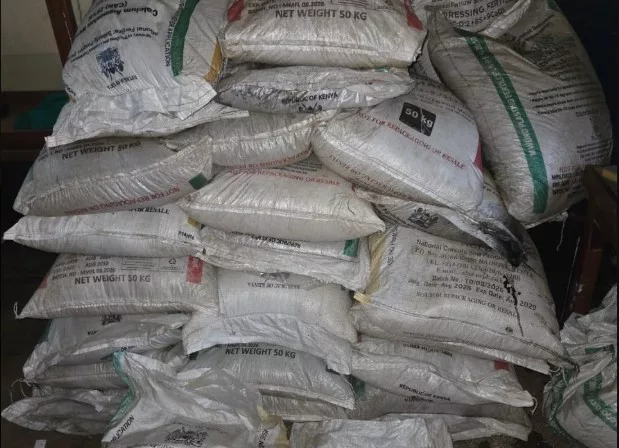
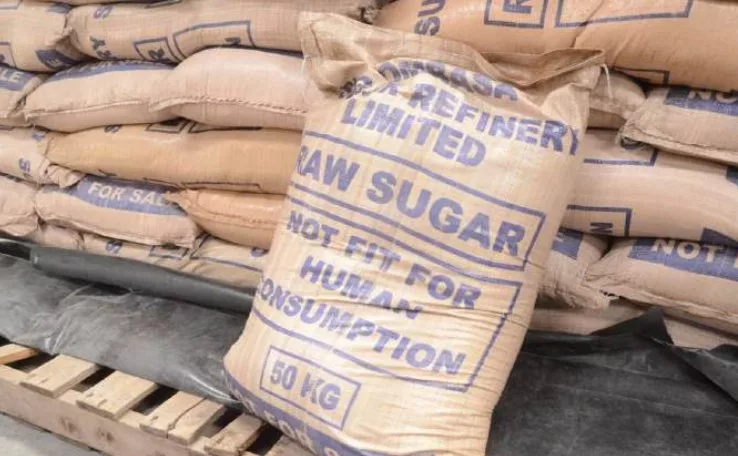
 Bags of sugar at the Inland Container Depot where MPs visited to ascertain the presence and status of the raw sugar imported by Kibos and Mombasa Sugar Refineries Limited on June 10 /DOUGLAS OKIDDY
Members of Parliament have raised concerns over a controversial Sh104 million tax waiver granted to a private company involved in raw sugar importation.
The lawmakers sitting at the National Assembly’s Trade and Investment Committee on Tuesday questioned the legality and procedure followed in approving the relief.
The probe follows a decision by the government to exempt Mombasa Sugar Refinery Limited from paying the Importation Declaration Fee and the Railway Development Levy on the raw sugar consignment.
Mombasa Sugar Refinery Limited was initially called Kibos Sugar Refinery Limited but changed name after relocating to Mombasa.
In the arrangement, the firm was to import 165,000 metric tonnes of raw sugar for industrial use at an import duty rate of 10 per cent for 12 months.
The import was to be used in manufacturing food grade and pharmaceutical grade refined white sugar.
The waiver is contained in the legal notice dated 18th April, 2025.
During a session with National Treasury Cabinet Secretary John Mbadi, the lawmakers argued that the process appeared to have bypassed established procedures and demanded full disclosure on how the decision was arrived at.
They sought to know whether the National Treasury conducted any cost benefit analysis before approving the tax waivers on the raw sugar consignment.
According to Mbadi, the government was to forego tax waiver amounting to Sh104 million.
“Kenya Revenue Authority estimated the revenue forgone from the exemption from Import Declaration Fee and Railway Development Levy at Sh104,090,404 comprising Sh57,828,002 in Import Declaration Fee and Sh46,262,402 in Railway Development Levy,” Mbadi told the committee.
The CS defended the tax exemption, maintaining that the decision was made in the public interest.
In justifying the public interest, Mbadi told MPs that the company employs thousands of Kenyans directly and indirectly, warning that failure to grant the waiver could have negatively affected its operations and livelihoods dependent on the firm.
“The exemption was granted pursuant to paragraph (xxvi) of Part A and paragraph (x) of Part B of the Second Schedule to the Miscellaneous Fees and Levies Act respectively,” Mbadi explained.
“The provisions empower the CS to exempt goods where the exception is considered to be in the public interest or is intended to promote an investment whose value is not less than Sh5 billion.”
“In the case of Mombasa Sugar Refinery Limited, the exemption was granted under the public interest criterion.”
Ministry of Agriculture and Livestock Development and the Ministry of Investments, Trade and Industry, he noted, recommended the waiver citing the anticipated benefits of supporting domestic refining of industrial sugar.
“The principal considerations included domestic value addition, utilisation of installed refining capacity, provision of a local source of industrial sugar, employment and skills development, and improved competitiveness of locally manufactured industrial sugar,” Mbadi said.
“The approval was limited to Import Declaration Fee and Railway Development Levy and was subject to the condition that the raw sugar be refined into sugar for industrial use. If the approved end use was not observed, the exempted levies, together with the applicable penalties and interest, would become due and payable to the commissioner.”
He assured the committee that the Treasury acted within its mandate and in consideration of broader economic interests.
MPs were however adamant poking holes into Mbadi’s defence while demanding evidence of public participation which qualify the move.
Funyula MP Wilberforce Oundo demanded that the CS provide evidence of public participation.
The lawmaker wondered how a private entity could constitute public interest.
“Public interest in a typical dictionary definition refers to the well being and common good of the society as a whole. The CS has said he made the decision based on public interest. I want the CS to explain to the country what he means by public interest,” Oundo said.
“The constitution says the only people who can determine issues of public interest are through a process of public participation. I want the CS to table to this committee any evidence of public participation.”
INSTANT ANALYSIS
The probe follows decision by the Government to exempt Mombasa Sugar Refinery Limited from paying the Importation Declaration Fee and the Railway Development Levy on the raw sugar consignment. In the arrangement, Mombasa Sugar Refinery Limited was to import 165,000 metric tonnes of raw sugar for industrial use at an import duty rate of 10 per cent for 12 months.