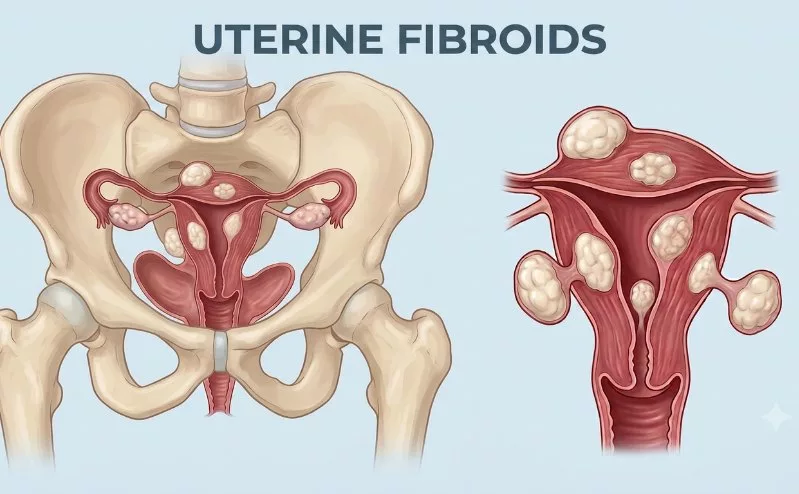
July is Fibroids Awareness Month. If that is news to you, you have just met the problem. This month passes every year in Kenya without a ministerial statement, screening drives or a budget line.
Yet fibroids are among the most common gynaecological conditions in the world: the UK's Royal College of Obstetricians and Gynaecologists notes that up to two-thirds of women will develop at least one in their lifetime, with international estimates putting the figure at 70 to 80 per cent by the age of 50.
The silence is not an oversight. It is a choice about whose suffering counts. Yet we barely measure the problem.
One of the few pieces of Kenyan data we have, a 2024 study at the Jaramogi Oginga Odinga Teaching and Referral Hospital in Kisumu, indicates how little fibroid research exists in this country.
The study found that in a single gynaecology ward in the hospital, the most common treatment, used in 42 per cent of cases, was total abdominal hysterectomy, removal of the uterus, with cases peaking among women aged 35 to 39, many of whom had never had children.
In other words, for a non-cancerous condition, the default treatment too often costs a woman the chance to ever carry a child. That default is not an accident. It is financed: Social Health Insurance Fund (SHIF) covers the standard surgeries, myomectomy and hysterectomy, while minimally invasive alternatives such as uterine fibroid embolisation and high-intensity focused ultrasound are largely excluded, payable out of pocket.
The state will fund the scalpel, but not the technologies that could spare a woman from it. Her treatment is determined less by her diagnosis than by her bank balance.
In March this year, nominated Senator Hamida Kibwana rose in the Senate to raise the alarm on fibroids. She asked the Standing Committee on Health to produce national prevalence data, to outline the Ministry of Health's plans for public awareness and early screening, to clarify research funding and to detail exactly what fibroid treatment the Social Health Insurance Fund covers, noting that treatment costs of between Sh100,000 and Sh500,000 put care beyond the reach of women without comprehensive insurance.
Consequently, Kenya has made important commitments to universal health coverage and women's health, yet uterine fibroids remain largely invisible in national policy. They receive little attention in public health campaigns, are absent from routine screening programmes and are rarely discussed as part of reproductive health planning.
The result is that many women seek care only after symptoms have become severe, when heavy bleeding, debilitating pain, anaemia, infertility or pressure on surrounding organs have already disrupted their lives.
Fibroids Awareness Month is the deadline for the answers. July is now half gone, and Kenyan women are still waiting. Kenyan women do not need another hashtag. We need the Health committee and the ministry to answer Senator Kibwana's questions and the three things above.
First, data: a national effort to measure fibroid prevalence and treatment outcomes, because the government cannot fix what it refuses to count. Second, coverage: SHIF must cover the full range of fibroid treatments, including minimally invasive options such as embolisation and focused ultrasound, not only in the operating theatre, so that avoiding major surgery is not a luxury good.
Third, pathways: clear clinical protocols so that a woman presenting repeatedly with heavy bleeding and pelvic pain is investigated. Too many women are dismissed, treated symptom by symptom, or diagnosed only when surgery becomes the only realistic option.
Fibroids are not simply a women's health issue. They are a health financing issue, a workforce issue, an economic issue and a question of equity. Every delayed diagnosis means lost productivity. Every unnecessary hysterectomy represents a missed opportunity to preserve fertility and quality of life.
Every woman forced to borrow money for treatment exposes the gap between Kenya's promise of universal health coverage and the reality patients face.
This July, Fibroids Awareness Month should not end with social media posts and purple ribbons. It should end with a commitment: to count women, to cover the care they need and to ensure that Kenyan women's treatment is determined by their clinical needs.
Communications professional, writer and human rights advocate