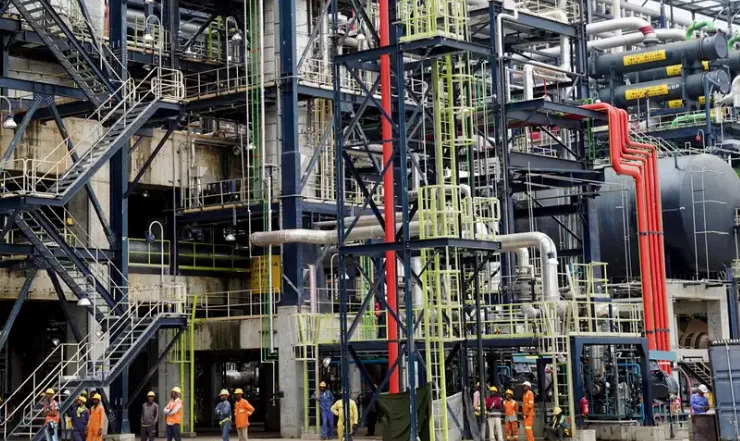
 Dangote Petroleum Refinery in Lagos Nigeria, similar to the one to be built in Lamu/SCREENGRAB
A proposed oil refinery backed by Africa's richest businessman, Aliko Dangote, has the potential to reshape East Africa's energy landscape, boost regional trade and position Kenya as a leading petroleum and logistics hub.
The planned refinery, expected to be built on Kenya's coast, is among the country's most ambitious industrial projects and could significantly reduce East Africa's dependence on imported refined petroleum products while creating thousands of jobs and attracting billions of shillings in investment.
President William Ruto on Wednesday announced that Deputy President Kithure Kindiki will chair a government committee tasked with working alongside private investors and employers to steer the implementation of the proposed East African oil refinery.
Describing it as one of the largest investments Kenya is preparing to undertake, the President said the committee would coordinate government engagement with investors, adding that preparations had reached an advanced stage.
"I have asked the Deputy President, Kithure Kindiki, to chair the government committee that is going to work with private investors and employers for what will be one of the largest investments in our country, the investment in the East African oil refinery," Ruto said.
He disclosed that the proposed project is valued at approximately Sh2.2 trillion and is expected to create about 60,000 jobs once construction and operations begin.
The refinery proposal follows an offer by Dangote Industries Limited to establish a world-class refining facility in Kenya.
Speaking during the Africa We Build Summit in Nairobi in April, Dangote said his company was ready to construct a refinery similar to the one it operates in Nigeria if governments in the region provided the necessary support.
If completed, the planned refinery would have a processing capacity of 700,000 barrels of crude oil per day, making it the largest refinery in East Africa and one of the biggest on the African continent.
The facility is expected to be located in Lamu, taking advantage of the county's strategic deep-water port and its position along the Lamu Port-South Sudan-Ethiopia Transport (LAPSSET) Corridor. The multi-billion-shilling infrastructure corridor links Kenya with Ethiopia, South Sudan and neighbouring markets through an integrated network of highways, railways, pipelines and ports.
Analysts say locating the refinery in Lamu would strengthen the port's role as a regional energy gateway while complementing Kenya's long-term ambition of becoming East Africa's logistics and industrial powerhouse.
The refinery is expected to fundamentally alter how petroleum products are supplied across the region.
Kenya, Uganda, Tanzania, Rwanda, Burundi, South Sudan, eastern Democratic Republic of Congo and parts of Ethiopia currently rely heavily on imported refined fuel shipped from Asia, the Middle East and Europe.
A regional refinery would shorten supply chains, reduce transportation costs and improve fuel security by ensuring a more reliable supply of diesel, petrol, aviation fuel and other petroleum products.
The project could also shield East African economies from disruptions caused by geopolitical conflicts and volatile global energy markets.
Recent international crises have demonstrated the vulnerability of countries that depend almost entirely on imported fuel, with supply disruptions often leading to higher pump prices and inflation.
Beyond energy security, the refinery is expected to stimulate industrialisation by supporting sectors such as manufacturing, transport, petrochemicals, shipping and construction.
The availability of locally refined petroleum products could lower production costs for industries while encouraging further investment in energy-intensive manufacturing.
The project is also likely to generate significant government revenue through taxes, exports and related economic activities while creating employment opportunities during both the construction and operational phases.
Ruto said the development is expected to generate approximately 60,000 jobs, providing a major boost to Kenya's labour market.
Although Dangote Industries has not announced the final cost of the project, Bloomberg has estimated that constructing the refinery could require investment of up to $17 billion (about Sh2.2 trillion), making it one of the largest privately financed industrial developments in East Africa.
Once operational, the refinery is expected to supply refined petroleum products not only to Kenya but also to neighbouring countries, positioning the country as a regional exporter of fuel and reinforcing its strategic importance within Africa's energy value chain.
If the project proceeds as envisioned, it could mark a turning point for East Africa's energy sector, reducing reliance on imported fuels, strengthening regional integration and accelerating Kenya's ambition to become the region's premier energy and logistics hub.